

TL;DR:
- B vitamins are essential water-soluble nutrients that support energy, brain, and heart health, especially after age 45. Proper supplementation and testing can prevent deficiencies that cause fatigue, cognitive decline, and cardiovascular risks. Active forms and targeted lab markers improve absorption and effectiveness for aging adults.
B vitamins are a family of eight water-soluble nutrients that power your body’s energy metabolism, support brain function, and protect cardiovascular health. Unlike fat-soluble vitamins, your body stores very little of them, which means daily replenishment through food or supplements is not optional. For adults aged 45–75, this matters more than most people realize. The benefits of B vitamins extend well beyond basic nutrition. They influence how clearly you think, how steadily your heart beats, and how much energy you actually feel on a given day. Getting them right can be the difference between thriving and simply getting by.
What are the eight B vitamins and what do they do?
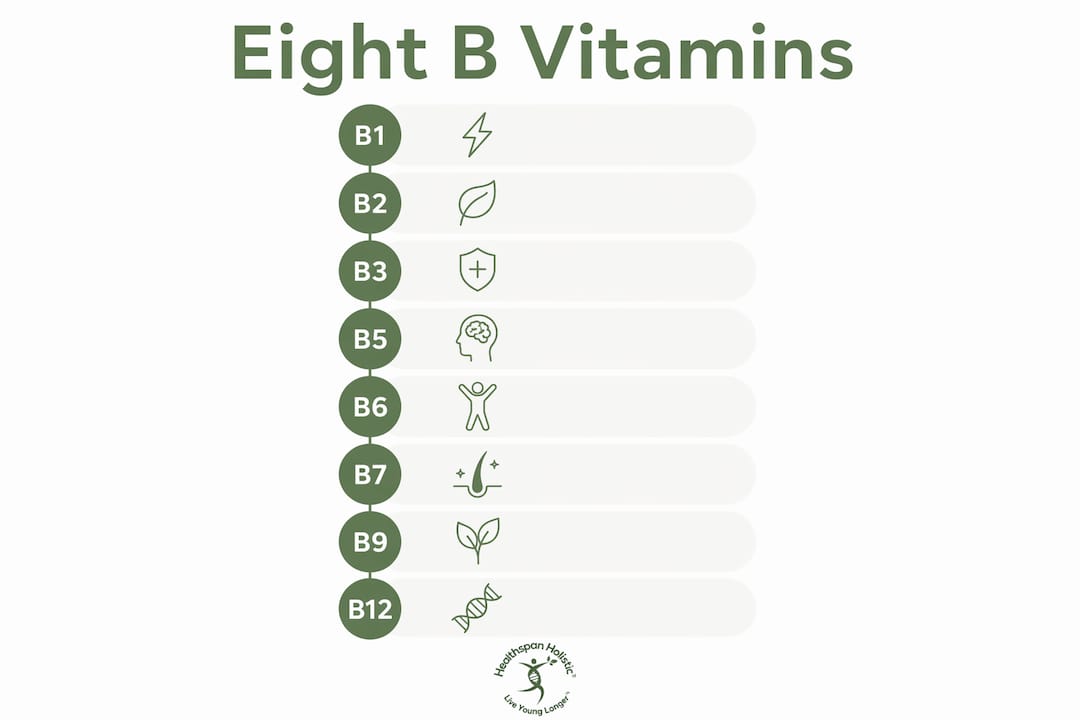
The B vitamin family includes eight distinct nutrients, each with a specific biological role. They work best together, which is why the term “B complex” refers to all eight taken as a group.
-
B1 (Thiamine): Converts carbohydrates into usable energy. Found in whole grains, legumes, and pork.
-
B2 (Riboflavin): Supports cellular energy production and acts as an antioxidant. Found in dairy, eggs, and leafy greens.
-
B3 (Niacin): Drives over 400 enzymatic reactions, including DNA repair and energy transfer. Found in meat, fish, and peanuts.
-
B5 (Pantothenic acid): Synthesizes coenzyme A, which is central to fat and carbohydrate metabolism. Found in avocados, mushrooms, and chicken.
-
B6 (Pyridoxine): Produces neurotransmitters like serotonin and dopamine, and regulates homocysteine. Found in bananas, potatoes, and poultry.
-
B7 (Biotin): Supports fatty acid synthesis and is widely associated with B vitamins for hair and nail strength. Found in eggs, nuts, and seeds.
-
B9 (Folate/Folic acid): Builds DNA and RNA, and is critical for cell division. Found in dark leafy greens, beans, and fortified grains.
-
B12 (Cobalamin): Maintains myelin sheaths around nerves and supports red blood cell production. Found almost exclusively in animal products.
These eight nutrients act as coenzymes, meaning they activate enzymes that run your metabolism. No single B vitamin works in isolation. A shortfall in one disrupts the entire chain.
| B Vitamin | Primary Role | Key Food Sources |
|---|---|---|
| B1 (Thiamine) | Energy from carbohydrates | Whole grains, legumes |
| B2 (Riboflavin) | Cellular energy, antioxidant | Dairy, eggs, leafy greens |
| B3 (Niacin) | DNA repair, energy transfer | Meat, fish, peanuts |
| B6 (Pyridoxine) | Neurotransmitter synthesis | Bananas, poultry |
| B9 (Folate) | DNA/RNA production | Dark greens, beans |
| B12 (Cobalamin) | Nerve health, red blood cells | Meat, fish, dairy |
How do B vitamins affect energy, brain health, and heart function after 45?
The connection between B vitamins and energy runs through your mitochondria. These are the structures inside every cell that convert food into ATP, the molecule your body actually uses for fuel. B vitamins, particularly B1, B2, B3, and B5, are required at multiple steps in this process. When any of them fall short, your mitochondria slow down. The result is fatigue that no amount of sleep seems to fix.
Brain health is where the evidence gets especially compelling. B6, B9, and B12 work together to break down homocysteine, an amino acid that accumulates in the blood and damages blood vessels and brain tissue when levels rise too high. Targeted B-complex supplementation can reduce homocysteine levels by 25–30%, lowering cardiovascular risk in adults aged 45–75. That reduction translates directly to a lower risk of stroke, heart attack, and cognitive decline.
B12 supplementation may help slow brain atrophy in older adults with mild cognitive impairment, but only when started early and in people with already-elevated homocysteine. Waiting until symptoms are severe significantly reduces the benefit. The window for meaningful intervention is earlier than most people expect.
The cognitive angle deserves more attention than it typically gets. B12 intervention is most effective when initiated early in patients with raised baseline homocysteine. This means the time to act is before memory lapses become noticeable, not after. Many adults in their 50s and 60s attribute brain fog, low mood, and persistent tiredness to aging. A significant portion of those symptoms are actually reversible markers of B-vitamin insufficiency, not permanent decline. That distinction changes everything about how you approach your health.
Do B vitamins boost mood? The answer is yes, with an important qualifier. B6 directly supports serotonin and dopamine synthesis. B12 and folate regulate the methylation cycle, which controls gene expression related to mood and stress response. When these nutrients are low, mood disorders and anxiety become harder to manage. Correcting the deficiency often produces noticeable improvement within weeks.

What makes B vitamin absorption harder as you age?
Absorption is where things get complicated for adults over 50. Your stomach produces less gastric acid as you age, and gastric acid is what separates B12 from the proteins in food. Without enough acid, dietary B12 passes through largely unused. Adults over 50 frequently have reduced gastric acid production that impairs B12 absorption regardless of how much they eat. This is not a dietary failure. It is a physiological shift that requires a different strategy.
Genetics add another layer. People with the MTHFR gene variant cannot efficiently convert standard folic acid or cyanocobalamin into their active forms. This variant is more common than most people realize. For these individuals, active forms like methylcobalamin and methylfolate bypass the metabolic conversion block entirely and deliver the nutrient the body can actually use.
Standard blood tests often miss the problem. Serum B12 levels can appear normal while cellular deficiency is already causing damage. Functional biomarkers like methylmalonic acid and homocysteine give a far more accurate picture of what is happening at the tissue level. These tests are available through most clinical labs and are worth requesting if you have symptoms.
One practical detail that catches many people off guard: if you take biotin supplements, stop them at least 48–72 hours before any blood draw. Biotin supplementation can interfere with common lab assays and produce false results, including falsely elevated or suppressed thyroid and hormone readings. This is a real clinical risk, not a theoretical one.
-
Ask your doctor to test methylmalonic acid and homocysteine, not just serum B12.
-
Disclose all supplements before lab work, especially biotin.
-
If you have a known MTHFR variant, request methylated forms specifically.
-
Retest after 3–4 months of supplementation to confirm your levels have responded.
Pro Tip: If your standard B12 test comes back “normal” but you still feel fatigued and mentally foggy, push for a methylmalonic acid test. That is the functional marker that reveals what your cells are actually getting.
What are the best practices for B vitamin supplementation after 45?
A well-formulated B-complex supplement providing 100–200% of the Daily Value for each nutrient is a solid foundation for most adults. This range covers daily needs without pushing into the territory where risks emerge. The goal is consistent, daily support, not occasional megadosing.
For adults over 50 with absorption concerns, targeted B12 supplementation in methylcobalamin form is the most direct solution. Sublingual and liquid forms bypass the gastric absorption step entirely, which makes them particularly effective. Quicksilver’s Methyl B-12 liquid supplement delivers active methylcobalamin in a format designed for rapid uptake. For folate support, especially for those with MTHFR variants, Xymogen’s 5-MTHF capsules provide the pre-converted active form that the body uses directly.
When it comes to safety, two B vitamins require specific caution. High-dose niacin and pyridoxine can cause toxicity and should be monitored closely. Niacin at therapeutic doses can cause liver stress and flushing. B6 at sustained high doses has been linked to peripheral neuropathy. Clinical guidance recommends basing intentional high-dose protocols on objective lab findings, not on general energy claims.
-
Choose a B-complex with active forms: methylcobalamin, methylfolate, and pyridoxal-5-phosphate (P5P).
-
Take B vitamins in the morning with food to support energy metabolism throughout the day.
-
Pair supplementation with nutrient-dense foods: leafy greens, eggs, legumes, and lean meats.
-
Avoid self-prescribing high-dose single B vitamins without lab confirmation of a deficiency.
-
Consistency matters more than dose. Daily intake at moderate levels outperforms sporadic high doses.
Supplements also work best alongside lifestyle factors that support absorption and utilization. Adequate sleep supports the methylation cycle. Reducing alcohol intake preserves folate stores. Regular movement improves mitochondrial efficiency, which means your B vitamins do more work per milligram. For adults focused on longevity after 40, B vitamins are foundational, not optional.
Pro Tip: Look for supplements that include P5P (pyridoxal-5-phosphate) instead of plain B6. P5P is the active coenzyme form, and it does not require liver conversion, which matters more as you age.
Key Takeaways
B vitamins are the most clinically underappreciated tool for restoring energy, protecting brain health, and reducing cardiovascular risk in adults aged 45–75.
| Point | Details |
|---|---|
| Eight vitamins, one team | All eight B vitamins work as coenzymes and function best together as a complete complex. |
| Homocysteine is the key marker | B6, B9, and B12 reduce homocysteine by 25–30%, cutting cardiovascular and cognitive risk. |
| Standard tests miss deficiency | Methylmalonic acid and homocysteine tests reveal cellular status that serum B12 tests miss. |
| Active forms matter after 50 | Methylcobalamin and methylfolate bypass age-related and genetic absorption barriers. |
| Biotin disrupts lab results | Stop biotin supplements 48–72 hours before blood draws to avoid false readings. |
What I’ve learned from watching B vitamins change people’s lives
I have seen adults in their 60s come in convinced their fatigue and brain fog were just part of getting older. After proper testing and a targeted B vitamin protocol, many of them felt genuinely different within six to eight weeks. Not dramatically different overnight, but steadily, noticeably better. That pattern has repeated enough times that I no longer treat it as coincidence.
The part that surprises most people is how often the standard blood panel misses the problem entirely. A serum B12 in the “normal” range does not mean the cells are getting what they need. I have seen functional deficiency show up in methylmalonic acid tests for people whose doctors told them their B12 was fine. That gap between serum levels and cellular function is where a lot of unnecessary suffering lives.
My caution is this: more is not always better. I have worked with people who were self-prescribing high-dose B6 for months because they read it helps with nerve pain. It does, at the right dose. At excessive doses, it causes the very neuropathy they were trying to treat. The neurological health research on B vitamin dosing is clear: targeted, lab-guided protocols outperform guesswork every time.
The most effective approach combines testing, active-form supplementation, and a diet built around real B vitamin sources. That combination is not complicated. It just requires being intentional rather than reactive.
— Chris
B vitamin supplements from Healthspan Holistic
If you are ready to act on what you have read, Healthspan Holistic has two products built specifically for adults who want real results. Xymogen’s B Activ® 180 Capsules deliver a complete B-complex with active forms of each nutrient, formulated for adults who need consistent daily support for energy, mood, and cardiovascular health. For targeted B12 support, our 2oz Vegan B12 supplement uses active methylcobalamin in a liquid format that absorbs quickly and bypasses the gastric acid barrier entirely.
1st Time Customers can take advantage of our BUY 1 GET 1 50% OFF special offer on all supplements.
FAQ
What do B vitamins actually do for energy?
B vitamins serve as coenzymes in the mitochondrial pathways that convert food into ATP, the molecule your body uses for fuel. Without adequate B1, B2, B3, and B5, this process slows and fatigue follows.
Do B vitamins boost mood and mental clarity?
Yes. B6 supports serotonin and dopamine production, while B12 and folate regulate methylation, a process tied directly to mood and cognitive function. Correcting a deficiency often produces noticeable improvement within weeks.
Why is B12 absorption harder after 50?
Reduced gastric acid production with age prevents the separation of B12 from food proteins, limiting absorption regardless of dietary intake. Active methylcobalamin in sublingual or liquid form bypasses this barrier.
What is the best way to test B vitamin status?
Functional biomarkers like methylmalonic acid and homocysteine provide a more accurate picture of cellular B vitamin status than standard serum tests. Ask your doctor for these specific markers if you have symptoms.
Can you take too many B vitamins?
Most B vitamins are water-soluble and excess is excreted, but high-dose niacin and B6 are exceptions. Sustained high doses of B6 can cause peripheral neuropathy, and therapeutic niacin requires liver monitoring. Always base high-dose protocols on lab findings.
Leave a comment: