

TL;DR:
The FDA reclassified some peptides to allow compounding with prescriptions, improving legal access.
Peptides remain unapproved drugs; safety and efficacy are not formally established by the FDA.
Ongoing regulation and clinical research are necessary for broader approval and safety assurance.
If you’ve been following the buzz around peptide therapies for longevity and wellness, you may have assumed these compounds were already widely available and largely unregulated. The reality is more nuanced. Many popular peptides were quietly restricted by the FDA in 2023, leaving patients and clinicians scrambling. Now, a major regulatory shift in early 2026 has changed the landscape again. This guide breaks down exactly what happened, why it matters for your health, and what practical steps you can take to access peptide therapies safely and responsibly.
Key Takeaways
| Point | Details |
|---|---|
| Recent reclassification explained | More peptides are now eligible for compounding with a prescription but not FDA approved as safe or effective. |
| Action for wellness seekers | See a medical professional for peptide therapies—never buy from unregulated sources. |
| Risks and next steps | Ongoing reviews and limited human data mean caution and close monitoring remain necessary. |
| FDA enforcement still active | The FDA continues to take action against illegal peptide sales despite the new announcement. |
How the FDA’s stance on peptides evolved
To understand where we are today, it helps to know how we got here. Peptides are short chains of amino acids that act as biological messengers in the body. They influence everything from tissue repair to hormone release. For years, compounding pharmacies (specialized pharmacies that custom-mix medications for individual patients) prepared and dispensed peptides with relatively little federal oversight.

That changed in 2023 when the FDA placed a large group of peptides into what it called Category 2 of the bulk drug substances list. Category 2 designation effectively restricted compounding pharmacies from producing these peptides, citing concerns about safety, purity, and lack of clinical evidence. Patients who had been using peptides for recovery, anti-aging, and metabolic support suddenly found their access cut off or pushed underground.
Then came a pivotal moment. On February 27, 2026, HHS Secretary Robert F. Kennedy Jr. announced the reclassification of approximately 14 of the original 19 Category 2 peptides back to Category 1, reopening the door for compounding pharmacies to legally resume production under prescription.
Here is a quick summary of the key regulatory milestones:
-
2023: FDA places ~19 peptides in Category 2, restricting compounding access
-
February 27, 2026: HHS Secretary Kennedy announces reclassification of ~14 peptides to Category 1
-
July 23-24, 2026: PCAC meetings scheduled to review seven peptides for the 503A bulks list
-
By February 2027: Additional PCAC meeting planned for further peptide review
“The FDA will hold Pharmacy Compounding Advisory Committee (PCAC) meetings on July 23-24, 2026, to discuss inclusion of seven peptides on the 503A bulks list, and another meeting by February 2027 for additional peptides.”
The PCAC meetings are critical checkpoints. They allow independent experts to weigh in on whether specific peptides meet the standards required for legal compounding. This process is still very much in motion, which means the regulatory picture will continue to evolve throughout 2026 and into 2027.
With that context set, we can dive deeper into why the FDA changed its approach.
Why the FDA’s announcement matters for longevity and wellness
Having seen how the FDA’s regulatory position evolved, let’s explore what this means for practical use in everyday wellness.
The reclassification directly affects some of the most talked-about peptides in the longevity and biohacking communities. These are not obscure compounds. They are peptides that clinicians have been using with patients for years, often reporting meaningful improvements in recovery, energy, and overall vitality.
Here is a look at three of the most commonly discussed peptides and their primary wellness applications:
| Peptide | Primary use | Why it matters for longevity |
|---|---|---|
| BPC-157 | Tissue repair, gut healing | Supports recovery from injury and inflammation |
| GHK-Cu | Skin regeneration, anti-aging | Promotes collagen synthesis and wound healing |
| CJC-1295 | Growth hormone release | Supports muscle mass and metabolic health |
The easing of restrictions on compounding these peptides is significant because it shifts access away from gray-market sources and toward regulated, physician-supervised channels. Before the reclassification, many people were obtaining peptides from unregulated online vendors, with no guarantee of purity, dosage accuracy, or sterility.
Regulated access through compounding pharmacies means:
-
Prescription required: A licensed physician evaluates your health before prescribing
-
Quality controls: Compounding pharmacies follow strict sterility and purity standards
-
Personalized dosing: Formulations can be tailored to your specific needs
-
Ongoing monitoring: Your clinician can track your response and adjust the protocol
Pro Tip: If you are considering peptide therapy, ask your physician specifically whether they work with an accredited compounding pharmacy that follows USP (United States Pharmacopeia) standards. This one question can tell you a lot about the quality of care you will receive.
For health-conscious individuals over 45, this shift is genuinely meaningful. Supervised access reduces the risks that come with self-sourcing and gives you a legitimate medical framework for exploring these therapies.
What Category 1 really means for peptide safety and access
Now that you see the direct benefits, let’s clarify what the new regulatory classification actually means and what it does not.
This is where many people get confused, and the confusion can lead to real harm. Category 1 does not mean the FDA has approved these peptides as safe or effective. It simply means compounding pharmacies are permitted to prepare them when a physician prescribes them.
| Feature | Category 1 | Category 2 |
|---|---|---|
| Compounding allowed | Yes, with prescription | No |
| FDA approved for safety/efficacy | No | No |
| Available over the counter | No | No |
| Requires physician oversight | Yes | N/A |
| Human clinical trial data | Limited | Limited |
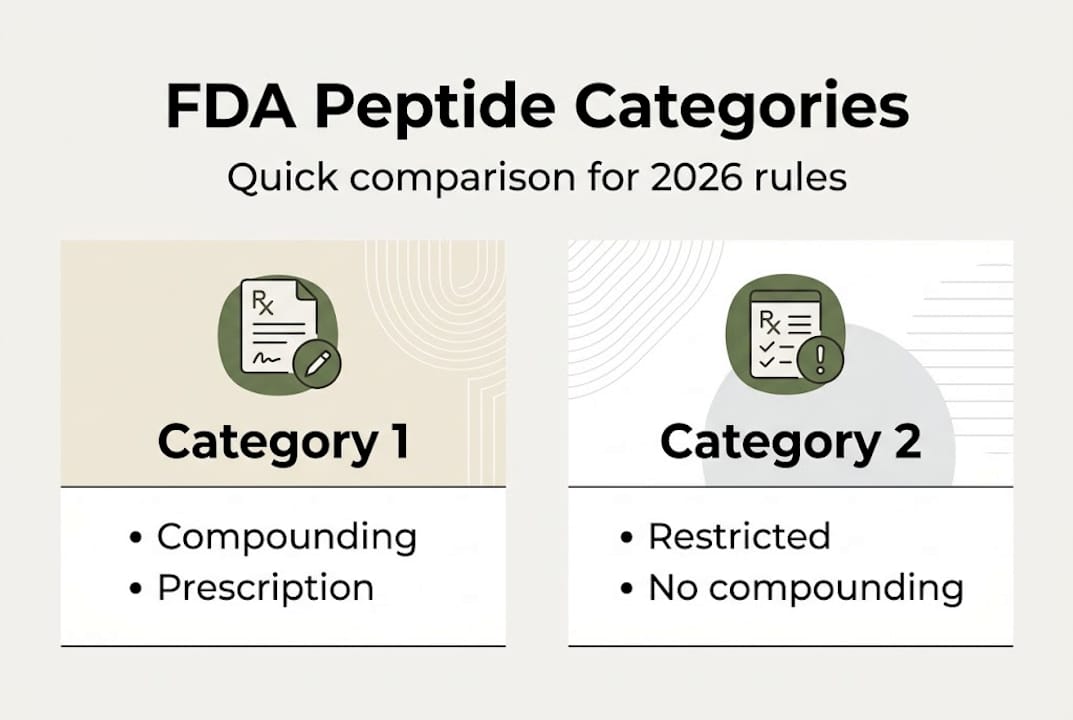
As the FDA makes clear, peptides remain unapproved drugs regardless of their compounding category. Reclassification to Category 1 permits compounding under prescription but carries no endorsement of safety or effectiveness from the agency.
The FDA’s position on unproven peptides is firm on one point: without formal approval, there are no established benchmarks for what constitutes a safe or effective dose. Most of the existing data comes from preclinical studies and animal models. Human trials are sparse, and long-term safety data is essentially nonexistent for many of these compounds.
Pro Tip: Think of Category 1 as a “permitted but not endorsed” status. It opens a legal pathway, but it does not replace the need for careful clinical judgment.
Here are practical steps for safe peptide use:
-
Consult a knowledgeable physician who specializes in longevity or integrative medicine
-
Request lab work to establish a baseline before starting any peptide protocol
-
Verify the compounding pharmacy is accredited and follows USP standards
-
Start with the lowest effective dose and monitor your response closely
-
Avoid combining multiple peptides without direct medical supervision
-
Review doctor-prescribed hormone therapies as part of a broader hormonal health strategy if relevant
These steps are not optional extras. They are the foundation of responsible use, especially when the science is still catching up to the enthusiasm.
Cautions, critics, and what happens next
Understanding what Category 1 does and does not allow sets us up to discuss the remaining cautions, controversies, and what’s on the horizon.
Not everyone is celebrating the reclassification. Critics, including some physicians and independent researchers, have raised pointed concerns. Their core argument is straightforward: loosening access to compounds that lack robust human safety data puts patients at risk, regardless of how promising the early science looks.
“Contrasting viewpoints: Restoring access may benefit patients with clinician-reported improvements, but limited human data, prior safety risks including cancer and organ damage, and sparse clinical trials lead some experts to call the move a ‘disaster’ for patient safety.”
The FDA itself has not gone silent on enforcement. On March 31, 2026, the agency issued a warning letter to Gram Peptides for selling unapproved new drugs, including Retatrutide and Tirzepatide. This makes clear that even under the new, more permissive framework, the FDA is actively pursuing vendors who operate outside the rules.
Key concerns that critics raise include:
-
Lack of large-scale human trials for most peptides currently being compounded
-
Risk of immunogenicity (immune reactions to foreign peptide sequences)
-
Potential for impurities in poorly manufactured batches
-
Reported cases of organ damage and tumor growth in some animal studies
-
Long regulatory path ahead before any of these peptides could receive formal FDA approval
What should you watch for going forward?
-
Results of the July 2026 PCAC meetings on the seven peptides under review
-
The February 2027 PCAC meeting covering additional peptides
-
Further FDA rulemaking and formal guidance on compounding standards
-
Ongoing enforcement actions against noncompliant sellers
-
Emerging human clinical trial data that could shift the safety picture in either direction
The regulatory process is moving, but it is moving carefully. That is probably the right pace given the stakes.
Our take: Proceed with optimism, but stay vigilant about peptide use
With the landscape and debates made clear, it’s worth stepping back to look at what most headlines miss.
Regulated access is genuinely good news. For years, people who wanted to explore peptide therapies were forced to choose between going without or sourcing compounds from unverified vendors. That is a real harm, and the reclassification addresses it meaningfully.
But here is what we think gets lost in the excitement: FDA status, whether Category 1 or otherwise, does not tell you how your body will respond. Dose titration, individual biochemistry, and ongoing monitoring matter far more than any regulatory label. We have seen too many people treat a Category 1 designation as a green light to self-experiment aggressively, and that approach carries real risk.
Peptides may play a valuable supporting role in a longevity strategy, but they are not a shortcut. The strongest outcomes we see come from people who pair any advanced therapy with solid fundamentals: optimized nutrition, quality sleep, regular movement, and thorough lab monitoring. Partner with a clinician who demands current safety data and adjusts your protocol based on your actual results. That is the standard worth holding.
Take the next step in your wellness journey safely
If the evolving peptide landscape has you thinking more carefully about your longevity strategy, that is a healthy instinct. The best foundation is always one built on regulated, evidence-supported tools combined with expert guidance.
At Healthspan Holistic, we believe in supporting your healthspan with professional-grade supplements that meet the highest quality standards. Whether you are looking to support bone density with D3 + K2 supplements, restore gut health with GI Balance for digestive support, or explore a personalized wellness plan, we are here to help you make informed, safe choices every step of the way.
Frequently asked questions
Are compounded peptides now FDA approved?
No. Category 1 status means compounding is allowed with a valid prescription, but peptides have not been approved by the FDA for safety or effectiveness.
Can I legally buy peptides without a prescription after the FDA announcement?
No. A doctor’s prescription is still required. The FDA only permits compounding for prescribed, individualized use, not for over-the-counter sale to the general public.
What safety concerns remain about peptides?
Key risks include limited human trial data, possible immune reactions (immunogenicity), manufacturing impurities, and reported cases of organ damage and cancer in some animal studies.
Is the FDA finished regulating peptides after this announcement?
Far from it. Future PCAC meetings and additional rulemaking are still required, and the FDA continues active enforcement against noncompliant sellers.
Leave a comment: