

TL;DR:
- Fulvic and humic acids are natural soil compounds with differing properties and bioavailability, affecting nutrient transport and health outcomes. Their benefits depend on dose, source, and individual mineral status, requiring personalized evaluation before supplementation. Although promising mechanisms exist, more rigorous human studies are needed to confirm their efficacy and safety in wellness protocols.
Fulvic and humic acids are showing up in more supplement aisles and wellness conversations than ever before. Marketers often bundle them together and promise identical, sweeping results for energy, detoxification, and gut health. But the reality is more nuanced and more interesting. These compounds behave very differently depending on dose, formulation, and the specific health context you’re addressing. If you’re over 40 and serious about optimizing your healthspan, understanding those distinctions isn’t optional; it’s the foundation of a smart supplementation strategy.
Key Takeaways
| Point | Details |
|---|---|
| Context matters most | Effects of fulvic and humic acids depend heavily on dose, formulation, and individual context. |
| Mechanisms are plausible | Their actions are biologically plausible but not fully proven for specific human outcomes. |
| Safety varies by product | Some fulvic acid formulations are shown to be safe, but quality and transparency are essential. |
| Function-driven supplementation | Personalized mineral testing and tailored selection optimize supplement benefits. |
| Evidence gaps remain | Despite promise, human clinical evidence is limited and more research is needed. |
What are fulvic and humic acids?
Now that we’ve set expectations and debunked surface-level claims, let’s ground ourselves in what fulvic and humic acids actually are.
Both belong to a broader category called humic substances, which are natural compounds formed over thousands of years as organic matter, such as plant material, microbes, and minerals, slowly decomposes in soil. Think of them as the concentrated biochemical wisdom of the earth, rich in carbon and biologically active molecules.
Here’s where they part ways:
-
Fulvic acid (FA) is a low-molecular-weight fraction that remains soluble across a wide pH range. It has a remarkable capacity to bind metals and minerals through a process called chelation, which makes nutrients more “bioavailable,” meaning your body or plant roots can actually absorb and use them. As one mechanistic review on FA in soils describes it, FA is a low-molecular-weight, pH-soluble fraction with metal-chelating capacity.
-
Humic acid (HA) is a larger, less soluble molecule. It plays a major role in soil structure and nutrient retention, but its effects on human physiology are more variable and depend heavily on the source and processing method.
-
Both compounds are found in rich deposits like leonardite, shilajit, and peat, which are the raw materials behind most commercial supplement products.
From a functional health overview perspective, these substances are interesting precisely because they sit at the intersection of environmental biochemistry and human biology. Their roles in soil ecosystems are well-documented. Their roles in human health are promising, but still being mapped.
Pro Tip: Not all humic substance supplements are the same. The raw source material, extraction method, and molecular weight distribution all affect what you actually get. Always look for products that disclose their source and provide third-party testing.
When considering supplements for longevity, knowing the origin and form of what you’re taking is just as important as the compound itself. For a broader view of supplements for longevity after 40, it’s worth exploring how FA and HA fit into a well-rounded protocol rather than treating them as standalone fixes.
How fulvic and humic acids work: Mechanisms and evidence
Understanding the basic identity of fulvic and humic acids, let’s examine how they actually work, in the soil and in the human body.

The mechanisms behind FA are genuinely fascinating. In plant systems, FA stimulates the plasma membrane H±ATPase enzyme, which acts like a molecular pump, helping roots pull nutrients across membranes. It also chelates metals, wrapping around mineral ions and escorting them into cells. According to a mechanistic review on FA in soils, FA stimulates plasma membrane H±ATPase activity and chelates metals, but direct genetic validation of these pathways in humans is still limited. That distinction matters for anyone translating soil science into supplement decisions.
In human biology, proposed mechanisms are grounded in plausibility but require more clinical confirmation. The primary areas of interest include:
-
Antioxidant activity: FA and HA can scavenge free radicals, similar to how vitamin D benefits modulate oxidative stress pathways.
-
Anti-inflammatory effects: Both compounds appear to reduce inflammatory signaling markers in cell-based and animal studies.
-
Immunomodulation: There is evidence that humic substances can both stimulate and regulate immune responses depending on dose and formulation.
-
Antimicrobial properties: Some HA and FA fractions have shown activity against certain pathogens in laboratory settings.
“Humic substances exhibit antioxidant, anti-inflammatory, antimicrobial, and immunomodulatory activities, though clinical translation is limited by heterogeneity in study design, dosing, and formulation.”
This is a fair summary of where the field stands today. The biology is plausible. The mechanisms are real. But translating them into predictable human outcomes requires more rigorous controlled trials than currently exist.
| Proposed mechanism | Evidence level | Key limitation |
|---|---|---|
| Metal chelation and nutrient transport | Strong (soil/plant studies) | Limited human pathway validation |
| Antioxidant activity | Moderate (in vitro, animal) | Few human RCTs |
| Anti-inflammatory effects | Moderate (cell/animal models) | Dose and formulation variability |
| Immunomodulatory activity | Emerging (limited clinical) | Heterogeneous study populations |
| Antimicrobial properties | Preliminary (lab-based) | Not yet tested in clinical settings |
This table gives you a realistic picture. We’re not saying these benefits don’t exist. We’re saying the evidence ladder still has rungs to climb. That context is what separates smart supplementation from wishful thinking. Much like peptide therapy for vitality, humic substances are best evaluated within a personalized framework rather than applied uniformly.
Comparing fulvic vs. humic acids: Context, dose, and health outcomes
Having explored their core mechanisms, let’s contrast how fulvic and humic acids perform, especially when it comes to dose and real-world health impacts.
One of the most striking data points in recent research comes from a calcareous soil study where high-dose FA increased Mn availability by up to 3,061%, while HA reduced copper (Cu) availability by 35.5%. The same study found effects varied dramatically based on soil type and mineralogy. That’s not a typo. A 3,061% change in manganese availability tells you something important: dose and context are everything.
Statistic callout: High-dose fulvic acid can increase micronutrient availability by thousands of percent in some contexts, while the same dose of humic acid reduces a different mineral by over a third. This is why “take fulvic and humic acids for minerals” is an oversimplification that can actually lead to imbalanced mineral status.
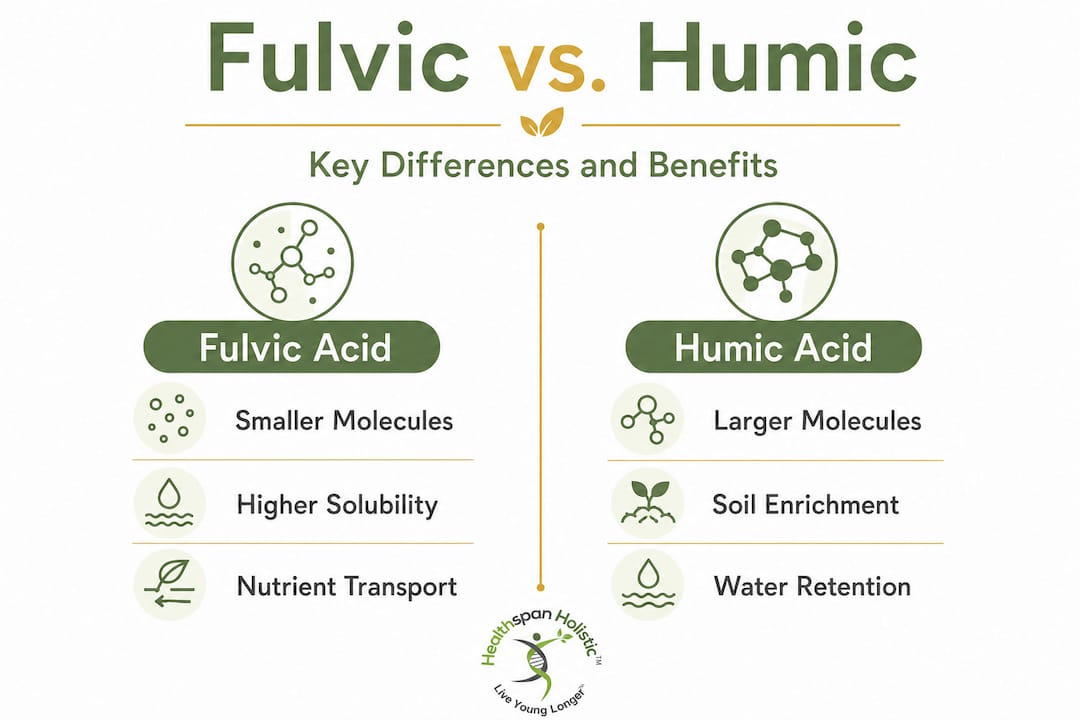
Here’s a direct comparison of the two compounds across key functional parameters:
| Factor | Fulvic acid (FA) | Humic acid (HA) |
|---|---|---|
| Molecular weight | Low | High |
| Solubility | High across pH ranges | Lower, pH-dependent |
| Chelation capacity | Strong | Moderate |
| Effect on Mn availability | Can increase dramatically at high doses | Less pronounced |
| Effect on Cu availability | Variable | Can reduce significantly |
| Human clinical data | Limited but growing | Limited and heterogeneous |
| Supplement formulation variability | High | Very high |
| Best established use | Nutrient transport support | Soil structure; limited human use |
Key takeaways for supplement users:
-
FA is generally more bioavailable and better studied for human applications
-
HA effects vary greatly by product source, so formulation transparency is critical
-
Neither compound delivers uniform benefits regardless of what the label implies
-
Personalized supplementation based on your actual mineral status is a far smarter approach than guessing
The copper reduction finding deserves special attention. For anyone who is already borderline copper-deficient (a surprisingly common issue in people over 40 who take high-dose zinc), adding humic acid supplements without knowing your mineral status could deepen that gap. That’s a real-world scenario where soil science translates directly into a caution worth heeding. Pairing your supplementation choices with nutrients like alpha lipoic acid, which has its own antioxidant and chelation activity, requires the same kind of contextual thinking.
Fulvic and humic acids for supplementation: Safety and practical tips
Comparisons underscore how context matters. Now, let’s distill the science into actionable supplement safety and selection advice.
The good news is that certain defined fulvic acid formulations have shown favorable cytocompatibility and genotoxic safety in tested models, but researchers note that controlled clinical trials are still needed to establish optimal dosing windows. In other words, early safety signals are encouraging, but we don’t yet have the full clinical picture for all formulations on the market.
Product variability is the biggest practical challenge. Because humic substances are extracted from natural deposits, no two products are chemically identical unless rigorous standardization is applied. This creates a wide spectrum of product quality in the supplement market.
Here’s a practical numbered guide to help you evaluate any fulvic or humic acid supplement:
-
Check the source material. Products derived from verifiable sources like high-quality leonardite or specific shilajit deposits are more likely to be consistent.
-
Look for third-party testing. Independent verification of purity, heavy metal content, and active compound concentration is non-negotiable for humic substances.
-
Assess formulation transparency. The label should clearly state the FA or HA percentage and the molecular weight fraction, not just use vague terms like “fulvic mineral complex.”
-
Start with a lower dose. Given the dose-dependent nature of effects, start conservatively and observe your body’s response before increasing.
-
Pair with functional mineral testing. Before adding FA or HA to your stack, get a baseline read on your mineral status to avoid amplifying imbalances.
Pro Tip: Consider running a minerals test before starting any new fulvic or humic acid supplement. Knowing your current levels of copper, manganese, zinc, and iron gives you a real baseline and helps you track whether supplementation is moving the needle in the right direction.
Additional considerations for practical use:
-
Humic substances may interact with gut microbiome composition, making them potentially relevant for gut health support protocols, but this connection needs more direct study.
-
If you are also monitoring your essential fatty acid balance, consider running an omega fatty acids test alongside mineral panels for a fuller picture of your nutrient status.
-
Avoid products that make sweeping detoxification or “complete mineral restoration” claims without any supporting data specific to their formulation.
-
Pregnant individuals or those on medications affecting mineral absorption should consult a qualified health practitioner before starting these supplements.
Safety, at the end of the day, is not a binary yes or no with humic substances. It’s a function of which product, at what dose, for which person, at what stage of their health journey.
The reality most supplement seekers miss about fulvic and humic acids
Here’s the perspective that most wellness content leaves out: the excitement around fulvic and humic acids often rests on a quiet but significant logical leap. Because these compounds perform impressively in soil and plant science, people assume those effects translate directly and predictably into human health benefits. That assumption is understandable. It’s also incomplete.
Soil is not a body. A plant root is not a gut epithelial cell. The dose-specific, context-driven findings from calcareous soil studies are genuinely fascinating, but they tell us about bioavailability in a mineralized soil matrix, not in a human digestive system with its own microbial ecosystem, enzymes, and absorption dynamics. Applying those numbers directly to supplement recommendations is a stretch that even enthusiastic researchers would caution against.
This doesn’t mean fulvic and humic acids are overhyped. It means they deserve the same rigorous, personalized evaluation you’d give to any functional health tool. The people who see the best results from these supplements are rarely the ones who just add a fulvic acid capsule to an already random stack. They’re the people who:
-
Know their mineral status before they start
-
Choose a product with documented sourcing and standardization
-
Adjust dose based on observed response and retesting
-
Use FA and HA as part of a broader, evidence-informed protocol
This is exactly what personalization for wellness means in practice. Not picking the trendiest supplement, but choosing what fits your actual biology at this moment in time. If you’ve spent any time exploring evidence-based longevity strategies, you’ll recognize this principle at work across the most effective approaches.
We’d go one step further. The soil science around these compounds is genuinely exciting because it points toward real biological mechanisms. The challenge for functional health seekers is learning to read that excitement as inspiration for further research rather than as proof of clinical outcome. That kind of discernment is what separates a robust healthspan strategy from a shopping cart full of hope.
Optimize your wellness journey with functional testing and holistic support
If the science around fulvic and humic acids has given you useful context, the next practical step is personalizing that knowledge to your own biology. Understanding mechanisms is powerful, but combining that knowledge with your actual lab data is transformative.
At Healthspan Holistic, we bring together advanced diagnostics, evidence-based supplementation, and one-on-one holistic coaching to help you make decisions your body can actually benefit from. Whether you’re curious about your mineral status before adding fulvic acid to your routine, or you’re ready to take a broader look at your healthspan, our 90 Day Detox & Recharge bundle is a great starting point. It pairs targeted support with a structured timeline so you can restore balance, track progress, and build sustainable wellness habits with expert guidance at every step.
Frequently asked questions
Are fulvic and humic acids safe for daily supplementation?
Certain fulvic acid formulations have shown favorable safety signals in in vitro and in vivo models, but clinical trials defining optimal daily dosing for humans are still in progress. Product quality and formulation transparency remain critical safety factors.
What functional benefits can I expect from fulvic and humic acid supplements?
They offer antioxidant, anti-inflammatory, and immunomodulatory activities, but outcomes depend heavily on your individual mineral status, the formulation you use, and the dose. As humic substances research confirms, evidence for specific human outcomes is still being established.
How do fulvic and humic acid effects change with dose?
At higher doses, fulvic acid can dramatically increase micronutrient availability in mineral-rich environments, but these effects are highly context-specific and do not translate uniformly to all minerals or all individuals. Starting low and monitoring your response is the practical approach.
Can fulvic and humic acids be combined with other supplements?
Yes, but combining them thoughtfully matters. Because FA and HA influence mineral absorption, you’ll want to assess your current mineral status first. Ideally, use functional testing to avoid compounding any existing imbalances before adding these compounds to an existing supplement stack.
Is the evidence for fulvic and humic acids strong for human health?
Most evidence comes from mechanistic studies, soil science, and limited clinical trials. As humic substances reviews note, clinical translation is constrained by heterogeneity in study design and formulation. More controlled, dose-specific human research is actively needed and ongoing.
Leave a comment: