

TL;DR:
- GHK-Cu is a naturally occurring copper-binding peptide that supports skin, hair, and nails by activating key enzymes involved in tissue repair and collagen production. Clinical evidence confirms its effectiveness through long-term topical application, with safety and efficacy validated in human trials, unlike injectable forms which lack approval and pose risks. Consistent use of 1-3% topical formulations over months enhances skin firmness, reduces fine lines, and promotes follicle health, making it a safe, evidence-backed anti-aging ingredient.
If you’ve been researching anti-aging skincare, you’ve likely come across GHK-Cu and wondered whether the buzz is justified. GHK-Cu is a naturally occurring copper-binding tripeptide that your body produces on its own, but levels drop significantly as you age. The ghkcu peptide has surged in popularity across skincare communities, and for good reason. Unlike trendy ingredients that overpromise and underdeliver, GHK-Cu has a growing body of clinical evidence behind it. This article breaks down what it actually does, how to use it effectively for skin, hair, and nails, and what you should realistically expect.
Key Takeaways
| Point | Details |
|---|---|
| GHK-Cu is clinically supported | Topical use at 1–3% concentration for 12+ weeks shows real improvements in skin density and fine lines. |
| Topical beats injectable | Topical GHK-Cu has human clinical evidence; injectable forms lack FDA approval and human trial data. |
| Benefits extend beyond skin | GHK-Cu supports hair follicle health, reduces thinning, and may strengthen nail growth over time. |
| Consistency is the key | Results build over months, not days. Formulation quality and daily application matter most. |
| Safety profile is strong | Topical use is well tolerated with minimal side effects; injectable use carries real risks. |
What GHK-Cu actually is and how it works
GHK-Cu stands for glycyl-L-histidyl-L-lysine copper. It is a tripeptide, meaning it is made of three amino acids, and it binds to a copper ion to become biologically active. Your body naturally produces it, but GHK-Cu levels decline with age, which corresponds with the slower wound healing, thinner skin, and reduced elasticity that many people notice after 40.
The copper in GHK-Cu is not decorative. It is a functional delivery system. Copper activates key enzymes including lysyl oxidase for collagen and elastin crosslinking, superoxide dismutase for antioxidant defense, and tyrosinase for pigmentation regulation. Without adequate copper delivery to these enzymes, skin repair slows down considerably.
Here is what GHK-Cu does at the cellular level:
-
Collagen and elastin synthesis: GHK-Cu activates fibroblasts, the cells responsible for producing structural proteins that keep skin firm and resilient.
-
Gene expression modulation: It influences hundreds of genes involved in tissue repair, inflammation control, and skin remodeling.
-
Hair follicle support: GHK-Cu interacts with follicle stem cells, helping to extend the anagen (growth) phase of the hair cycle.
-
Nail matrix support: Copper-dependent enzymes in the nail matrix benefit from GHK-Cu’s delivery mechanism, supporting stronger, faster-growing nails.
-
Antioxidant defense: By activating superoxide dismutase, it helps neutralize free radicals that accelerate visible aging.
Pro Tip: Think of GHK-Cu as a copper courier service for your skin. The peptide itself is the delivery vehicle; the copper is the cargo that powers your skin’s repair machinery.
Topical GHK-Cu skincare: what the evidence shows
This is where GHK-Cu earns its reputation. The ghkcu skincare evidence is grounded in real human trials, not just lab dishes or animal models.
-
Clinical results at 8 to 12 weeks: Topical GHK-Cu at 1–2% concentration applied twice daily for 8 to 12 weeks significantly improves skin density, thickness, and reduces the appearance of fine lines and wrinkles. These are statistically significant results, not marginal changes.
-
Recommended product concentrations: The sweet spot for topical formulations is 1 to 3%. Clinical trials used 1–3% concentrations applied twice daily for 12 or more weeks. Products below 0.5% are unlikely to deliver meaningful results.
-
Best product formats: Serums are the most effective delivery format because they penetrate more deeply than creams. Eye creams with GHK-Cu can help with periorbital thinning and fine lines. Scalp serums are the preferred format for hair applications.
-
Layering with other actives: GHK-Cu is compatible with niacinamide, hyaluronic acid, and peptide blends. Avoid combining it directly with high-concentration vitamin C (ascorbic acid) or strong exfoliating acids in the same application step, as these can destabilize the copper complex.
-
Hair and scalp applications: Copper peptide formulations have shown improvements in early-to-moderate androgenetic alopecia by supporting hair follicle health and extending the growth phase. Results in pilot human studies showed increased hair fullness with consistent use.
“GHK-Cu is most valuable as a long-term skin repair ingredient rather than a quick fix.” — Dermatologist perspective via Westlake Dermatology
Pro Tip: Apply your GHK-Cu serum to slightly damp skin after cleansing. This improves absorption and reduces the chance of mild surface irritation, especially when you are first starting out.
Many users are unaware that topical use offers the strongest evidence for skin benefits, while injectable claims rely almost entirely on preclinical studies. That distinction matters when you are deciding how to spend your money and what risks you are willing to accept.
Topical vs. injectable GHK-Cu: a clear comparison
The ghkcu peptide uses debate often centers on whether topical or injectable forms are more effective. Here is a straightforward comparison to help you make an informed decision.
| Feature | Topical GHK-Cu | Injectable GHK-Cu |
|---|---|---|
| Human clinical trials | Yes, multiple published studies | None as of 2026 |
| FDA regulatory status | Cosmetic ingredient, approved for use | Not FDA approved; research use only |
| Safety profile | Well established, mild side effects | Unknown; potential copper accumulation risk |
| Primary evidence base | Human skin trials | Animal and in vitro studies only |
| Accessibility | Widely available in skincare products | Restricted; compounding pharmacy gray area |
| Recommended for consumers | Yes | No, without medical supervision |
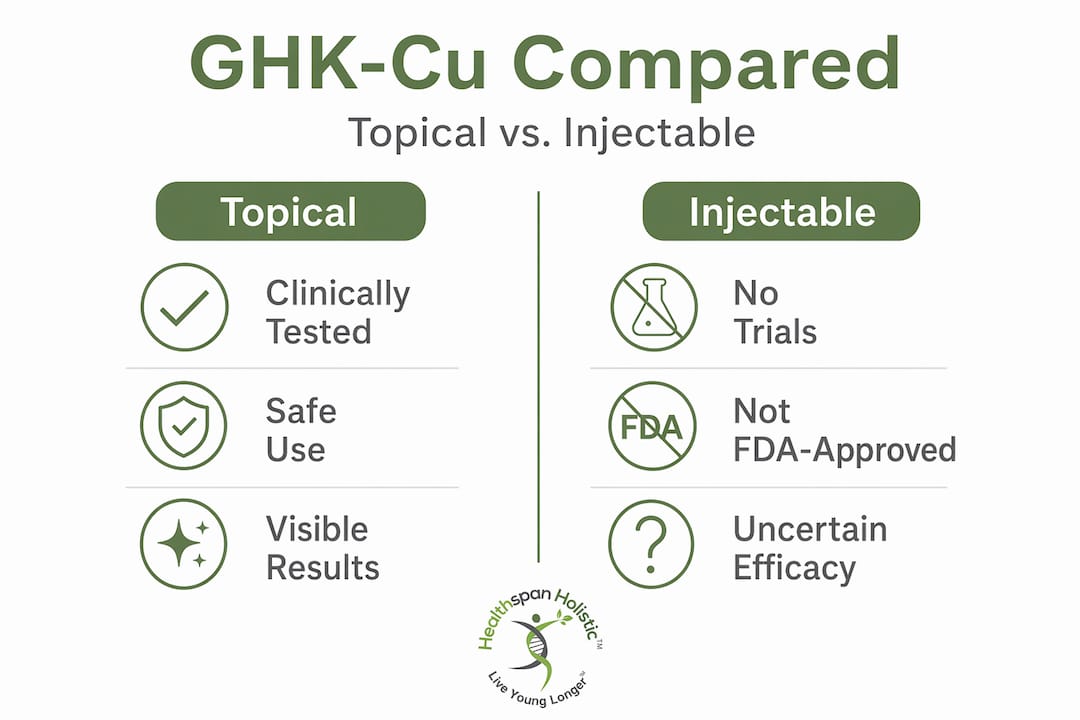
Injectable GHK-Cu is not FDA-approved and is classified as research use only. The FDA’s 503A and 503B bulk drug substance listings restrict compounding pharmacies from producing it for general consumer use. As of May 2026, zero human clinical trials exist for injectable GHK-Cu safety or efficacy.
Key concerns with injectable use:
-
Chronic high-dose injectable GHK-Cu carries risks of copper accumulation, which can cause systemic toxicity if not carefully monitored.
-
Subcutaneous injection without provider supervision is genuinely risky. Experts caution that the biohacking injectable trend is unsupported by human clinical data.
-
Dosing protocols circulating online are based on extrapolations from animal studies, not validated human pharmacokinetics.
The bottom line: topical GHK-Cu gives you real, clinically validated benefits with a strong safety record. Injectable GHK-Cu is an uncharted territory that is not worth the risk for cosmetic goals. You can learn more about FDA peptide updates in 2026 and how they affect your options.
GHK-Cu for aging skin, hair thinning, and nails
Understanding ghkcu benefits in the context of aging tissue makes the science feel personal. After your mid-30s, natural GHK-Cu production drops, and the effects accumulate quietly over years.
Here is where you will notice the difference with consistent topical use:
-
Skin firmness and fine lines: GHK-Cu stimulates collagen and elastin synthesis through fibroblast activation. Over 12 or more weeks, skin feels noticeably firmer and fine lines appear softer, particularly around the eyes and mouth.
-
Skin texture and tone: Users report smoother texture and more even tone, partly because GHK-Cu supports the extracellular matrix, the scaffolding beneath the skin surface.
-
Hair thinning: GHK-Cu is not a hair loss cure, but it genuinely supports follicle health. It prolongs the anagen phase, which means more hairs stay in the active growth phase longer. This translates to fuller-looking hair over time.
-
Scalp health: By supporting local tissue repair and reducing oxidative stress at the scalp, GHK-Cu creates a better environment for healthy follicle function.
-
Nail strength: Copper-dependent enzymes in the nail matrix support keratin formation. Regular use of GHK-Cu products, particularly those applied near the nail bed, can support stronger, less brittle nails.
-
Wound healing and skin resilience: GHK-Cu helps skin recover faster from minor damage, sun exposure, and environmental stress. It is particularly useful for anyone whose skin feels reactive or slow to bounce back.
It is worth noting that copper peptides support tissue quality during periods of rapid physical change, including significant weight loss, where skin laxity and hair thinning are common concerns. GHK-Cu will not replace structural changes, but it supports the tissue repair process from within the skin layers.
Pairing GHK-Cu with a collagen support product can amplify results, since GHK-Cu activates the machinery for collagen production while dietary collagen provides the raw building blocks.
Safety, side effects, and smart usage tips
GHK-Cu has one of the better safety records among active skincare peptides. A safety analysis across 12 studies with 892 participants found that topical GHK-Cu is well tolerated, with mild redness occurring in only 4.2% of cases and mild itching in 2.1%. There was no evidence of systemic copper overload from topical application.
That said, a few practical points deserve your attention:
-
Start with once daily: If you have sensitive skin, begin with one application per day and build to twice daily over two weeks.
-
Patch test first: Apply a small amount to your inner forearm for 48 hours before using it on your face or scalp.
-
Avoid mixing with strong acids: High-concentration AHAs, BHAs, and vitamin C can destabilize the copper complex. Use these at separate times of day.
-
Consult your doctor if: You have Wilson’s disease or any copper metabolism disorder. GHK-Cu topical products are not appropriate for these individuals.
-
Pregnancy and breastfeeding: There is insufficient safety data for topical copper peptides during pregnancy. Speak with your healthcare provider before using them.
-
**Topical application enhances local enzymatic processes](https://www.kalios.health/compounds/ghk-cu.html) with minimal systemic exposure, which is precisely why it is the safer and more practical route for routine skincare.
Pro Tip: If you are using retinol in your routine, apply GHK-Cu in the morning and retinol at night. They work synergistically over time but can cause irritation if layered together in the same application.
For a broader look at how peptides fit into a longevity-focused health routine, the peptide therapy and vitality guide at Healthspanholistic is worth reading.
My honest take on GHK-Cu
I’ve been following the GHK-Cu research closely for years, and I’ve seen it work well for people who approach it with the right expectations. What I’ve noticed consistently is that the people who get the best results are the ones who commit to daily use for at least three months, choose a well-formulated product at an effective concentration, and treat GHK-Cu as one part of a thoughtful routine rather than a standalone solution.
In my experience, GHK-Cu genuinely improves skin resilience and texture. It is not dramatic in the way a peel or laser treatment is. But at the six-month mark, the cumulative effect on skin firmness and hair fullness is real and noticeable.
What I caution against is the injectable trend. The regulatory and safety picture is not there yet. When someone tells me they are self-injecting GHK-Cu based on a protocol they found online, my concern is immediate. The absence of human trial data is not a technicality. It is a meaningful gap that should give anyone pause.
My recommendation is straightforward: use a quality topical product consistently, pair it with proven actives like retinol and vitamin C (at separate times), support your skin from the inside with good nutrition and targeted supplements, and be patient. That approach will serve you far better than chasing the next biohacking trend.
— Chris
Support your skin from the inside out
GHK-Cu skincare works best when your body has the nutritional foundation to support tissue repair. Checkout these GHK-Cu based skin care products that we carry from Neurogan Health. Additionally, we have curated a selection of professional-grade supplements designed to complement what your skincare routine starts on the surface. Our ActivNutrients capsules deliver a broad spectrum of micronutrients that support skin, hair, and nail health from within, including the cofactors your body needs for collagen synthesis and antioxidant defense. For botanical support, our Liver Sauce Botanical Blend supports tissue health and detoxification pathways that directly affect skin clarity and resilience. You can also explore mushroom-based skin support as a natural complement to peptide-based skincare. 1st Time Customers can take advantage of our BOGO 50% OFF special offer: Buy 1, Get 1 50% Off on all supplements & skin care products.
FAQ
What is GHK-Cu and what does it do?
GHK-Cu is a naturally occurring copper-binding tripeptide that supports collagen synthesis, tissue repair, and antioxidant defense. It delivers copper to key enzymes involved in skin remodeling, hair follicle health, and nail strength.
How long does it take for GHK-Cu to show results?
Clinical trials show statistically significant skin improvements after 8 to 12 weeks of twice-daily topical application at 1 to 2% concentration. Hair and nail benefits typically require 12 or more weeks of consistent use.
Is injectable GHK-Cu safe to use?
Injectable GHK-Cu is not FDA-approved and has no published human clinical trials supporting its safety or efficacy. Experts strongly caution against self-administration due to risks including copper accumulation and unknown systemic effects.
Can GHK-Cu help with hair thinning?
Yes. Topical copper peptide formulations have shown improvements in early-to-moderate androgenetic alopecia by supporting hair follicle health and prolonging the active growth phase in both pilot human studies and animal models.
Can I use GHK-Cu with other skincare actives?
GHK-Cu is compatible with niacinamide, hyaluronic acid, and peptide blends. Avoid applying it at the same time as high-concentration vitamin C or strong exfoliating acids, as these can destabilize the copper complex.
Leave a comment: