

Low dose naltrexone, commonly called LDN, is a low-dose formulation of the FDA-approved drug naltrexone, used off-label at doses of 0.5–6 mg daily to modulate immune function and reduce chronic pain and inflammation. At standard doses of 25–100 mg, naltrexone treats opioid and alcohol use disorder. At a fraction of that amount, it behaves differently at the cellular level, making it a genuinely distinct therapeutic tool. The most common target dose in clinical research is 4.5 mg per day.
LDN is not approved by the FDA for chronic pain or autoimmune conditions. It remains experimental and off-label, which means you need a prescribing physician and a compounding pharmacy to access it. That said, the clinical interest is real and growing, particularly for people who have not responded well to standard treatments.
Key uses and characteristics at a glance:
-
Chronic pain syndromes, including fibromyalgia and complex regional pain syndrome
-
Autoimmune and neuroimmune conditions: multiple sclerosis, Crohn’s disease, lupus
-
Post-COVID chronic fatigue syndrome and myalgic encephalomyelitis
-
Dermatological conditions such as Hailey-Hailey disease
-
Generally well tolerated with a favorable short-term safety profile
-
Requires compounding pharmacy access; no commercial low-dose tablet exists in the U.S.
-
Most effective when used as part of a monitored, individualized treatment plan
-
Best reserved for treatment-resistant cases where standard therapies have not worked.
LDN is not a cure, and the evidence base, while promising, is still maturing. What follows is an up-to-date review of the science, dosing, safety, and practical application as of 2026.
How does low dose naltrexone work in the body?

LDN’s mechanism is genuinely different from how most pain or immune medications work. Rather than suppressing the immune system directly or blocking pain signals at high doses, it works through two complementary pathways that together reduce inflammation and restore more balanced immune signaling.
The two core mechanisms:
-
Transient opioid receptor blockade: LDN briefly blocks mu-opioid receptors for a few hours. The body responds by upregulating its own endogenous opioids, specifically endorphins and enkephalins. This rebound effect can reduce pain sensitivity and improve mood over time.
-
Glial cell modulation via Toll-like receptor 4 (TLR4): LDN acts as a TLR4 antagonist, targeting microglial cells in the central nervous system. Microglia, when overactivated, release proinflammatory cytokines that drive neuroinflammation and amplify pain. LDN suppresses this release, quieting the inflammatory signal at its source.
These two pathways work together. The opioid rebound addresses pain sensitivity, while the glial modulation targets the underlying inflammatory environment. That dual action is what makes LDN particularly interesting for conditions like fibromyalgia and MS, where both neuroinflammation and dysregulated pain processing are central features.
There is also a concept called hormesis at play here. At very low doses, naltrexone produces a stimulatory response that would be suppressive at higher doses. This biphasic, dose-dependent effect is why the therapeutic window for LDN is narrow. Too little and the receptor blockade is insufficient; too much and you lose the rebound benefit and start approaching standard-dose pharmacology.
Pro Tip: The timing of LDN dosing matters because the receptor blockade is temporary. Most protocols target nighttime dosing to align the blockade with the body’s natural endorphin release cycle, though morning dosing is sometimes preferred to reduce sleep disruption.
What does the clinical evidence say about LDN?
The honest answer is that the evidence is promising but incomplete. A 2026 narrative review published in a peer-reviewed journal reviewed 105 studies, including 15 randomized controlled trials (RCTs), spanning chronic pain, autoimmune disorders, gastrointestinal disease, dermatological conditions, post-infectious syndromes, mental health, and oncology. The consistent finding across fields: early positive results from uncontrolled studies were rarely replicated in placebo-controlled trials.
That is not a reason to dismiss LDN. It is a reason to understand it accurately.
Conditions with the most clinical support
-
Fibromyalgia. This is where the strongest evidence sits. A case series of fibromyalgia patients reported average pain reductions of about 4.7 points on a 10-point scale. A retrospective cohort study found self-reported improvement in a majority of those using LDN, with lower percentages reported for amitriptyline and physical therapy alone. An observational study showed improvements in mean SF-36 quality-of-life scores over 12 weeks.
-
Multiple sclerosis. Small trials have shown reductions in fatigue and improvements in quality of life, though effects on disease progression remain unclear.
-
Crohn’s disease. Pediatric and adult studies suggest LDN may reduce disease activity scores and promote mucosal healing, though sample sizes remain small.
-
Long COVID and chronic fatigue. A growing body of literature supports LDN’s role in targeting neuroinflammation in post-COVID fatigue syndromes. One pre-post retrospective cohort study showed improvement in post-COVID functional status, fatigue severity, and sleep quality. Another combined LDN with nicotinamide adenine dinucleotide and found increased quality of life and reduced fatigue after 12 weeks. Long COVID affects a notable proportion of people infected with SARS-CoV-2, and a subset meet diagnostic criteria for myalgic encephalomyelitis/chronic fatigue syndrome, making this an area of real clinical urgency.
-
Other inflammatory and autoimmune conditions. Case reports and small studies cover lupus, psoriasis, complex regional pain syndrome, and HIV-associated pain, with generally positive but preliminary findings.
Evidence limitations you should know
| Limitation | Clinical Implication |
|---|---|
| Small sample sizes | Results may not generalize to broader populations |
| Lack of blinding in many studies | Placebo effect difficult to separate from true drug effect |
| Subjective outcome measures | Pain and fatigue scores rely on self-report |
| Publication bias | Negative results less likely to be published |
| No standardized dosing protocol | Comparisons across studies are difficult |
| Off-label, no FDA indication | Insurance coverage often denied; access varies |
The current evidence does not support routine clinical use of LDN across the board. Where it does have a pragmatic role is in treatment-resistant cases where standard therapies have failed, provided patients understand its experimental status clearly. Larger, well-designed RCTs with objective endpoints are needed before LDN can move from promising to proven.
Dosing, administration, and safety profile
Getting the dosing right with LDN is not straightforward, partly because there is no FDA-approved low-dose formulation and no single standardized protocol. What exists is a body of clinical experience and research that points toward some consistent patterns.
Typical dosing protocol
| Phase | Dose Range | Duration |
|---|---|---|
| Starting dose | 0.5–1.5 mg/day | Weeks 1–2 |
| Titration phase | Increase by 0.5–1 mg every 1–2 weeks | Weeks 2–8 |
| Target maintenance dose | 4.5 mg/day | Ongoing |
| Maximum studied dose | Around 4.5 mg in most research | Varies |
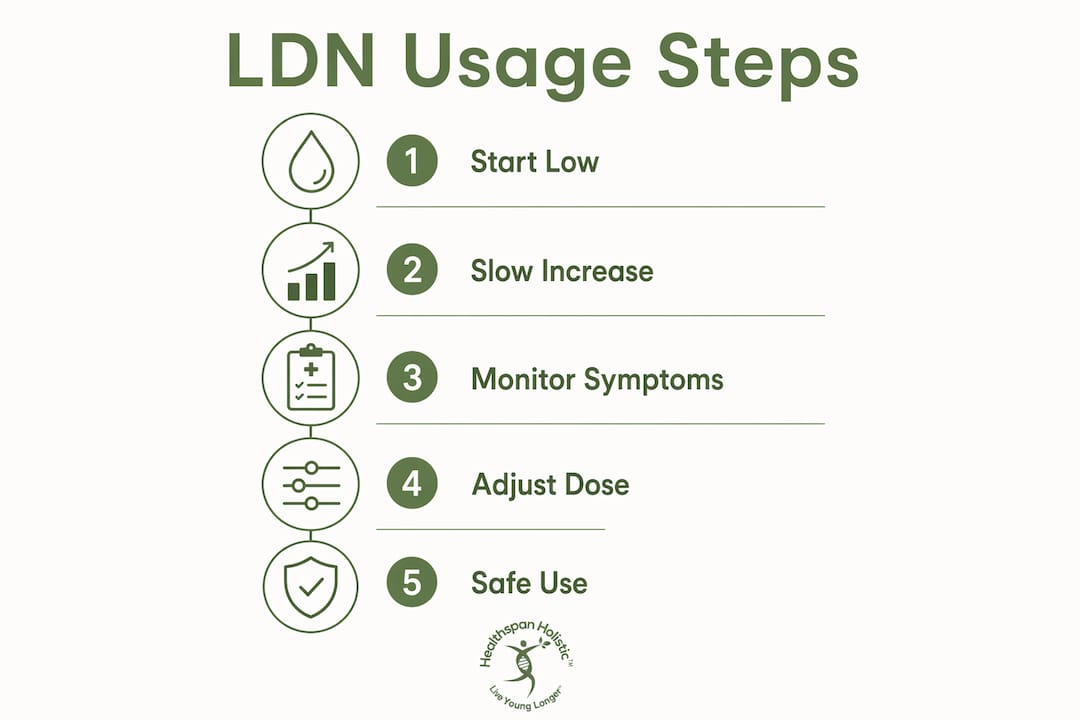
Slow titration starting as low as 0.5 mg with gradual increments to around 4.5 mg over several weeks is the typical approach. Patients often need weeks to months before clinical effectiveness becomes clear. Rushing the titration tends to increase side effects without improving outcomes.
Because naltrexone is only commercially available in the U.S. as a 50 mg tablet or a once-monthly extended-release injection, LDN must be ordered through a compounding pharmacy. This creates real access barriers. Compounded medications are not always covered by insurance, and quality can vary between pharmacies. Choosing an accredited compounding pharmacy is worth the extra effort.
Common side effects
LDN’s safety profile is favorable, with most side effects being mild, transient, and dose-dependent. The most frequently reported include:
-
Insomnia and vivid dreams: The most common complaint, especially in the first few weeks
-
Nausea: Usually mild and often resolves with continued use
-
Dizziness: Reported less frequently, typically early in treatment
-
Irritability: Noted in some fibromyalgia case series
-
Headache: Occasional, particularly during titration
Sleep-related side effects can often be reduced by switching from evening to morning dosing. The traditional recommendation was nighttime dosing to align with endorphin rhythms, but morning dosing has shown comparable effectiveness with fewer sleep complaints for many patients.
Who should not use LDN
-
People currently using opioid medications (LDN will precipitate withdrawal)
-
Individuals with acute hepatitis or liver failure
-
Those with known hypersensitivity to naltrexone
-
Patients who may need opioid analgesia for acute pain management
LDN is not appropriate as a first-line treatment for any condition. It belongs in a monitored clinical setting, with clear communication between patient and prescriber about its experimental status, expected timeline for response, and exit criteria if it is not working.
Pro Tip: If you are considering LDN and currently take any opioid-containing medication, including some cough suppressants and combination pain relievers, discuss this with your prescriber before starting. Even low-dose opioid exposure can interfere with LDN’s mechanism and trigger withdrawal symptoms.
Personalized integrative approaches to LDN for better healthspan
LDN does not work in isolation. The patients who tend to respond best are those who approach it as one component of a broader health strategy, not a standalone fix. At Healthspan Holistic, we see this clearly: the people who get the most out of emerging therapies like LDN are those who pair them with solid diagnostics, lifestyle work, and close monitoring.
The N-of-1 approach to LDN
Integrative clinics emphasize individualized N-of-1 dosing and close patient monitoring for outcomes like pain, fatigue, and cognitive function. An N-of-1 trial means treating yourself as your own control: tracking symptoms systematically before and during LDN use, adjusting dose incrementally, and making decisions based on your personal response data rather than population averages. This approach aligns directly with how Healthspan Holistic structures its personalized supplementation protocols.
What to track while using LDN
Effective monitoring turns anecdotal experience into useful data. Consider tracking:
-
Pain levels: Daily 0–10 scale, noting time of day and activity context
-
Fatigue: Morning and evening ratings, plus sleep quality scores
-
Cognitive function: Brain fog, concentration, and word-finding
-
Mood and irritability: Particularly relevant in the first 4–8 weeks
-
Side effects: Timing, severity, and whether they resolve with dose adjustment
-
Functional capacity: What you can do today that you could not do last month
Wearable devices and structured symptom journals make this tracking practical. The goal is to identify whether you are a responder within 8–12 weeks, then decide whether to continue, adjust, or discontinue.
Combining LDN with complementary strategies
LDN works on neuroinflammation and opioid receptor dynamics. Other evidence-based approaches address different parts of the chronic pain and autoimmune puzzle. An integrative health framework might layer LDN alongside:
-
Anti-inflammatory nutrition protocols (Mediterranean-style eating, elimination of processed foods)
-
Targeted supplementation for immune support and mitochondrial function
-
Stress regulation practices: sleep hygiene, breathwork, and nervous system downregulation
-
Gentle movement and physical therapy, particularly for fibromyalgia and MS
-
Lab-based monitoring of inflammatory markers, hormone panels, and metabolic function
Baseline diagnostics matter here. Knowing your inflammatory status, hormone levels, and metabolic markers before starting LDN gives you a clearer picture of whether the therapy is moving the needle. A comprehensive metabolic panel and a hormone assessment can establish that baseline and help your care team make better decisions over time.
The Healthspan Holistic perspective on LDN
We support an evidence-informed, patient-centered approach to therapies like LDN. That means being honest about what the research shows, helping you track your own response with real data, and integrating any new therapy into a broader plan that addresses root causes rather than just symptoms. LDN may be one useful tool in that plan. Whether it belongs in yours depends on your specific condition, your history with standard treatments, and your willingness to engage in the monitoring it requires.
Support your LDN journey with Healthspan Holistic
If you are exploring LDN as part of a broader chronic pain or autoimmune management plan, having the right diagnostic foundation makes all the difference. Healthspan Holistic offers LDN through our telehealth partner Altro Health. We also offer lab testing, AI-powered health tracking, and one-on-one coaching designed specifically for adults who want to take a proactive, data-driven approach to their health.
Start with our 90 Day Journey to Longevity program, which pairs personalized lab testing with coaching to help you build a clear picture of your health and track progress over time. Whether you are managing a chronic condition or simply want to feel better and function at a higher level, this program gives you the structure and support to make real progress.
1st Time Customers can take advantage of our BUY 1 GET 1 50% OFF special offer on all supplements.
Key Takeaways
Low dose naltrexone is a well-tolerated, off-label therapy with a 4.5 mg/day target dose that shows genuine promise for treatment-resistant chronic pain and autoimmune conditions, though large-scale RCT evidence remains limited as of 2026.
| Point | Details |
|---|---|
| Target dose is 4.5 mg/day | Most clinical research uses 4.5 mg/day, titrated slowly from 0.5–1.5 mg to reduce side effects. |
| Dual mechanism of action | LDN works via TLR4 glial modulation and opioid receptor rebound, reducing neuroinflammation and boosting endogenous opioids. |
| Evidence is promising but limited | A 2026 review of 105 studies found early positive results rarely replicated in placebo-controlled trials. |
| Compounding pharmacy required | No commercial low-dose tablet exists in the U.S.; LDN must be ordered through a compounding pharmacy. |
| Best for treatment-resistant cases | Experts recommend LDN when standard therapies have failed, with clear communication about its experimental status. |
FAQ
What is the standard dosage for low dose naltrexone?
The most common target dose in clinical research is 4.5 mg per day, typically reached through slow titration starting at 0.5–1.5 mg and increasing gradually over several weeks.
What conditions can low dose naltrexone treat?
LDN is used off-label for fibromyalgia, multiple sclerosis, Crohn’s disease, chronic fatigue syndrome, long COVID, and other chronic pain and autoimmune conditions, though all uses remain experimental.
What are the most common side effects of low dose naltrexone?
The most frequently reported side effects are insomnia, vivid dreams, nausea, and dizziness. These are generally mild and transient, and switching to morning dosing often reduces sleep-related complaints.
Can you take low dose naltrexone with other medications?
LDN is contraindicated with opioid medications because it will precipitate withdrawal. Always review your full medication list with a prescriber before starting, including any opioid-containing combination products.
How long does it take for low dose naltrexone to work?
Most patients need weeks to months before clinical effectiveness becomes clear. Experts recommend a structured monitoring period of at least 8–12 weeks before assessing whether LDN is producing a meaningful response.
Recommended
-
Nicotinamide Mononucleotide: What Adults 45+ Need to Know | Healthspan Holistic
-
NAC Supplement Benefits: What Adults 40+ Need to Know | Healthspan Holistic
-
Natural Statins: What Adults 40–75 Need to Know | Healthspan Holistic
-
Reta Peptide: Evidence, Risks, and Muscle Loss Guide | Healthspan Holistic
Leave a comment: