

Most people pay $500 to $1,400 out-of-pocket for the first month of peptide therapy in the United States, then settle into ongoing monthly costs of roughly $150 to $600, depending on the pathway they choose. A telehealth subscription with pharmacy compounding lands at the low end. Clinic-based or concierge programs run higher, and branded GLP-1 medications sit in their own, more expensive tier.
That first invoice usually bundles several line items together, not just the medication itself:
-
Initial consultation and medical intake
-
Baseline lab panel (hormones, metabolic markers, sometimes IGF-1)
-
First month’s medication supply
-
Injection supplies or an oral/sublingual delivery device
-
Shipping, often cold-chain for injectable peptides
-
Healthspan Holistic’s bundle includes everything in 1 competitive price. Sign In Here for access to our entire line of peptides.
Almost none of this is reimbursed by insurance. Most wellness-focused peptide protocols fall outside FDA-labeled indications, which means commercial plans, Medicare, and Medicaid typically treat the entire expense as a private, cash-pay purchase.
Key Takeaways
Peptide therapy in the U.S. typically costs $500 to $1,400 for the first month and $150 to $600 monthly after that, with sourcing path driving most of the variation.
| Point | Details |
|---|---|
| First-month range | Budget $500 to $1,400 for consultation, labs, and initial supply combined. |
| Ongoing monthly cost | Expect $150 to $600 a month depending on peptide and provider type. |
| Insurance rarely helps | Most wellness peptide indications are cash-pay; check HSA/FSA eligibility separately. |
| Skip gray-market vials | Unverified research vials save money but remove sterility and prescriber oversight. |
| Healthspan Holistic option | Offers itemized pricing, licensed prescribers with verifiable NPIs, and oral spray peptide formats for readers who want transparency built in. |
How Much Does Peptide Therapy Cost by Category?
Price depends far more on where you get your peptides than on which peptide you’re taking. Four distinct paths exist, and each has its own pricing logic worth understanding before you commit a dollar.
Telehealth plus pharmacy compounding is the most predictable option. Legitimate providers who work with licensed compounding pharmacies often price single-peptide subscriptions around $199 to $299 a month, with everything from the consult to shipping folded into one recurring fee. This is generally the practical price floor for a clinically supervised, quality-controlled product.
Clinic and concierge bundles cost more because you’re not just buying a compound. You’re buying office visits, in-person injection training, and hands-on monitoring, which is why clinics often mark up the same compounded peptide by 30% to 100% compared to a pharmacy-direct refill.
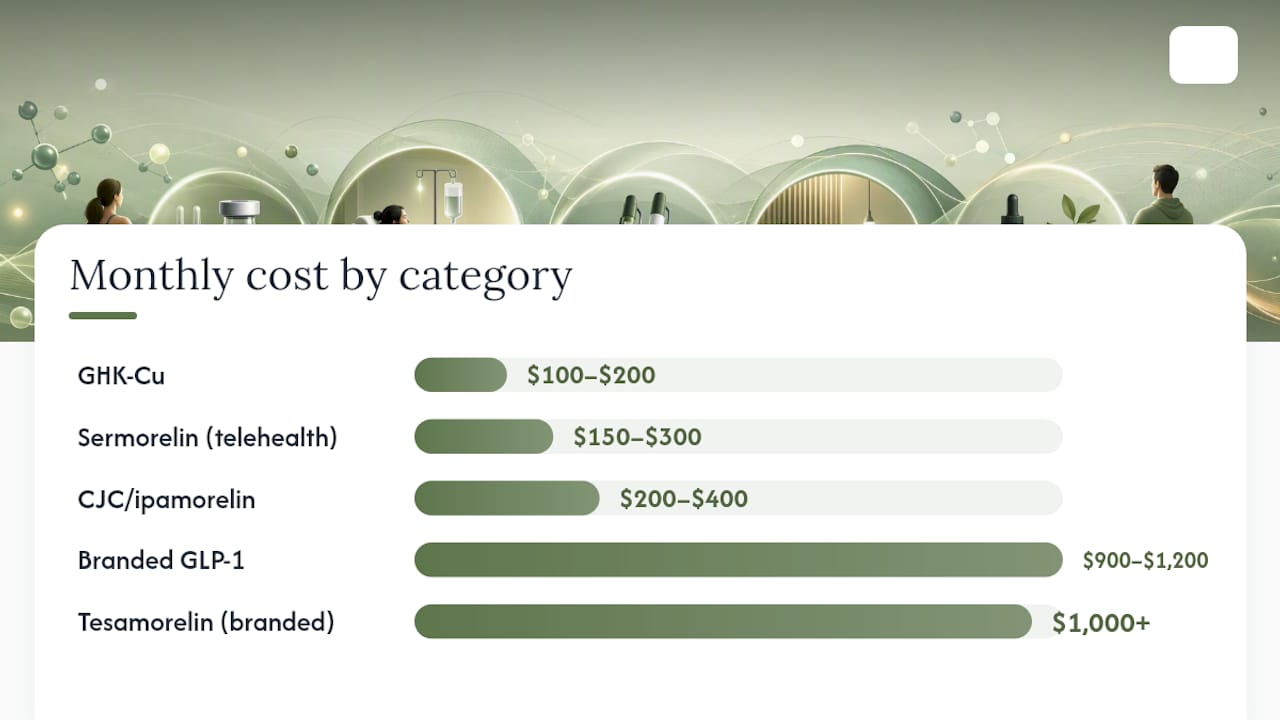
Branded, FDA-approved biologics occupy a separate specialty tier entirely. Tesamorelin (sold as Egrifta) is manufactured and distributed under a commercial model closer to a specialty drug than a compounded wellness product, which explains its outlier pricing.
Research-use vials are the cheapest option per milligram, sometimes by 30 to 60 times less than branded products at starter doses. They also come without sterility testing, potency verification, or any prescriber oversight, which turns the apparent savings into an unpriced risk.
| Category | Typical Monthly Cost | What’s Included | Delivery Method |
|---|---|---|---|
| Sermorelin (telehealth) | $150–$300 | Consult, compounded peptide, shipping | Injection |
| CJC/ipamorelin stack | $200–$400 | Combo vial, follow-up messaging | Injection |
| BPC-157 (telehealth or clinic) | $150–$350 | Compounded vial or oral spray, dosing guidance | Injection or oral spray |
| GHK-Cu | $100–$200 | Compounded vial, topical or injectable | Injection or topical |
| Compounded semaglutide | $150–$350 | Titration schedule, telehealth support | Injection |
| Branded GLP-1 (Wegovy/Ozempic) | $900–$1,200 | Retail pharmacy fill | Injection |
| Tesamorelin (branded) | $1,000+ | Specialty biologic, pharmacy distribution | Injection |
Regional pricing shifts these numbers somewhat. Urban clinics with higher overhead tend to charge more for in-person visits, while telehealth pricing stays relatively flat nationwide since it doesn’t depend on local rent or staffing costs.
What Drives the Price of Peptide Therapy?
Two people on the same peptide can pay wildly different amounts, and the gap almost always traces back to a handful of specific variables.
-
Molecule and patent status. A compounded generic peptide costs a fraction of a patented, branded biologic like tesamorelin.
-
Brand versus compounded. Retail GLP-1s cost roughly three to six times more than their compounded equivalents for a comparable dose.
-
Dosage and frequency. Daily injections cost more to maintain than a peptide dosed two or three times weekly.
-
Provider type and credentialing. MDs, nurse practitioners, and physician assistants all carry different overhead and billing structures.
-
Monitoring and lab work. More frequent panels raise the ongoing cost but also raise the safety margin.
-
Clinic overhead versus telehealth. Rent, staff, and in-person visits get baked into every clinic invoice.
-
Region. Urban markets generally charge more for consultations and in-person services than rural or telehealth-first providers.
-
Bundled stacks. Combining several peptides into one protocol raises the total but often lowers the per-peptide cost.
A licensed prescriber’s National Provider Identifier is a small but meaningful trust signal. If a provider won’t share credentials or an NPI, that’s worth treating as a red flag rather than an oversight.
Pro Tip: A higher price is worth paying when it buys something concrete: a multi-peptide protocol that requires careful sequencing, specialty lab panels beyond a basic metabolic screen, or genuine hands-on care for someone managing a complex health issue. A higher price that only buys a nicer waiting room is not worth it.
What Does a Typical 3-Month Peptide Protocol Cost?
Budgeting gets easier once you see it laid out against a real timeline. Here are three common paths, from entry-level to concierge.
Scenario A: the starter protocol. A first-time user starts sermorelin through a telehealth provider. Month one runs $400 to $600 once you add the consult and baseline labs to the medication. Months two and three settle into $200 to $300 each, assuming no additional labs are needed until a three-month recheck. At Healthspan Holistic, our sermorelin both starts at and continues to cost only $184 per month.
Scenario B: the recovery stack. An active adult adds a BPC-157 and TB-500 combination under clinic-based supervision for tendon or joint recovery. Onboarding runs $700 to $1,000 for the initial visit, imaging review, and first supply. Ongoing months run $350 to $500 each with periodic check-ins. At Healthspan Holistic, our BPC-157 and TB-500 Wolverine stack both starts at and continues to cost only $249 per month.

Scenario C: the concierge longevity stack. A comprehensive multi-peptide protocol with extensive lab work and in-person visits front-loads cost heavily. Onboarding can reach $1,200 to $1,400, with monthly maintenance settling around $500 to $600 once labs are established.
| Scenario | 3-Month Total | Included | Main Cost Driver |
|---|---|---|---|
| Starter (telehealth sermorelin) | $800–$1,200 | Consult, labs, medication, shipping | Provider type, dosing frequency |
| Recovery stack (clinic-based) | $1,200–$1,400 | Combo vial, in-person visits, monitoring | Multi-peptide stacking, clinic overhead |
| Concierge longevity | $2,200–$2,600 | Extensive labs, multiple peptides, in-person care | Lab depth, provider credentials, monitoring |
Your actual number depends on which peptides you combine and how often your provider wants you back in for labs, but these three scenarios cover most of what health-conscious adults actually book.
Is Peptide Therapy Worth the Cost?
Evidence quality varies a lot by category, and that should shape how much you’re willing to pay. A peer-reviewed review of peptide therapeutics documents solid mechanistic and clinical support for several peptide drug classes, particularly in metabolic and hormonal applications, while wellness-oriented healing peptides like BPC-157 have thinner published human data despite widespread anecdotal use.
Roughly 70% to 80% of U.S. peptide therapy spending happens without any insurance involvement, since most indications fall outside FDA-labeled use. That reality shapes the entire cost conversation: you’re paying cash, so monitoring isn’t optional overhead, it’s your main safety net.
Budget for monitoring the same way you budget for the medication itself:
-
Baseline labs before starting (hormones, metabolic panel, sometimes inflammatory markers)
-
A follow-up panel around the 8 to 12 week mark
-
A follow-up visit to review results and adjust dosing
Over six months, monitoring alone typically adds $200 to $500 to your total cost, and that’s money well spent. Avoid gray-market vials for anything you’re putting in your body. The savings never justify skipping sterility testing and prescriber oversight, especially when a legitimate pharmacy-compounded protocol closes most of that price gap anyway.
How Can You Lower Peptide Therapy Costs Safely?
You don’t have to choose between affordability and oversight. A few tactics lower your bill without cutting corners on safety.
-
Choose a telehealth subscription that already bundles labs into the monthly fee instead of billing them separately like Healthspan Holistic offers.
-
Ask about multi-month supply discounts, which often run 10% to 20% cheaper than paying month to month.
-
Request combination vials instead of separate vials for stacked peptides. It usually costs less than buying each compound individually.
-
Favor pharmacy-compounded channels over clinic markups when you don’t need in-person injection training.
-
Check whether your HSA or FSA administrator allows peptide therapy reimbursement. Coverage varies by plan and often requires a documented diagnosis code. Healthspan Holistic prescriptions are HSA/FSA eiigible.
Pro Tip: When a clinic recommends a multi-peptide protocol, ask for an itemized quote broken out by compound. Then compare that bundle against what a pharmacy-direct refill would cost for the same peptides. The gap between the two numbers tells you exactly how much you’re paying for the clinic’s service layer. This buying guide checklist walks through the same comparison process in more detail.
Will Insurance Cover Peptide Therapy?
For most wellness-focused peptide protocols, the honest answer is no. U.S. commercial insurance, Medicare, and Medicaid generally don’t cover compounded peptides prescribed for off-label wellness goals like recovery, longevity, or general vitality. Coverage only kicks in for specific FDA-labeled indications, and tesamorelin for HIV-associated lipodystrophy is one of the few examples that sometimes qualifies.
HSA and FSA eligibility lives in a gray area. Some plan administrators will reimburse peptide therapy when a licensed provider documents a legitimate diagnosis code and medical necessity. Others won’t touch it regardless of documentation. Always check with your specific plan administrator before assuming eligibility.
Keep every prescription, lab result, and provider note from your treatment. If you ever want to pursue reimbursement or need documentation for a future plan, that paper trail is the difference between a quick approval and a denied claim.
What Does Transparent Peptide Therapy Pricing Look Like?
A trustworthy provider itemizes your invoice instead of hiding costs inside a vague package price. At Healthspan Holistic, a typical protocol breaks down like this: an initial consultation, baseline lab panel, first month of pharmacy-compounded medication, injection or oral spray supplies, and a scheduled follow-up visit, generally landing in the $150 to $300 per month range for a single-peptide protocol depending on the compound and lab depth involved.
What that fee includes matters as much as the number itself:
-
A licensed prescriber (MD, NP, or PA), listed with a verifiable NPI
-
Pharmacy-compounded product rather than unverified research-use vials
-
Baseline and follow-up lab panels tailored to your protocol
-
Cold-chain shipping for temperature-sensitive peptides
-
Scheduled follow-up monitoring, not a one-time sale
For readers considering oral delivery instead of injections, Healthspan Holistic carries a Body Protecting Peptide Oral Spray, an Epitalon Pinealon Peptide Oral Spray, and a KPV Peptide Ultra Oral Spray as sublingual alternatives worth discussing with your provider.
This is general information and not medical advice. Talk with a licensed provider before starting any peptide protocol.
Pro Tip: Ask any provider you’re considering for their NPI number and confirm it matches a real, active license before you book a consultation. It takes thirty seconds and tells you whether you’re dealing with a credentialed clinician or a storefront.
Peptide Therapy Cost: What U.S. Buyers Should Expect
The conventional advice on this topic gets one thing badly wrong: it treats price as the main decision variable when sourcing path should come first. Two providers can quote the same number for the same peptide, and one of them is selling you a sterile, pharmacy-compounded product with lab oversight while the other is selling you an unverified vial with a nicer marketing page. The dollar figure tells you nothing about which one you’re getting.
What the research actually supports is this: telehealth models built on licensed compounding pharmacies deliver the best cost-to-oversight ratio available right now, generally landing in that $199 to $400 monthly range without cutting corners on safety. Concierge clinics earn their premium only when they provide something genuinely harder to replicate, like coordinated multi-peptide protocols or hands-on care for a complex case.
If you take one thing from this article, budget for monitoring before you budget for the peptide itself. Skipping labs to save $150 is the single most common way people turn a reasonable wellness investment into an expensive mistake.
A Straightforward Way to Start Peptide Therapy With Confidence
Healthspan Holistic gives you what most peptide providers don’t: a fully itemized quote before you commit a dollar, built around licensed prescribers, pharmacy-compounded products, and lab-backed monitoring instead of guesswork.

If you’ve been comparing telehealth subscriptions against clinic packages and feeling unsure which one actually protects you, that’s the exact gap Healthspan Holistic was built to close. You get a licensed provider, baseline labs matched to your protocol, and follow-up monitoring built into the price from day one.
1st Time Customers can take advantage of our BUY 1 GET 1 50% OFF special offer on all supplements.
This article is general information, not a substitute for advice from a qualified doctor. Consult a qualified healthcare professional about your own circumstances before acting on anything here.
Sources
FAQ
How much do three months of peptides cost?
A three-month starter protocol through telehealth typically totals $800 to $1,200, while a concierge multi-peptide program can run $2,200 to $2,600 over the same period.
Are peptides cheaper than TRT?
It depends on the peptide and protocol. Basic growth-hormone secretagogues like sermorelin often cost similarly to or less than testosterone replacement therapy, while multi-peptide stacks or branded GLP-1s can exceed typical TRT pricing.
How much do peptides actually cost?
Most people pay $150 to $600 a month after an initial setup cost of $500 to $1,400, though branded biologics like tesamorelin and retail GLP-1s can run considerably higher.
Will insurance cover peptide therapy?
Generally no. Most U.S. commercial insurance, Medicare, and Medicaid plans don’t cover wellness-focused peptide protocols, since coverage is limited to specific FDA-labeled indications.
Does Healthspan Holistic offer transparent peptide pricing?
Yes. Healthspan Holistic provides itemized pricing that separates consultation, labs, medication, and follow-up monitoring so patients know exactly what each dollar covers.
Leave a comment: