

TL;DR:
- BPC 157 is a peptide derived from human gastric juice that promotes tissue repair, reduces inflammation, and supports recovery. It accelerates healing by increasing blood vessel growth and improving collagen structure, with rodent studies showing significantly faster tendon healing, and small human studies indicating symptom reduction in injuries. Although it shows promise for musculoskeletal and gut health, its safety and effectiveness in humans require cautious use due to limited clinical data and regulatory concerns.
BPC 157 is a 15-amino-acid peptide derived from human gastric juice, and its bpc 157 peptide benefits center on accelerating tissue repair, reducing inflammation, and supporting whole-body recovery. Formally known as Body Protection Compound 157, it has attracted serious attention from researchers studying musculoskeletal injuries, gut health, and neuroprotection. If you are between 30 and 60 and dealing with a stubborn injury, slow recovery, or chronic inflammation, BPC 157 may be one of the most promising research peptides you have not yet considered. The science is compelling, the practical applications are growing, and the safety profile looks encouraging, though important caveats apply.
What are the BPC 157 peptide benefits for tissue healing?
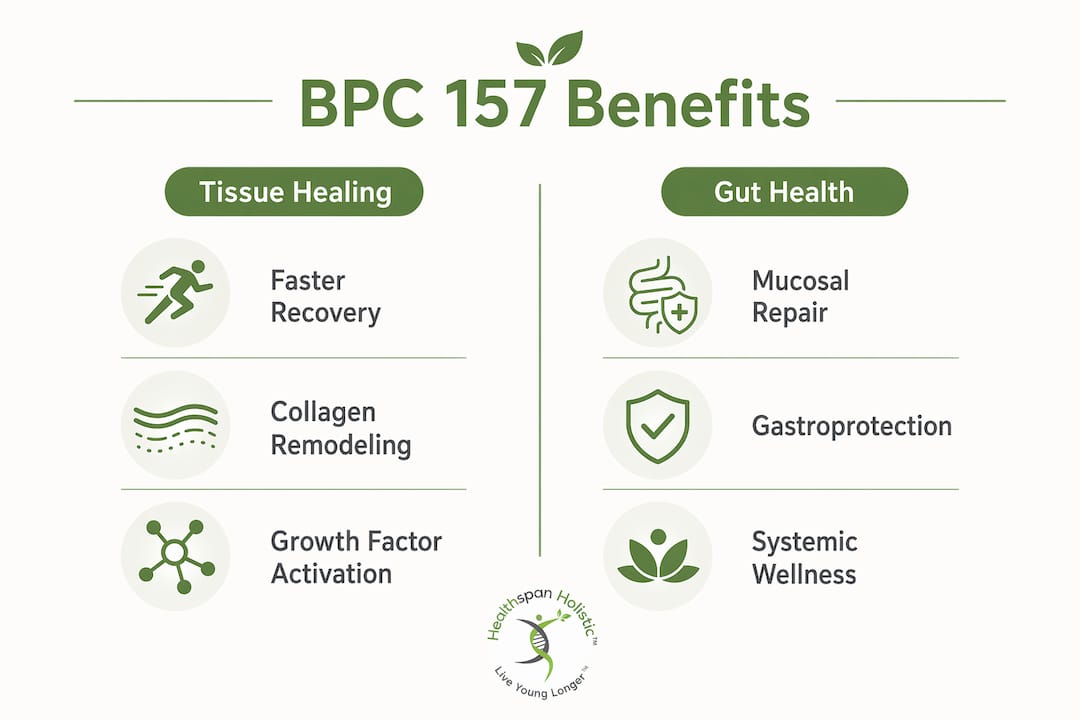
BPC 157 accelerates healing by activating multiple growth factor pathways simultaneously. Specifically, it upregulates VEGF receptors, driving angiogenesis, which is the formation of new blood vessels that carry oxygen and nutrients directly to damaged tissue. Without adequate blood supply, injured tendons, ligaments, and muscles repair slowly. BPC 157 essentially fast-tracks that supply line.

The peptide also modulates the nitric oxide system and promotes collagen remodeling. Collagen is the structural protein that gives tendons and ligaments their tensile strength. When collagen is poorly organized after an injury, the repaired tissue remains weak and prone to re-injury. BPC 157 improves collagen fiber alignment, which means the healed tissue is structurally closer to the original.
Rodent studies show 2–3 times faster Achilles tendon healing with better collagen organization and tensile strength compared to controls. That is not a marginal improvement. It suggests BPC 157 changes the fundamental biology of repair, not just the speed.
Human data is still limited, but a clinical case series found that intra-articular knee injections of BPC 157 reduced symptoms in over 90% of 17 patients with tendon and ligament injuries after 6 months. That is a strong signal, even from a small sample. It aligns with what the animal research predicts and with what practitioners are observing in clinical settings.
| Tissue type | Observed effect | Evidence level |
|---|---|---|
| Tendons | 2–3x faster healing, improved collagen organization | Preclinical rodent models |
| Ligaments | Symptom reduction in over 90% of patients | Human case series |
| Muscles | Accelerated repair via angiogenesis and VEGF upregulation | Mechanistic and preclinical |
| Bone | Supported remodeling through growth factor activation | Preclinical |
Pro Tip: If you are recovering from a tendon or ligament injury, pairing BPC 157 with physical therapy may produce better outcomes than either approach alone. The peptide restores the biological environment for repair; movement and load guide the tissue to rebuild correctly.
For a broader look at how peptides like BPC 157 fit into modern recovery protocols, the regenerative peptides guide at Healthspan Holistic covers the cellular and molecular pathways in detail.
How does BPC 157 support gut health and systemic wellness?
BPC 157’s origins in gastric juice are not coincidental. The peptide shows strong gastroprotective effects across multiple injury models, including NSAID-induced ulcers, ethanol damage, and stress-induced mucosal injury. Research confirms it accelerates mucosal repair in these models, making it relevant for anyone dealing with gut lining damage from medications, alcohol, or chronic stress.
The gut-healing mechanism involves direct tissue regeneration of the mucosal lining, the protective barrier between your digestive contents and your bloodstream. When that barrier is compromised, inflammation spreads systemically. BPC 157 helps restore it, which has downstream effects on whole-body inflammation levels.
Beyond the gut lining, BPC 157 interacts with dopamine and serotonin systems, which influence gut motility, mood regulation, and neuroprotection. This gut-brain axis connection is one of the more surprising aspects of the research. It suggests BPC 157 is not simply a local repair agent but a systemic regulator.
Key systemic effects supported by current research include:
-
Gastroprotection: Shields the stomach lining from NSAID, ethanol, and stress-induced damage
-
Mucosal regeneration: Actively rebuilds damaged gut tissue rather than just reducing symptoms
-
Dopamine and serotonin modulation: Supports gut motility and may contribute to mood stability
-
Vascular tone normalization: Emerging data points to effects on blood pressure regulation and thrombosis prevention
-
Bidirectional inflammation regulation: BPC 157 balances inflammation and hemostasis without the single-target risks common in pharmaceutical drugs
This bidirectional effect is what separates BPC 157 from most anti-inflammatory compounds. It does not simply suppress inflammation. It helps the body find the right level of response, which is a fundamentally different and more sophisticated mechanism.
How is BPC 157 administered, and what should you know before starting?
Administration method matters significantly with BPC 157. Subcutaneous or intramuscular injection delivers the highest bioavailability and the most direct therapeutic effect. Oral administration is possible because BPC 157 is naturally present in gastric juice, but oral bioavailability is lower than injection, meaning you need higher doses to achieve comparable results.
The practical approach most practitioners follow:
-
Inject near the injury site. Localized injection near the damaged tissue maximizes local concentration and therapeutic effect. Systemic distribution from a distant injection site is less potent for musculoskeletal injuries.
-
Use subcutaneous injection for general wellness goals. If the target is gut health or systemic inflammation rather than a specific injury, subcutaneous injection in the abdomen is a common approach.
-
Consider oral use for gut-specific applications. For gastrointestinal healing, oral BPC 157 delivers the compound directly to the target tissue, which partially compensates for the lower bioavailability.
-
Source from reputable suppliers. Peptide quality varies widely. Purity testing and third-party verification are non-negotiable when choosing a supplier.
-
Work with a knowledgeable practitioner. Dosing protocols vary based on body weight, injury severity, and administration route. A practitioner familiar with peptide therapy for adults can help you build a protocol that fits your specific situation.
Pro Tip: For musculoskeletal injuries, injecting as close to the affected tendon or ligament as safely possible produces noticeably better results than a distant injection site. Think of it as delivering the repair crew directly to the construction site rather than dropping them off across town.
What are the side effects and regulatory risks of BPC 157?
BPC 157 has a favorable safety profile in available studies. No major adverse effects have been reported in animal research or in the human case series published to date. Anecdotal reports from practitioners and users are similarly reassuring, with nausea being the most commonly mentioned minor complaint.
That said, the regulatory picture is more complicated. BPC 157 is not FDA-approved, and its legal status varies by country. In the United States, it sits in a regulatory gray area, available for research purposes but not approved as a therapeutic drug. The FDA has moved to restrict certain compounded peptides, so staying current on regulatory changes is important. The FDA peptide announcement from 2026 outlines what these changes mean for people using peptides for health purposes.
Key risks to understand before using BPC 157:
-
Sourcing variability: Peptide purity and potency vary significantly across suppliers due to lack of standardization and no FDA oversight
-
Limited human clinical data: Rodent models show compelling benefits, but human data remain limited and require cautious interpretation
-
No standardized dosing protocol: Without approved clinical guidelines, dosing relies on practitioner experience and extrapolation from animal studies
-
Regulatory grey area: Legal status differs by country, and regulations are actively evolving in 2026
-
Injection risks: Improper injection technique carries standard risks including infection, bruising, and nerve irritation
The absence of serious adverse effects in existing research is genuinely encouraging. At the same time, the lack of large-scale human trials means you are making decisions based on incomplete data. That is a reasonable trade-off for many people dealing with chronic injuries or gut issues, but it requires eyes-open decision-making.
Key Takeaways
BPC 157 is the most studied repair peptide in preclinical research, and its combination of tissue healing, gut protection, and systemic regulation makes it uniquely relevant for adults seeking faster recovery and reduced inflammation.
| Point | Details |
|---|---|
| Tissue healing mechanism | BPC 157 upregulates VEGF and growth factor receptors to drive angiogenesis and collagen remodeling. |
| Speed of recovery | Rodent studies show 2–3 times faster tendon healing with improved structural integrity. |
| Gut protection | BPC 157 repairs mucosal damage from NSAIDs, alcohol, and stress through direct tissue regeneration. |
| Administration method | Injection near the injury site delivers the strongest local effect; oral use suits gut-specific goals. |
| Regulatory awareness | BPC 157 is not FDA-approved; sourcing quality and legal status must be verified before use. |
My honest assessment of BPC 157 in 2026
I have followed the BPC 157 research closely and my view is that the excitement is justified but the hype sometimes outpaces the evidence. The preclinical data is genuinely impressive. A peptide that heals tendons two to three times faster, protects the gut lining, and modulates both the dopamine system and vascular tone is not a minor compound. That breadth of effect is rare.
What I caution people about is the gap between animal models and human clinical trials. The 17-patient knee injection case series is promising, but it is not a randomized controlled trial. We do not yet have the kind of large-scale human data that would let us say definitively how BPC 157 performs across different injury types, age groups, and dosing protocols. That gap matters.
What I have observed practically is that people who get the most benefit from BPC 157 are those who combine it with a solid recovery foundation. That means adequate protein intake, quality sleep, targeted micronutrient support, and structured physical therapy. BPC 157 is not a shortcut. It is a biological amplifier. Give it a strong signal to work with, and the results are far more consistent.
Sourcing is the other variable I take seriously. The difference between a high-purity peptide and a low-quality product is not visible to the naked eye. Working with a practitioner who can guide you to verified suppliers and monitor your response is worth the extra effort. The research peptides wellness guide at Healthspan Holistic is a good starting point for understanding what quality sourcing looks like.
My overall position: BPC 157 is one of the most promising recovery compounds in current research. Use it with clear eyes, good sourcing, and a complete wellness strategy behind it.
— Chris
Supporting your recovery with Healthspan Holistic
Recovery does not happen in isolation. BPC 157 works best when your body has the nutritional foundation to rebuild. At Healthspan Holistic, we pair education with professional-grade diagnostics and supplements designed for adults who want to recover faster and age better. Checkout our line of oral spray, capsule, & powder peptides by Clicking Here.
Our 90 Day Journey to Longevity is a structured supplement regimen built to support tissue repair, energy, and long-term vitality. Every product in our collection is selected for quality and backed by evidence. If you want to know where your micronutrient levels stand before adding any peptide protocol, our cellular micronutrient test gives you a precise baseline to work from.
1st Time Customers can take advantage of our BUY 1 GET 1 50% OFF special offer on all supplements.
FAQ
What is BPC 157 and where does it come from?
BPC 157 is a 15-amino-acid peptide derived from a protein found in human gastric juice. It is classified as a research peptide and is studied for its tissue repair, anti-inflammatory, and gastroprotective properties.
How long does BPC 157 take to show results?
Results vary by injury type and administration method. The human case series using intra-articular injections showed meaningful symptom reduction over a 6-month period, though some practitioners report earlier responses in acute injuries.
Is BPC 157 safe to use?
Available studies and anecdotal reports show no major adverse effects. However, BPC 157 is not FDA-approved, and sourcing quality varies significantly, which introduces real risk if you purchase from unverified suppliers.
Can you take BPC 157 orally instead of injecting it?
Oral BPC 157 is possible and may be preferable for gut-specific healing, but oral bioavailability is lower than injection. Higher oral doses are typically needed to match the effect of injected BPC 157.
Is BPC 157 legal in the United States?
BPC 157 exists in a regulatory gray area in the United States. It is not FDA-approved as a therapeutic drug, and regulations around compounded peptides are actively evolving in 2026. Checking current FDA guidance before use is the responsible step.
Leave a comment: