

TL;DR:
- Selenium is an essential trace mineral that supports thyroid health, immune function, and antioxidant defenses. Supplementation benefits are strongest for autoimmune thyroid conditions like Hashimoto’s and should be carefully dosed to avoid toxicity. Testing your selenium levels beforehand guides safe, personalized intake and prevents potential harm from excess.
Selenium is defined as an essential trace mineral that powers a family of proteins called selenoproteins, which defend your cells against oxidative damage, regulate immune responses, and drive thyroid hormone conversion. Most adults get enough selenium from food, but specific health conditions, particularly autoimmune thyroid disease, create a clear clinical case for supplementation. Understanding the selenium supplement benefits that are actually supported by evidence, and the real risks of taking too much, is the difference between a supplement that helps and one that quietly harms. This article gives you the full picture so you can make a confident, informed decision.
What are the major scientifically supported benefits of selenium supplements?
Selenium’s most proven benefit is in autoimmune thyroid disease, specifically Hashimoto’s thyroiditis. A meta-analysis of 21 randomized controlled trials with 1,610 patients showed that 200 mcg per day of selenomethionine significantly reduced thyroid peroxidase antibodies (TPOAb) and TSH levels after 3–6 months. That matters because high TPOAb levels drive the immune attack on thyroid tissue, and lowering them can slow disease progression.

Beyond thyroid health, selenium plays a measurable role in immune function. Selenoproteins act as immune redox calibrators, neutralizing the oxidative stress that spikes during immune activation. Think of selenium as a circuit breaker for your immune system. It prevents the inflammatory response from burning too hot and damaging healthy tissue in the process.
The antioxidant case for selenium is also well established. Selenoproteins like glutathione peroxidase and thioredoxin reductase neutralize free radicals that accumulate with age. For adults over 45, this matters because oxidative stress is a primary driver of cellular aging, joint inflammation, and metabolic decline.
“Selenium acts as an immune calibrator rather than a mere booster, supporting an appropriate immune response without tipping the balance toward chronic inflammation.” — clinical nutrition research
Where the evidence gets thinner is cancer prevention and heart disease. Studies show no clinical benefit for selenium supplementation in reducing prostate cancer or cardiovascular risk in adults who already have adequate selenium levels. If you are not deficient, adding more selenium for these goals is not supported by current evidence.
Key selenium health benefits with clinical backing include:
-
Reduced thyroid peroxidase antibodies in Hashimoto’s thyroiditis
-
Support for innate and adaptive immune function through selenoprotein activity
-
Antioxidant defense via glutathione peroxidase and thioredoxin reductase
-
Thyroid hormone conversion from T4 to active T3
How much selenium should adults take?
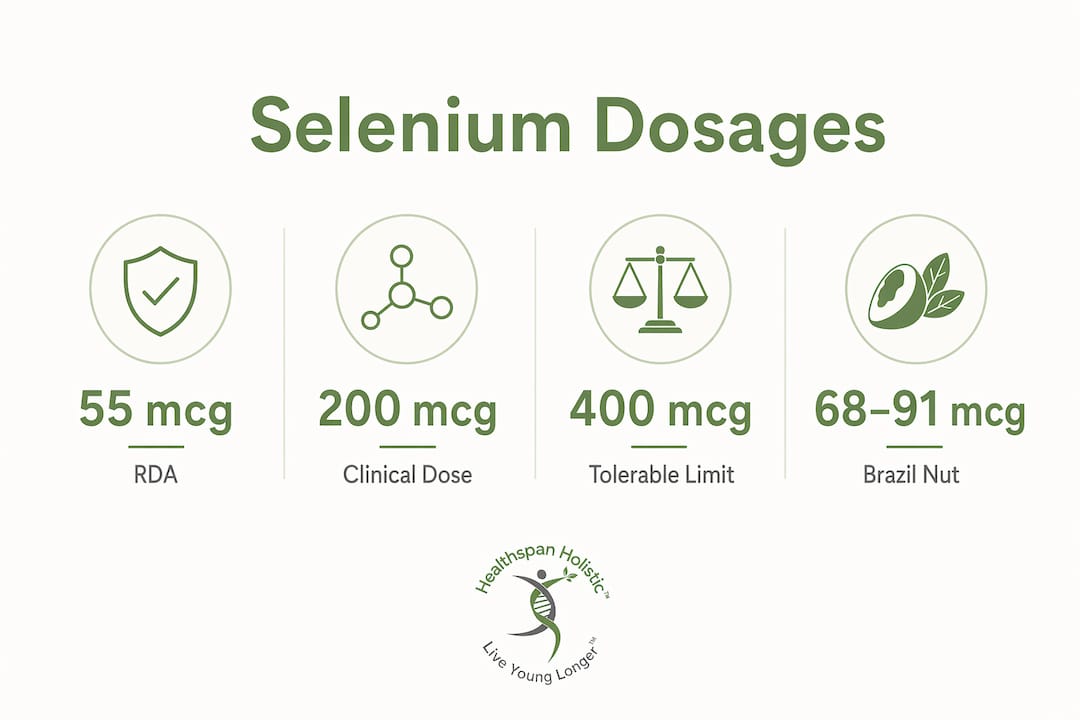
The Recommended Dietary Allowance (RDA) for selenium is 55 mcg per day for adults. The Tolerable Upper Intake Level (UL) is 400 mcg per day, and exceeding it consistently causes selenosis, a toxicity syndrome that includes hair loss, brittle nails, skin rashes, and in severe cases, neurological symptoms.
The gap between the RDA and the UL sounds wide, but it closes faster than most people expect. Consider the table below.
| Selenium source | Approximate selenium content |
|---|---|
| Brazil nut (1 nut) | 68–91 mcg (highly variable) |
| Tuna, canned (3 oz) | 68 mcg |
| Sardines (3 oz) | 45 mcg |
| Standard supplement dose | 55–200 mcg |
| Tolerable Upper Limit | 400 mcg/day |
Brazil nuts are the most striking example of how quickly selenium adds up. Their selenium content varies widely depending on the soil where they were grown. Eating just 3–4 Brazil nuts daily, combined with a standard supplement, can push you past the UL without realizing it.
Pro Tip: If you eat Brazil nuts regularly, skip the selenium supplement on those days. Tracking both food and supplement sources prevents accidental overload.
For adults with Hashimoto’s thyroiditis, the clinically studied dose is 200 mcg per day of selenomethionine, taken consistently with meals. For general wellness, staying at or near the 55 mcg RDA through diet is sufficient for most people. Always confirm your baseline before choosing a dose.
What are the risks and limitations of selenium supplementation?
Selenium follows a U-shaped health curve. Both too little and too much cause harm. Research confirms that supplementing beyond sufficiency does not reduce the risk of heart disease or prostate cancer and may increase the risk of type 2 diabetes, with a relative risk of 1.07 noted in some long-term studies. That is a modest number, but it is a real signal that excess selenium is not neutral.
The SELECT trial, a large clinical study on selenium and vitamin E for prostate cancer prevention, found no cancer prevention benefit and flagged a possible increased diabetes risk in well-nourished adults taking high-dose selenium long term. The lesson is clear. More is not better when your baseline is already adequate.
Risks of unsupervised selenium supplementation include:
-
Selenosis from chronic intake above 400 mcg per day (hair loss, nail brittleness, fatigue, nerve damage)
-
Modest increased type 2 diabetes risk in selenium-replete adults
-
Disruption of immune redox balance, which may worsen rather than support immune health
-
Potential interference with microbiome health at high doses
Experts advise assessing blood selenium levels before starting any high-dose supplementation. Routine supplementation without prior testing offers no proven benefit to people with adequate selenium and carries real downside risk. This is why personalized supplementation guided by lab data is the only approach that makes clinical sense.
How does selenium support longevity and vitality in adults over 45?
Selenium’s role in thyroid function is one of its most underappreciated contributions to energy and vitality. The thyroid gland contains the highest selenium concentration of any organ in the body. Selenium-dependent enzymes convert the inactive thyroid hormone T4 into the active T3 form, which governs metabolic rate, body temperature, and energy production. When selenium is low, this conversion slows, and fatigue, weight gain, and brain fog follow. Understanding why thyroid levels matter is the first step toward addressing these symptoms at the root.
For immune resilience, selenium’s redox-modulating role becomes more relevant as you age. Older immune systems tend toward chronic low-grade inflammation, a state researchers call “inflammaging.” Selenoproteins help regulate this by keeping oxidative signals in check during immune activation. The result is a more measured, efficient immune response rather than a sluggish or overactive one.
Realistic expectations matter here. Selenium supplementation is not a quick fix. Follow these steps to get the most from it:
-
Test first. Get a baseline selenium blood level before starting any supplement. This tells you whether you are deficient, sufficient, or already at the high end of normal.
-
Choose the right form. Selenomethionine is the most bioavailable form and the one used in clinical trials for Hashimoto’s thyroiditis.
-
Take it with meals. Consistent intake with food maximizes absorption and reduces any gastrointestinal discomfort.
-
Give it time. Benefits for autoimmune thyroid conditions build over 3–6 months of consistent use. Do not judge results in the first few weeks.
-
Retest periodically. Blood selenium levels should be rechecked every 6–12 months to confirm you are staying within the safe range.
Pro Tip: Pair selenium testing with a broader micronutrient assessment to see how it interacts with other nutrients like zinc, iodine, and vitamin D, all of which influence thyroid and immune function.
Lifestyle factors also shape how well selenium works. A diet rich in whole foods, adequate protein intake, and low chronic stress all support selenoprotein activity. Selenium is one piece of a larger metabolic puzzle, not a standalone solution.
Key takeaways
Selenium supplement benefits are real but specific. They apply most clearly to adults with documented deficiency or autoimmune thyroid disease, not to the general population seeking broad wellness gains.
| Point | Details |
|---|---|
| Proven thyroid benefit | 200 mcg/day of selenomethionine reduces TPOAb levels in Hashimoto’s thyroiditis after 3–6 months. |
| Narrow safety window | The RDA is 55 mcg/day and the UL is 400 mcg/day. Excess intake causes selenosis and raises diabetes risk. |
| Test before you supplement | Blood selenium testing before starting supplements prevents unnecessary risk in selenium-adequate adults. |
| Immune and antioxidant roles | Selenoproteins regulate immune redox balance and neutralize free radicals, supporting healthy aging. |
| Consistency drives results | Taking selenium with meals and maintaining intake for months produces the best clinical outcomes. |
Why I think most people are approaching selenium all wrong
Most adults I speak with about selenium fall into one of two camps. Either they have never heard of it, or they are taking it daily because they read it supports immunity and assume more is better. Both positions miss the point.
Selenium is one of the few nutrients where the gap between helpful and harmful is genuinely narrow. The clinical evidence for supplementation is strongest in Hashimoto’s thyroiditis, a condition affecting millions of adults who often go undiagnosed for years. For everyone else, the honest answer is that dietary selenium from tuna, eggs, and whole grains is almost always sufficient.
What I find most overlooked is the diabetes signal. A modest but real increased risk of type 2 diabetes from long-term high-dose selenium in well-nourished adults is not a reason to panic. It is a reason to test. If your selenium levels are already in the normal range, adding a supplement is not protective. It is potentially counterproductive.
The adults who benefit most from selenium supplementation are those who know their numbers. They have tested their thyroid antibodies, confirmed a deficiency or autoimmune condition, and are working with a clinician to dose appropriately. That is not a complicated process. It just requires the right lab work upfront. Supplementing without that information is like adjusting a thermostat without knowing the current temperature in the room. You might get lucky, but you are just as likely to make things worse.
My practical advice: treat selenium like a prescription, not a daily vitamin. Use it when the evidence supports it, at the dose the evidence supports, and recheck your levels regularly. That approach protects you and actually delivers the benefits you are looking for.
— Chris
Selenium testing and supplementation with Healthspan Holistic
Knowing your selenium status before you supplement is the smartest move you can make. Healthspan Holistic offers the Toxic & Essential Minerals Test and the Cellular Micronutrient Test to give you a clear picture of where your levels actually stand. Both tests take the guesswork out of supplementation and help you dose with confidence. For adults ready to take a structured approach to longevity, the 90 Day Journey to Longevity program integrates targeted nutrient support with personalized coaching. Start with your numbers, then build from there.
1st Time Customers can take advantage of our BUY 1 GET 1 50% OFF special offer on all supplements.
FAQ
What does selenium do in the body?
Selenium activates selenoproteins that protect cells from oxidative damage, regulate immune responses, and convert inactive thyroid hormone T4 into active T3. The thyroid gland holds the highest selenium concentration of any organ.
What are the main selenium supplement benefits for adults over 45?
The strongest evidence supports selenium supplementation for reducing thyroid peroxidase antibodies in Hashimoto’s thyroiditis and supporting immune redox balance. General antioxidant defense is also a documented benefit for aging adults.
What are the selenium supplement side effects to watch for?
Chronic intake above 400 mcg per day causes selenosis, with symptoms including hair loss, brittle nails, fatigue, and skin problems. Long-term high-dose use in selenium-adequate adults also carries a modest increased risk of type 2 diabetes.
What is the best selenium supplement form?
Selenomethionine is the most bioavailable form and the one used in clinical trials for autoimmune thyroid conditions. Taking it consistently with meals improves absorption and reduces gastrointestinal discomfort.
Do I need a selenium supplement if I eat Brazil nuts?
Not necessarily. A single Brazil nut contains 68–91 mcg of selenium, which can meet or exceed the 55 mcg RDA on its own. Combining Brazil nuts with a supplement risks pushing intake toward the 400 mcg UL, so testing your baseline first is the safest approach.
Leave a comment: