

Yes, genetic testing for longevity is genuinely useful — but only when you pair it with clinical follow-up, longitudinal biomarker tracking, and a personalized action plan. A one-time DNA report sitting in your inbox changes nothing on its own.
Your clearest first step: choose clinical-grade testing over a consumer genotyping kit if you have a strong family history of early-onset disease, then schedule a genetic counseling session to interpret results in context.
Three findings anchor why this matters:
-
Roughly 3–4% of people carry clinically actionable pathogenic variants detectable by proactive genetic screening — variants that can quietly shorten life expectancy when left undetected.
-
Longitudinal DNA methylation tracking shows that a one-SD increase in biological age slope corresponds to a 17–28% higher mortality risk, meaning your rate of aging matters as much as your starting point.
-
Systems-based epigenetic clocks can now measure aging rates across 11 organ systems from a single blood draw, giving you a far more targeted picture than any single global “biological age” number.
The bottom line: genetic analysis for lifespan is most powerful when it combines fixed inherited risk data with dynamic molecular monitoring, then feeds directly into clinical surveillance and lifestyle change.
Key Takeaways
Genetic testing for longevity delivers its greatest value when clinical-grade variant detection is combined with dynamic epigenetic monitoring and a structured follow-up plan.
| Point | Details |
|---|---|
| Clinical testing catches hidden risk | Roughly 3–4% of people carry actionable pathogenic variants that can shorten life expectancy when undetected. |
| Epigenetic clocks track your aging rate | A one-SD increase in biological age slope is linked to 17–28% higher mortality risk, making repeat monitoring clinically meaningful. |
| Systems-based clocks beat single numbers | Organ-level DNAm scores across 11 systems better predict system-specific disease than one global biological age figure. |
| Privacy gaps are real | GINA does not cover life insurance or long-term care insurance; always review a provider’s data-sharing policy before ordering. |
| Healthspan Holistic integrates it all | The 90 Day Journey to Longevity combines clinical testing, epigenetic monitoring, blood panels, and coaching into one personalized program. |
How do genes and molecular biomarkers actually shape how long you live?
Your DNA sets a predisposition, not a destiny. Understanding the difference between what is fixed and what is modifiable is the foundation of any smart longevity testing strategy.
Fixed inherited variants include single-nucleotide polymorphisms (SNPs) and high-penetrance pathogenic mutations in genes like BRCA1/2, APOE, or Lynch syndrome genes. These are present from birth and do not change. When a pathogenic variant is identified, it typically triggers a specific clinical response: enhanced surveillance, preventive medication, or surgical risk reduction.
Polygenic risk scores (PRS) aggregate hundreds or thousands of common SNPs into a single risk estimate for conditions like coronary artery disease, type 2 diabetes, or Alzheimer’s disease. As Genome, PRS are useful for stratifying inherited risk, but they vary significantly by ancestry and explain only a portion of overall disease risk. Large-scale genomic studies of lifespan confirm that genetic contributions to longevity are distributed across many loci, which is precisely why no single gene “controls” how long you live.
Dynamic molecular biomarkers are where the real monitoring power lives:
-
DNA methylation (DNAm) clocks: Measure epigenetic age across tissues. A blood-based epigenetic clock for intrinsic capacity predicts mortality and functional decline, and responds to lifestyle and clinical changes, making it a practical monitoring tool.
-
Systems-based clocks: Rather than one global number, organ-specific scores across 11 systems (heart, lung, liver, brain, immune, and others) better predict system-relevant diseases, according to research published in Nature Aging.
-
Telomere length: Shorter telomeres correlate with cellular aging, but the relationship to individual lifespan is more complicated than most marketing suggests (more on that in the limits section).
The key insight: Fixed variants tell you what risks you inherited. Dynamic biomarkers tell you how fast those risks are compounding right now — and whether your interventions are working.
Combining both gives you the most clinically useful picture for personalized health for longevity.
What types of tests are marketed as longevity tests?
The phrase “longevity gene testing” covers a wide range of products with very different levels of evidence and clinical utility. Here is what each category actually measures.
Clinical diagnostic gene panels
Ordered by a physician or genetic counselor, these panels use next-generation sequencing to identify pathogenic or likely pathogenic variants in high-penetrance genes. Examples include hereditary cancer panels (BRCA1/2, MLH1, MSH2) and cardiovascular panels (LDLR, PCSK9). Results directly inform medical management. These require clinician ordering.
Proactive health screening panels
Broader sequencing panels designed for asymptomatic adults who want to identify actionable variants before symptoms appear. They overlap with clinical panels but are positioned as wellness-oriented. Clinician involvement varies by provider.
Direct-to-consumer (DTC) genotyping
Services that analyze a saliva sample using genotyping arrays (not full sequencing). They identify hundreds of thousands of SNPs but miss many clinically significant variants. Consumer-accessible, no physician required, but the clinical utility is limited for high-penetrance disease detection.
Polygenic risk scores
An add-on layer that converts your SNP data into a composite risk estimate for specific diseases. Available through some DTC services and clinical platforms. Useful for risk awareness, not diagnosis.
DNA methylation (epigenetic) clocks
Blood-based tests that measure epigenetic age across tissues or organ systems. The most clinically informative versions use machine-learning models trained on mortality and functional outcomes. Require a blood draw; some are available through longevity clinics and direct-to-consumer labs.
Telomere length assays
Measure average telomere length in white blood cells. As Harvard Health notes, these tests are marketed as longevity predictors but have limited value for forecasting individual lifespan. Consumer-accessible.
Multi-omic panels
Combine genomic, epigenomic, proteomic, and metabolomic data into an integrated aging profile. Emerging category; currently available through specialized longevity clinics and research programs. Highest potential actionability, highest cost.
| Category | What it measures | Predictive power | Actionability | Best use case |
|---|---|---|---|---|
| Clinical gene panel | Pathogenic variants in high-penetrance genes | High for specific diseases | High — direct clinical protocols | Strong family history, known familial variant |
| Proactive screening panel | Broad variant detection in asymptomatic adults | Moderate to high | High when variants found | Adults 40+ wanting baseline risk profile |
| DTC genotyping | Common SNPs across the genome | Low to moderate | Low to moderate | Curiosity, ancestry, PRS input |
| Polygenic risk score | Aggregated common-variant risk | Moderate | Moderate — informs surveillance | Risk stratification alongside clinical data |
| DNAm epigenetic clock | Biological age, organ-system aging rates | Moderate to high for mortality | High — tracks intervention response | Monitoring aging trajectory over time |
| Telomere length assay | Average telomere length in blood cells | Low for individual lifespan | Low | General wellness awareness |
| Multi-omic panel | Integrated molecular aging profile | Emerging, potentially high | High in specialized clinical settings | Comprehensive longevity program |
Who benefits most from testing, and when should you choose clinical vs. consumer options?
Not everyone needs a clinical gene panel. The right test depends on your personal risk profile, your goals, and how you plan to act on results.
High-priority indications for clinical-grade testing
You should prioritize clinical diagnostic testing if any of these apply:
-
First-degree relative diagnosed with cancer, heart disease, or neurological disease before age 50
-
Known pathogenic variant in your family (e.g., BRCA1, familial hypercholesterolemia)
-
Unexplained clinical findings such as elevated LDL unresponsive to lifestyle changes, or multiple primary cancers
-
Personal history of a condition with a strong hereditary component
-
Desire for targeted surveillance with a clinician-managed protocol
Decision flow for choosing the right test
-
Strong family history or known familial variant → Clinical diagnostic gene panel, ordered through a physician or genetic counselor.
-
No specific family history but want a proactive baseline → Proactive health screening panel or broad clinical panel, ideally with genetic counseling access.
-
Want to track your biological aging rate over time → DNAm epigenetic clock, ideally a systems-based version that scores organ-level aging.
-
Curious about general inherited risk without clinical urgency → DTC genotyping with PRS add-on, with the understanding that results need clinical context to be useful.
-
Already have genetic data and want to monitor intervention effects → Repeat epigenetic clock testing at 6–12 month intervals.
Timing and preparation
Epigenetic monitoring tends to be most informative starting in your 40s, when biological age divergence from chronological age becomes more clinically meaningful. For clinical gene panels, there is no strict age cutoff, but adults with family history benefit from testing sooner rather than later.
Pre-test preparation is minimal for most genetic tests. Avoid recent illness or major surgery before a DNAm blood draw, as acute inflammation can temporarily shift methylation patterns. No fasting is required for most genetic panels. Discuss any current medications with your ordering clinician, particularly immunosuppressants, which can affect epigenetic markers.

What should you do after results show elevated risk or accelerated biological age?
A result is only as valuable as the action it triggers. Here is a practical, clinician-aligned sequence for responding to high-risk or accelerated findings.
-
Confirm result quality. Ask your provider whether the finding was confirmed by a second method (e.g., Sanger sequencing for a pathogenic variant) and whether a variant of uncertain significance (VUS) was reclassified before you act on it.
-
Consult a genetic counselor or clinician. For pathogenic variants, this is non-negotiable. A board-certified genetic counselor will explain penetrance, risk magnitude, and options. For accelerated epigenetic age, a longevity-focused clinician can contextualize the finding against your blood panel and lifestyle data.
-
Initiate targeted surveillance. Depending on the finding: annual MRI or mammography for BRCA carriers, coronary calcium scoring for high cardiovascular PRS, or enhanced metabolic monitoring for accelerated metabolic system aging.
-
Arrange family cascade testing. If you carry a pathogenic variant, first-degree relatives have up to a 50% chance of sharing it. Informing them and facilitating testing is one of the highest-impact steps you can take.
-
Apply lifestyle and medical interventions. Pharmacogenomic results can directly alter prescribing — the FDA maintains a table of biomarkers that appear in drug labeling, covering medications from statins to antidepressants. Beyond medications, evidence-backed interventions for elevated genetic risk include structured aerobic exercise, Mediterranean-pattern diet, sleep optimization, and targeted supplementation guided by your blood panel. For a practical overview of ways to improve longevity after testing, Healthspan Holistic’s guide covers the most evidence-supported lifestyle levers.
-
Schedule repeat epigenetic monitoring. A one-SD increase in biological age slope is associated with a 17–28% higher mortality risk in longitudinal data, which means tracking whether your interventions are slowing your biological aging rate is clinically meaningful, not just motivational.
Pro Tip: Ask your provider to run a systems-based DNAm clock rather than a single global biological age score. Knowing that your cardiovascular system is aging faster than your brain, for example, lets you prioritize interventions far more precisely than a single number ever could.
What are the accuracy limits and privacy risks you should know about?
Genetic testing for longevity carries real limitations and U.S.-specific legal considerations that every informed consumer should understand before ordering.
Accuracy and interpretation pitfalls
-
Variants of uncertain significance (VUS): Many sequencing results include VUS findings, which are variants whose clinical impact is unknown. Acting on a VUS as though it were pathogenic is a common and potentially harmful mistake. Ask your provider how they handle VUS and whether they re-contact patients when reclassification occurs.
-
Ancestry bias in PRS: Most polygenic risk scores were developed using predominantly European ancestry cohorts. Their predictive accuracy is lower for people of African, Asian, or Latino ancestry, which means risk may be systematically underestimated or overestimated depending on your background.
-
Genotyping vs. sequencing: DTC genotyping arrays check known positions in the genome but miss novel or rare variants. Clinical sequencing reads the full gene sequence and catches variants that arrays would not detect.
-
Epigenetic clocks as correlation, not prophecy: DNAm clocks measure a statistical association with aging outcomes. They do not determine your fate. A high biological age score is a signal to investigate and intervene, not a diagnosis.
-
Telomere tests: Harvard Health’s review is direct on this point: telomere length provides a snapshot with limited predictive value for individual lifespan. Population-level trends are real; individual predictions are not reliable.
U.S. privacy and regulatory landscape
-
GINA protections: The Genetic Information Nondiscrimination Act (GINA) prohibits discrimination based on genetic information in health insurance and employment. It does NOT cover life insurance, disability insurance, or long-term care insurance. This gap is material if you are considering purchasing those products.
-
FDA oversight: The FDA regulates certain genetic tests as medical devices and oversees pharmacogenomic labeling. DTC tests occupy a gray zone; some have received FDA authorization, many have not.
-
Data sharing risks: Several DTC companies share de-identified genetic data with pharmaceutical or research partners, sometimes by default. Read the privacy policy before ordering.
Privacy checklist before you order
-
Does the company have a clear opt-out from research data sharing?
-
Can you download your raw data and delete your account?
-
Is the lab CLIA-certified and CAP-accredited?
-
Does a clinician review results before they are released to you?
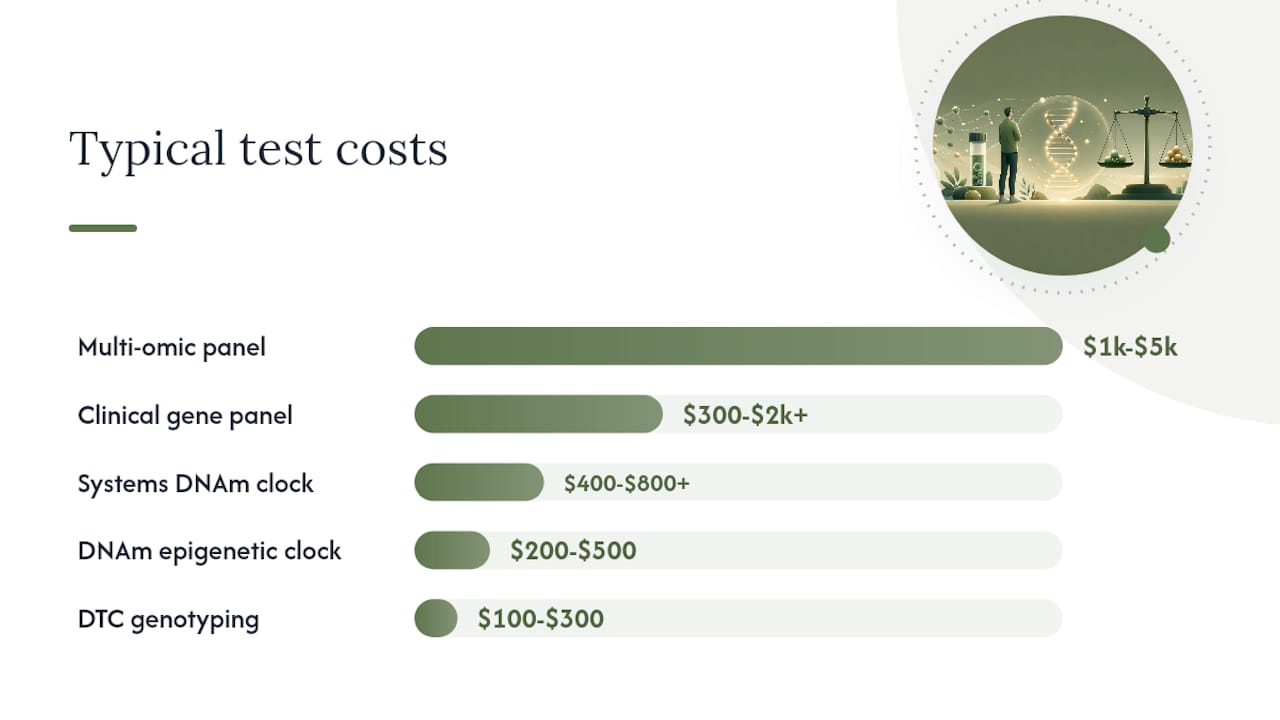
What do genetic and epigenetic tests typically cost, and how long do results take?
Prices vary widely depending on test type, whether a clinician is involved, and whether insurance covers the cost.
-
Clinical diagnostic gene panel: $300–$2,000+ out of pocket; often covered by insurance when ordered for a clinical indication (family history, symptoms). Turnaround: 2–4 weeks.
-
Proactive health screening panel: $250–$1,500; insurance coverage is inconsistent for asymptomatic screening. Turnaround: 2–3 weeks.
-
DTC genotyping: $100–$300; not typically covered by insurance. Turnaround: 3–6 weeks.
-
Polygenic risk score add-on: Often bundled with genotyping or clinical panels; standalone PRS reports range from $50–$200.
-
DNAm epigenetic clock (single global score): $200–$500; not typically covered by insurance. Turnaround: 2–4 weeks.
-
Systems-based DNAm clock (organ-level): $400–$800+; emerging category, limited insurance coverage. Turnaround: 2–4 weeks.
-
Telomere length assay: $100–$300; not typically covered. Turnaround: 1–3 weeks.
-
Multi-omic panel: $1,000–$5,000+; rarely covered; primarily available through specialized longevity clinics. Turnaround: 4–8 weeks.
Insurance is most likely to cover clinical gene panels ordered for a documented clinical indication. Diagnostic-grade tests ordered by a physician with appropriate documentation have the strongest coverage case. Bundling tests through a longevity clinic or integrated program like Healthspan Holistic’s 90 Day Journey to Longevity often reduces per-test cost compared to ordering each separately.
How do you vet a provider before ordering longevity genetic testing?
The quality of your results depends heavily on the lab and clinical infrastructure behind the test. Here is what to ask and what to watch for.
Provider checklist
-
Is the lab CLIA-certified and CAP-accredited? These are the minimum U.S. quality standards for clinical laboratory testing.
-
Does a licensed clinician or board-certified genetic counselor review results before they reach you?
-
Does the provider offer access to genetic counseling for high-risk findings?
-
What sequencing methodology do they use? Full gene sequencing catches more variants than genotyping arrays.
-
For PRS: what reference population was used to build the score, and does it match your ancestry?
-
How do they handle VUS findings? Do they re-contact patients when a VUS is reclassified?
-
What is their data-sharing policy? Can you opt out of research use?
Red flags
-
No clinician access or genetic counseling option
-
Results delivered as raw data only, with no clinical interpretation
-
Vague claims about “clinical-grade” testing without CLIA/CAP certification listed
-
Automatic enrollment in research data sharing without explicit consent
-
No process for variant reclassification or follow-up contact
Pro Tip: Ask the provider directly: “What is your process when a variant of uncertain significance gets reclassified?” A quality provider will have a documented re-contact protocol. A provider that cannot answer this question clearly is not set up to serve you well over time.
For a deeper look at how to choose lab testing as an adult over 45, Healthspan Holistic’s guide walks through the key criteria in plain language.
A note on using genetic data responsibly
Genetic data is one of the most powerful tools available for personalized health planning. It is also one of the most easily misread.
The most common mistake is treating a genetic risk finding as a fixed verdict. A BRCA variant does not mean cancer is inevitable. An accelerated epigenetic age does not mean your best years are behind you. What these findings do is sharpen your focus: they tell you where to look harder, what to monitor, and where lifestyle and medical interventions will have the greatest return.
The second mistake is using epigenetic clocks as a scoreboard rather than a compass. A biological age number is a snapshot of a dynamic process. Its value lies in tracking direction over time, not in the absolute figure on any single test day.
If your results show a high-penetrance pathogenic variant, please consult a board-certified genetic counselor before making any medical decisions. For epigenetic findings, use repeat monitoring as a tool to evaluate whether your interventions are working, not as a deterministic forecast of how long you will live. Genetic data is most powerful when it is one layer in a broader picture that includes longitudinal bloodwork, clinical oversight, and honest lifestyle assessment.
Ready to put your genetic data to work?

Healthspan Holistic gives adults over 40 a clear path from genetic and epigenetic testing to a personalized plan that actually moves the needle. Rather than a standalone report, you get clinical-grade testing integrated with advanced blood panels, AI-powered analytics, and one-on-one coaching, all designed to translate your data into concrete surveillance, supplementation, and lifestyle actions.
The 90 Day Journey to Longevity is the fastest way to start: testing, coaching, and a structured 90-day intervention plan in one program. Pair it with targeted lab panels like the Basic Heart Health Test or Metabolic Panel to build a complete molecular picture of where your body needs support.
1st Time Customers can take advantage of our BUY 1 GET 1 50% OFF special offer on all supplements.
Sources
The following primary sources informed this article. For clinical decisions, consult a board-certified genetic counselor or physician alongside peer-reviewed literature.
-
NEJM article on actionable genetic findings in population screening
-
Can this DNA test help predict your longevity? | Harvard Health
This article is general information, not a substitute for advice from a qualified doctor. Consult a qualified healthcare professional about your own circumstances before acting on anything here.
FAQ
What is the strongest genetic predictor of longevity?
No single gene determines lifespan. The APOE ε4 allele is one of the most studied variants for longevity risk (linked to Alzheimer’s and cardiovascular disease), but large-scale genomic studies confirm that genetic contributions to lifespan are distributed across many loci, which is why polygenic risk scores and epigenetic clocks are more informative than any single variant.
Is longevity inherited from the mother or father?
Both parents contribute. Mitochondrial DNA, which is maternally inherited, plays a role in cellular energy and aging, but the vast majority of longevity-related genetic variants are inherited from both parents through standard autosomal inheritance. Neither parent’s contribution dominates the overall picture.
What are the top biomarkers for longevity?
The most clinically informative longevity biomarkers include DNA methylation biological age (especially organ-system-specific scores), fasting insulin and glucose, high-sensitivity CRP, lipid particle size and number, and telomere length. Epigenetic clocks currently show the strongest association with mortality and functional decline in longitudinal research.
How accurate is genetic testing for predicting lifespan?
Genetic testing identifies risk, not destiny. Clinical gene panels are highly accurate for detecting pathogenic variants in specific genes, but no test predicts individual lifespan with precision. Epigenetic clocks correlate with mortality risk at a population level, and a one-SD increase in biological age slope is associated with 17–28% higher mortality risk, but these are probabilistic signals, not personal forecasts.
Does genetic testing for longevity require a doctor?
Clinical diagnostic gene panels and most proactive screening panels require or strongly benefit from physician or genetic counselor involvement. DTC genotyping and some epigenetic clock tests are consumer-accessible, but results from any test that could inform medical decisions should be reviewed with a qualified clinician before you act on them.
Leave a comment: