

A well-formulated Mediterranean keto approach can produce meaningful short-term weight loss and improve triglycerides, liver fat, and HbA1c, but it can also raise LDL cholesterol and cut fiber intake if you follow the stricter version too long. This works best for adults targeting fast metabolic gains, especially with fatty liver or high triglycerides, under medical supervision. Get baseline lipids and HbA1c first, then retest at 6 to 12 weeks before deciding whether to stay strict or shift to a moderate model.
TL;DR:
A stricter Mediterranean keto diet can significantly reduce triglycerides and liver fat but may raise LDL cholesterol and lower fiber intake, requiring careful monitoring.
Both MedKD and Med-Plus lower HbA1c and body weight similarly over 12 weeks, with MedKD offering quicker triglyceride and liver fat improvements.
Long-term adherence is generally easier with Med-Plus, which maintains more fiber-rich foods and moderate carb levels, making it suitable for sustained use.
Individuals with fatty liver, high triglycerides, or seeking rapid weight loss should consider MedKD under medical supervision, while those with elevated LDL or over 60 should prefer Med-Plus.
Baseline testing of lipids, HbA1c, and nutrient levels is crucial before starting, with retesting at 6 to 12 weeks to adjust diet based on individual health responses.
What Is the Mediterranean Keto Diet?
Two workable versions exist under the “Mediterranean keto” label, and mixing them up is where most people get confused about what results to expect.
The first is the well-formulated Mediterranean ketogenic diet, or MedKD: a low net carb intake, built around olive oil, fatty fish, eggs, nonstarchy vegetables, olives, and nuts. It’s ketogenic first, Mediterranean in its choice of fats and proteins second. The second is what we’ll call Med-Plus, a moderate low-carb Mediterranean pattern that stays under a moderate net carb intake daily. Med-Plus keeps legumes, whole fruit, and modest portions of intact grains, which classic Mediterranean eating has always leaned on.
The trade-off between the two comes down to what you’re willing to give up. MedKD’s stricter carb ceiling pushes out most legumes, grains, and higher-sugar fruits, which lowers fiber intake and raises the odds you’ll need to supplement magnesium, potassium, or vitamin D. Med-Plus keeps more of the fiber-rich, micronutrient-dense foods Mediterranean eating is known for, but may lead to slower or smaller shifts into ketosis.
Quick comparison:
-
Carb range: MedKD sits at 20 to 50 grams net carbs daily; Med-Plus runs 100 to 150 grams.
-
Fiber intake: MedKD tends to run low unless you’re deliberate about nonstarchy vegetables; Med-Plus retains legumes and fruit, so fiber generally remains higher.
-
Supplement need: MedKD more often calls for added magnesium, potassium, or omega-3 support; Med-Plus usually requires less supplementation.
-
Sustainability: Med-Plus is generally easier to maintain long-term; MedKD is better suited to defined, supervised periods.
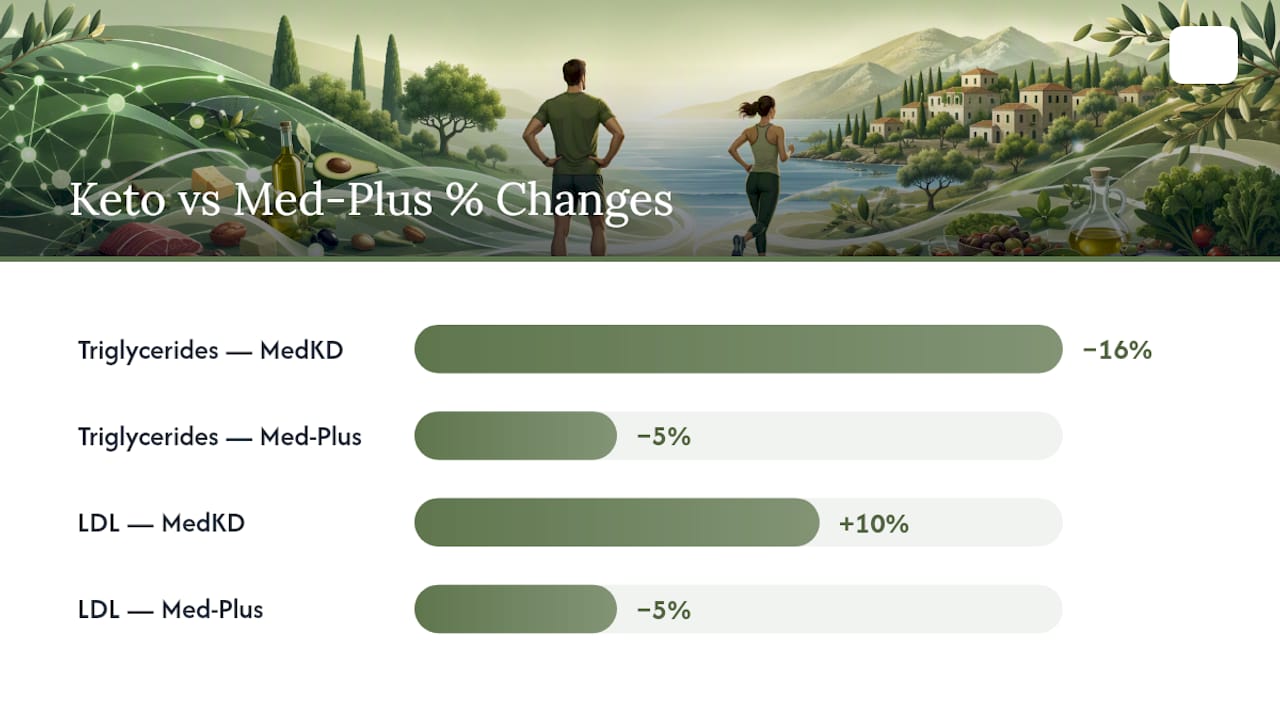
A key figure to know: in the Keto-Med randomized crossover trial, the well-formulated ketogenic diet cut triglycerides by 16% over 12 weeks compared to a 5% drop on the Mediterranean-plus pattern, but LDL rose 10% on keto versus a 5% decline on Med-Plus. That single data point captures the whole trade-off in miniature.
Does Mediterranean Keto Beat Standard Keto or Mediterranean Diets?
The honest answer is: it depends on which outcome you care about most, and the trial data backs that up cleanly rather than crowning one clear winner.
Start with glycemic control. In the Keto-Med trial, conducted in adults with prediabetes or type 2 diabetes, HbA1c improved by similar amounts on both the ketogenic diet and Med-Plus after 12 weeks. Neither diet had a clear edge on blood sugar control. That matters because it undercuts the idea that stricter carb restriction automatically means better glucose outcomes. Weight loss followed a similar pattern, with participants losing comparable proportions of body weight on both diets, a difference too small to call meaningful.
Where the diets actually diverged was lipids. The ketogenic group’s steeper triglyceride drop and LDL rise show up as a genuine fork in the road: good news if your triglycerides are the bigger problem, worse news if your LDL is already elevated or you have a family history of heart disease. Med-Plus participants also reported better overall nutrient intake and found the pattern easier to stick with, which lines up with what researchers at Stanford Medicine have said about long-term adherence: Mediterranean-style eating tends to be easier to maintain than very restrictive ketogenic diets, largely because it keeps legumes, fruit, and whole grains in play.
A separate prospective study looking specifically at a whole-food MedKD found it produced weight loss comparable to a very-low-calorie ketogenic diet, roughly 15% of starting body weight over three months, along with meaningful improvement in HOMA-IR, a standard marker of insulin resistance. That’s a strong signal that a food-based, Mediterranean-flavored ketogenic approach doesn’t sacrifice much compared to a more extreme medically supervised protocol, at least over a three-month window.
Then there’s the liver. Research summarized by Washington University School of Medicine indicates ketogenic diets can reduce liver triglyceride production, lower liver fat, and improve liver insulin sensitivity, benefits that go beyond simple weight loss. For anyone managing nonalcoholic fatty liver disease, this is one of the stronger arguments for choosing a stricter ketogenic phase over a moderate one, at least initially.
What the evidence actually supports:
-
Both diets lower HbA1c and body weight by similar amounts over 12 weeks when they share core habits like cutting added sugar and refined grains.
-
Ketogenic patterns tend to win on triglycerides and liver fat.
-
Mediterranean-plus patterns tend to win on LDL and long-term adherence.
-
A whole-food MedKD can match a VLCKD for short-term weight loss and insulin resistance improvement.
None of these findings come from large, multi-year trials. Sample sizes in this research space are modest, follow-up windows run 12 weeks to three months, and “keto” gets implemented differently from one study to the next, which limits how far you can generalize. Treat these numbers as a solid directional signal, not a verdict carved in stone.
Who Should Try Mediterranean Keto, and Who Shouldn’t?
Your goal should decide which version you pick, not the other way around.
If you’re dealing with fatty liver, significantly elevated triglycerides, or you want faster short-term weight loss and can commit to close monitoring, a stricter MedKD phase, run under medical or coaching supervision, gives you the biggest early wins. If your priority is long-term cardiovascular risk management, you already have elevated LDL, or you’re over 60 and want to protect nutrient intake and muscle mass, Med-Plus is the safer long-term home base.
Some people should skip both approaches, at least without direct clinical guidance. That includes anyone who is pregnant, has a history of disordered eating, has significant kidney disease, or takes medications (insulin, sulfonylureas, blood pressure drugs) that need close adjustment when carbohydrate intake changes fast. Poorly supervised carb restriction alongside diabetes medication is one of the more common ways people end up with dangerous blood sugar swings.
Before you start, run through this checklist:
-
What’s your baseline LDL and triglyceride level, and would a rise in one outweigh a drop in the other for your specific risk profile?
-
Are you on any medication that needs monitoring or adjustment as carb intake shifts?
-
Do you have the social or household support to sustain a stricter carb ceiling, or would Med-Plus fit your life better?
-
Are you willing to retest labs at 6 to 12 weeks and adjust based on what they show?
Pro Tip: If you’re on the fence between MedKD and Med-Plus, start with Med-Plus for two to three weeks. It’s a lower-risk way to see how your body responds to carb reduction before committing to a stricter ceiling.
For a deeper look at whether cutting carbs this far even makes sense for your age and activity level, this guide on carbohydrate needs for adults 45 to 75 is worth reading before you commit either way.
What Can You Eat on a Mediterranean Ketogenic Diet?
Building your plate is simpler than the carb math makes it sound. The core Mediterranean staples, olive oil, fatty fish, eggs, nuts, and olives, stay exactly where they were. What changes is how much room you have for starchy or sugary carbohydrates, and that room shrinks a lot if you’re running strict MedKD instead of Med-Plus.
Foods to build meals around:
-
Extra virgin olive oil, used generously as your primary fat.
-
Fatty fish like salmon, sardines, and mackerel, several times a week.
-
Eggs, in any preparation.
-
Leafy greens, cauliflower, zucchini, peppers, and other nonstarchy vegetables.
-
Olives, avocado, and nuts like almonds and walnuts.
-
Small portions of low-sugar berries if your carb budget allows.
-
Feta, goat cheese, and other Mediterranean cheeses in moderation.
Foods to limit or avoid, especially on strict MedKD:
-
Bread, pasta, rice, and other grains.
-
Most legumes (lentils, chickpeas, beans), which UC Davis Health notes are core to standard Mediterranean eating but need replacing on a keto version.
-
Starchy vegetables like potatoes and corn.
-
High-sugar fruit like bananas, grapes, and mangoes.
-
Added sugars in any form, including honey and most sauces.
Counting net carbs is simpler than it sounds: subtract fiber grams from total carbohydrate grams on the label or in your tracking app. Hitting a 20 to 50 gram MedKD target usually means one or two small portions of nonstarchy vegetables per meal and almost nothing else in the carb column. A 100 to 150 gram Med-Plus target gives you room for a serving of legumes at lunch, a piece of fruit, and a small portion of intact grain like farro or barley, alongside your usual vegetables and fats.
For your plate itself, put protein first, about a palm-sized portion of fish, eggs, or poultry, then build the rest around high-quality fat and a generous pile of nonstarchy vegetables. Simple swaps make this easier than it sounds: cauliflower rice instead of white rice, zucchini noodles (“zoodles”) instead of pasta, and roasted eggplant slices instead of bread for anything you’d normally scoop or dip.
Because you’re cutting legumes, whole grains, and higher-sugar fruit, watch four nutrients closely: magnesium, potassium, fiber, and vitamin D, along with omega-3 status if your fish intake is inconsistent. These are the deficits that show up most often when people restrict carbohydrates hard for weeks at a stretch, and they’re worth testing rather than guessing about.
Pro Tip: Magnesium and potassium are sometimes called the spark plugs of life for a reason. Without enough of them, you’ll feel the classic “keto flu,” fatigue, headaches, and muscle cramps, within the first week of cutting carbs hard.
What Does a Sample Mediterranean Keto Meal Plan Look Like?
A short plan makes the carb math concrete. Here’s three days built around strict MedKD, with a Med-Plus swap noted for each day.
Day 1: Scrambled eggs with spinach and feta (breakfast), grilled salmon with olive oil and arugula salad (lunch), roasted chicken thighs with sautéed zucchini and olives (dinner). Med-Plus swap: add a half-cup of lentils at lunch.
Day 2: Greek yogurt with a small handful of walnuts (breakfast), tuna salad with olive oil, cucumber, and feta (lunch), baked cod with roasted cauliflower and pesto (dinner). Med-Plus swap: add a small apple as a snack.
Day 3: Omelet with mushrooms and olives (breakfast), sardines over mixed greens with olive oil dressing (lunch), lamb kebabs with grilled peppers and tzatziki (dinner). Med-Plus swap: swap in a quarter-cup of cooked chickpeas at dinner.
For a full recipe, this Mediterranean salmon with roasted cauliflower, olives, and feta hits every note the diet is built on: omega-3s from the salmon, monounsaturated fat from the olives and olive oil, and enough fiber-equivalent bulk from the cauliflower to keep the meal satisfying without pushing net carbs high.
If you’re vegetarian, swap the fish for baked tofu or a two-egg omelet with the same vegetables and fat. Dairy-intolerant readers can drop the feta and add extra olives or avocado to keep the fat content similar.
When Should You Test Labs on Mediterranean Keto?
Testing before you start isn’t optional if you’re serious about doing this safely, since the lipid shifts on strict keto can move fast and in a direction you don’t want if you’re not tracking them.
Baseline panel, before you change anything:
-
Fasting lipid panel (LDL, HDL, triglycerides)
-
HbA1c and fasting glucose or insulin
-
Comprehensive metabolic panel for electrolytes, kidney, and liver function
-
Vitamin D, omega-3, and magnesium status
Retest at 6 to 12 weeks, then again at 3 to 6 months, since clinical trial protocols show lipid and glycemic markers shift quickly once ketogenic changes take hold, and medication doses sometimes need adjusting as a result.
| Health goal | Relevant Healthspan Holistic test |
|---|---|
| Overall metabolic baseline | Metabolic Panel |
| Cardiovascular risk tracking | Basic Heart Health Test |
| Nutrient adequacy on restricted carbs | Vitamin D, Omega 3, & Magnesium Test |
| Hormone status alongside weight change | Comprehensive Hormone Panel |
Contact a clinician promptly if LDL rises sharply from your baseline, you notice symptoms of low blood pressure (dizziness, lightheadedness on standing), or kidney or liver markers move outside normal range. Those aren’t signs to wait out. For anyone tracking insulin resistance alongside these changes, this breakdown of which insulin resistance tests matter is a useful next read.
How Do You Transition Off Strict Keto Without Losing Progress?
The gains you get from a few months of strict MedKD don’t have to disappear once you loosen the carb ceiling, as long as you reintroduce foods deliberately rather than all at once.
Add legumes back first, since they’re gentle on blood sugar and rich in fiber. Whole fruit comes next, and intact grains like barley or farro last, since they move your carb count the most. Keep added sugar and refined carbohydrates (white bread, pastries, sugary drinks) low throughout this process regardless of which phase you’re in.
Habits that make this stick:
-
Try carb cycling: a few stricter, lower-carb days each week paired with moderate Med-Plus days.
-
Build a standing list of two or three go-to meals for social occasions so eating out doesn’t derail your carb target.
-
Batch-cook Mediterranean staples (roasted vegetables, marinated proteins) on weekends to remove decision fatigue on weekdays.
Some people do best adopting Med-Plus permanently once they’ve hit their initial goal. Others prefer cycling back into strict MedKD periodically, especially if a lab retest shows triglycerides or liver markers creeping back up.
Pro Tip: Think of the transition like turning down a dimmer switch, not flipping it off. Gradual carb increases give your body time to adjust insulin response without the whiplash of going from 30 grams to 150 grams overnight.
How Healthspan Holistic Supports a Mediterranean Keto Plan
Healthspan Holistic offers lab testing, tracking, and coaching services designed to support dietary shifts like the one covered here.
Start with testing options like the Metabolic Panel and Basic Heart Health Test for your baseline, and consider nutrient assessments such as Vitamin D, Omega 3, & Magnesium. Coaching programs and curated supplement bundles are available to support nutritional transitions and common nutrient gaps associated with carb restriction.
1st Time Customers can take advantage of our BUY 1 GET 1 50% OFF special offer on all supplements.
Editorial Perspective: Why the Debate Misses the Point
The Mediterranean-versus-keto framing you see everywhere treats this like a competition with one winner. It isn’t. The Keto-Med trial makes that obvious: similar HbA1c improvement, similar weight loss, and a lipid trade-off that cuts in opposite directions depending on what you already have wrong with your numbers. Anyone who tells you one diet definitively “wins” hasn’t looked closely at the data.
What’s underrated is how much the two approaches actually share. Both diets in that trial worked partly because they cut added sugar and refined grains, full stop. That overlap explains more of the benefit than the carb ceiling itself does, and it’s the part conventional advice glosses over.
What you should prioritize first isn’t picking a camp. It’s getting your baseline lipids and HbA1c drawn, choosing the stricter or moderate model based on what those numbers actually say about your risk, and retesting on a schedule instead of guessing how you feel. The diet is a lever. The lab work tells you which direction to pull it.
— Chris
Ready to Build Your Mediterranean Keto Plan?
You’ve got the science and the food lists. What you probably don’t have yet is a clear picture of where your own lipids, glucose, and nutrient levels stand right now, and that’s the piece that actually determines whether MedKD or Med-Plus is the smarter starting point for you.

If rapid fat loss or liver health is the priority, start with the Metabolic Paneland the Basic Heart Health Test to see exactly where your triglycerides and LDL sit before you cut carbs. If you’re more focused on long-term cardiovascular risk or you suspect nutrient gaps, the Vitamin D, Omega 3, & Magnesium Test is the better first move.
Getting started is simple: order your test kit, get your blood drawn, and review your results with a Healthspan Holistic coach who helps you set a 12-week nutrition plan built around your actual numbers, not a generic template. For anyone ready to commit to a structured transition, our 90 Day Journey to Longevity program walks you through the whole process with built-in retesting checkpoints.
This article is general information, not a substitute for advice from a qualified doctor. Consult a qualified healthcare professional about your own circumstances before acting on anything here.
FAQ
What is the number one habit to break on the Mediterranean diet?
Overreliance on refined grains and added sugar, even within an otherwise Mediterranean-style pattern, undercuts the metabolic benefits both keto and Mediterranean research point to. Cutting those two categories first matters more than any other single change.
Can I eat Greek yogurt every day on keto?
Plain, full-fat Greek yogurt fits most Mediterranean keto plans in moderate portions, since it’s relatively low in carbs and high in protein and fat. Check the label carefully, since flavored varieties often carry hidden added sugar that can push you out of ketosis.
Can I lose 20 pounds in one month on keto?
A 20 pound loss in one month is aggressive and not typical; trial data shows more realistic short-term results, with one prospective study finding about 15% of body weight lost over three months on a whole-food Mediterranean ketogenic diet. Faster losses are usually water weight and level off as your body adjusts.
What carbs are okay on a Mediterranean diet?
Standard Mediterranean eating includes whole grains, legumes, and whole fruit as primary carbohydrate sources. On a Mediterranean keto or Med-Plus version, those get scaled back or swapped for nonstarchy vegetables, with small portions of legumes or fruit allowed under the moderate 100 to 150 gram net carb ceiling.
Leave a comment: