

Molecular hydrogen (H2) is the smallest molecule in existence, a colorless, odorless gas that acts as a selective antioxidant by neutralizing the most destructive reactive oxygen species (ROS) in your body without interfering with the beneficial ones your cells need to function. Unlike broad-spectrum antioxidants that can blunt normal cellular signaling, H2 specifically targets hydroxyl radicals and peroxynitrite, two of the most damaging free radicals linked to chronic disease and accelerated aging. Here is what the research shows about what it does for you:
-
Selective antioxidant action: H2 neutralizes hydroxyl radicals (•OH) and peroxynitrite (ONOO⁻) while leaving beneficial ROS intact for normal cell signaling.
-
Anti-inflammatory effects: It modulates pro-inflammatory cytokines and suppresses pathways like NF-κB, reducing chronic low-grade inflammation at the cellular level.
-
Deep tissue penetration: With a molecular weight of 2 Da and a kinetic diameter of 289 pm, H2 crosses the blood-brain barrier and reaches mitochondria, places most antioxidants simply cannot access.
-
Cellular homeostasis support: By influencing gene expression related to antioxidant enzymes, H2 helps your body strengthen its own internal defenses rather than just supplying an external fix.
-
Broad therapeutic potential: Clinical research has explored its role in cardiovascular health, metabolic function, neurological protection, and exercise recovery.
How molecular hydrogen works in your body
Understanding the biology behind H2 helps you appreciate why researchers are genuinely excited about it. Its mechanisms go well beyond simple free radical scavenging.
-
Selective ROS scavenging. H2 reacts with hydroxyl radicals and peroxynitrite, the most cytotoxic ROS, while sparing superoxide and hydrogen peroxide, which your cells use as signaling molecules. This selectivity is what sets it apart from vitamin C or vitamin E, which can disrupt beneficial redox signaling when taken in excess.
-
Upregulation of endogenous antioxidant enzymes. H2 modulates gene expression to increase production of your body’s own protective enzymes, including superoxide dismutase (SOD) and catalase. Rather than acting as a one-time scavenger, it primes your internal defense systems for sustained protection.
-
Suppression of pro-inflammatory pathways. H2 inhibits NF-κB and PI3K/AKT/mTOR signaling, two of the most studied inflammatory cascades in chronic disease. By dialing down these pathways, it reduces the production of inflammatory cytokines that drive conditions from metabolic syndrome to neurodegeneration.
-
Rapid diffusion into cells and the brain. Because H2 is nonpolar and extremely small, it penetrates cellular membranes and crosses the blood-brain barrier within minutes of administration. Conventional antioxidants like glutathione cannot cross this barrier efficiently, which is one reason H2 has attracted attention for neurological applications.
-
Mitochondrial protection. H2 reaches the mitochondrial matrix directly, where oxidative stress tends to be highest. Supporting mitochondrial health at this level has downstream effects on energy production, cellular repair, and longevity.
-
Anti-apoptotic and anti-allergic effects. Beyond antioxidant and anti-inflammatory activity, H2 has shown anti-apoptotic properties in models of gastric injury and neuropathic pain, and anti-allergic effects in immediate-type allergy models, suggesting a broader regulatory role in immune function.
These mechanisms work together rather than in isolation. The result is a molecule that influences multiple disease pathways simultaneously, which is part of why molecular hydrogen therapy has been studied across such a wide range of conditions.
What does the research actually show?
Clinical evidence for hydrogen-rich water and H2 therapy has grown steadily since the landmark 2007 Nature Medicine paper by Ohsawa et al. demonstrated selective hydroxyl radical scavenging in a rat model of cerebral ischemia. Here is a summary of where the human evidence stands today.

| Health Area | Key Finding | Evidence Level |
|---|---|---|
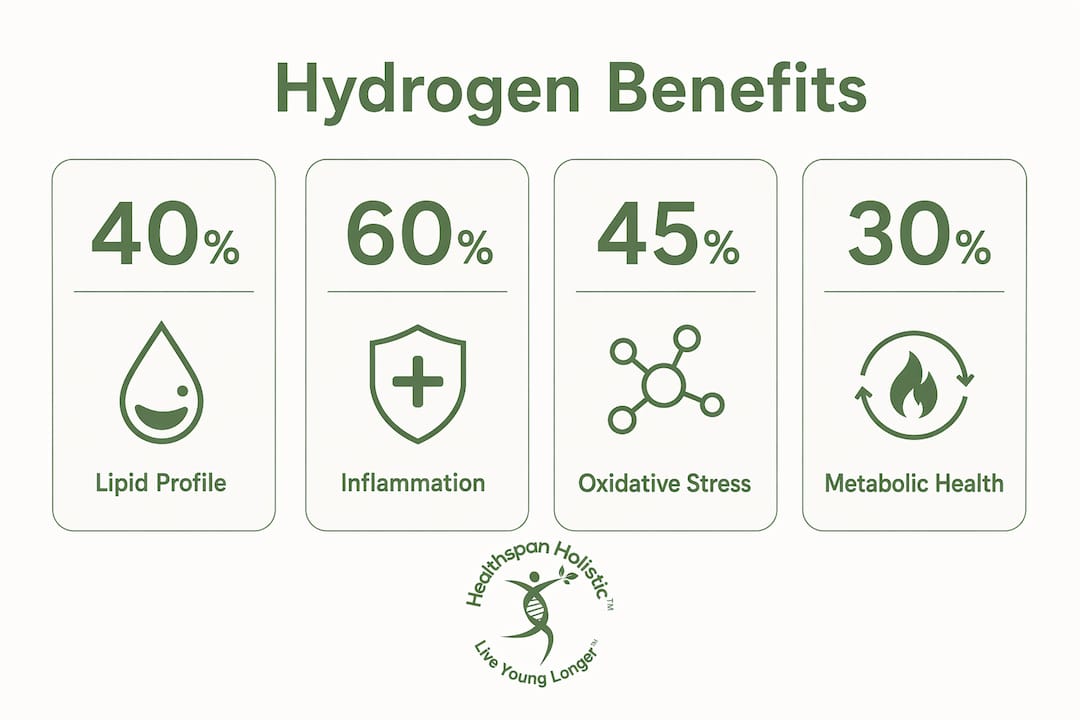
| Lipid profile | Meta-analysis of seven clinical trials found statistically significant improvements in total cholesterol and LDL cholesterol with hydrogen-rich water | Meta-analysis |
| Athletic performance | 1,500 ml of hydrogen-enriched water before exercise reduced blood lactate levels in 10 male soccer players vs. placebo | Randomized controlled trial |
| Oxidative stress markers | Hydrogen water consistently reduces markers of oxidative stress across multiple disease models | Multiple clinical trials |
| Neurological protection | H2 has shown protective effects in models of neurodegenerative disease, including Parkinson’s and Alzheimer’s | Preclinical and early clinical |
| Inflammatory bowel disease | Hydrogen-rich water and hydrogen-rich saline reduce intestinal inflammation and ROS in IBD models | Animal and early human studies |
| Safety profile | No toxic effects reported at typical supplementation doses across multiple human trials | Multiple human trials |
A few things stand out in this data. The lipid profile findings are particularly relevant for adults over 40, where cardiovascular risk tends to climb. The athletic performance data, while based on a small trial, aligns with what we see mechanistically: lower blood lactate means less exercise-induced oxidative stress and faster recovery. The safety record across all delivery methods is consistently clean, with no serious adverse events reported in clinical studies to date.
That said, researchers are clear that most trials are small and that larger, longer studies are needed before H2 therapy can be considered a first-line intervention. Think of the current evidence as a strong foundation, not a finished building.
How to consume molecular hydrogen safely
H2 can be delivered to your body in several ways, and the method you choose affects both how much reaches your tissues and how practical it is to maintain long term.
-
Hydrogen-rich water (HRW): The most common and accessible method. You drink water that has been infused with dissolved H2, either from a hydrogen water generator, a ready-to-drink canned product, or effervescent tablets. The main limitation is low water solubility at 1.57 mg/L, which means you would need to consume many liters daily to match the doses used in some clinical protocols. Tablets that dissolve directly in water tend to produce higher concentrations than most generators.
-
Molecular hydrogen tablets: Effervescent tablets dropped into water react to release H2 gas, often achieving concentrations above what standard generators produce. They are portable, shelf-stable when sealed, and easy to dose consistently. Dr. Mercola’s H2 Molecular Hydrogen tablets are a professional-grade option designed for this purpose.
-
Hydrogen gas inhalation: Inhalation delivers H2 directly to the lungs and bloodstream, achieving higher systemic concentrations than drinking HRW. The critical safety point: hydrogen gas becomes flammable above 4% concentration in air, so inhalation therapy must be conducted with medical-grade equipment in controlled settings. This is not a method to attempt at home with improvised devices.
-
Hydrogen-rich saline injections: Used primarily in clinical and research settings, intravenous or intraperitoneal H2-rich saline bypasses the solubility limitations of oral delivery entirely. Not a practical option outside of medical supervision.
-
Hydrogen baths: H2 can penetrate the skin, and hydrogen-rich water baths have shown systemic benefits in some studies. This is a lower-dose, non-ingestive option that works well as a complementary approach rather than a primary delivery method.
Dosage guidance: Clinical trials have used a wide range of doses and durations, from 7 days to over 60 days of daily consumption. No universal therapeutic dose has been established yet. For HRW, most protocols use 500–1,500 ml per day. For tablets, follow the manufacturer’s guidance and start conservatively.
Medication interactions: H2 has not shown significant interactions with common medications in clinical trials to date. However, because it modulates oxidative and inflammatory pathways, people taking immunosuppressants or anticoagulants should consult a healthcare provider before starting supplementation.

Pro Tip: Drink hydrogen-rich water on an empty stomach or immediately before exercise. H2 dissipates quickly once dissolved, so consuming it within minutes of preparation maximizes the dose you actually absorb.
Do you actually need molecular hydrogen in your diet?
Your body already produces H2 naturally. Gut bacteria ferment dietary fiber and produce hydrogen gas as a byproduct, and some of that H2 is absorbed into the bloodstream and tissues. This endogenous production is real and biologically meaningful.
Q: Does everyone produce enough H2 from gut bacteria? Not necessarily. Endogenous production varies widely based on your gut microbiome composition, fiber intake, and overall digestive health. People with dysbiosis, low-fiber diets, or compromised gut function may produce far less H2 than those with a diverse, fiber-rich microbiome.
Q: Can you boost endogenous H2 production through diet? Yes. Consuming prebiotic fibers, inulin, and lactulose promotes H2-producing bacteria in the gut. This is a natural, food-first strategy worth prioritizing before turning to supplements.
Q: Is molecular hydrogen an essential nutrient? No. H2 is not classified as an essential dietary nutrient, and no deficiency disease has been identified. Think of it as a supportive adjunct, something that may extend your body’s antioxidant capacity beyond what diet alone provides, particularly under conditions of high oxidative stress like intense exercise, illness, or aging.
Q: Who benefits most from supplementation? Adults over 40, people with metabolic or cardiovascular risk factors, and those with high physical training loads are the groups most represented in positive clinical findings. If your gut health is compromised, supplementation may also compensate for lower endogenous production.
The honest answer is that supplemental H2 is not essential for everyone. But for health-conscious adults looking to support cellular resilience and reduce oxidative burden, the evidence suggests it can be a worthwhile addition to a well-rounded wellness plan.
Insights from Healthspan Holistic: getting the most from H2 supplementation
At Healthspan Holistic, we work with adults who want to do more than just feel okay. They want to understand what is happening at the cellular level and make choices that actually move the needle on their healthspan. Molecular hydrogen fits naturally into that approach, but only when used thoughtfully.
Here is what we recommend for anyone considering H2 supplementation:
-
Pair it with baseline diagnostics. Oxidative stress and inflammatory markers vary widely between individuals. Running a comprehensive blood panel before starting H2 supplementation gives you a real baseline, so you can track whether your lipid profile, inflammatory markers, or energy levels actually shift over time.
-
Choose products with verified H2 concentration. Stability is the biggest quality issue in this category. H2 dissipates rapidly from open containers, and many products on the market deliver far less than their labels claim. Look for tablets in sealed, airtight packaging and products from brands that provide third-party testing data.
-
Stack it with complementary support. H2 works at the mitochondrial level, and pairing it with nutrients that support mitochondrial function amplifies the effect. Fulvic and humic acids are one example of a complementary supplement with overlapping metabolic benefits.
-
Be consistent, not sporadic. The clinical trials showing lipid and exercise benefits used daily protocols over weeks. A single dose here and there is unlikely to produce measurable results. Build it into a daily routine, ideally at the same time each day.
-
Treat it as adjunct therapy, not a cure. Current clinical evidence supports H2 as a supportive tool alongside established health strategies, not as a replacement for proven interventions like diet, exercise, and medication when indicated.
1st Time Customers can take advantage of our BUY 1 GET 1 50% OFF special offer on all supplements.
Dr. Mercola’s H2 Molecular Hydrogen tablets are formulated for consistent, high-concentration delivery in a convenient effervescent tablet. If you are ready to add H2 to your wellness routine, this is a practical, professional-grade place to start.
Key Takeaways
Molecular hydrogen is a selective antioxidant that neutralizes the most harmful free radicals, modulates inflammation at the gene-expression level, and reaches tissues, including the brain and mitochondria, that most antioxidants cannot access.
| Point | Details |
|---|---|
| Selective antioxidant action | H2 targets hydroxyl radicals and peroxynitrite without disrupting beneficial ROS needed for cell signaling. |
| Lipid and metabolic benefits | A meta-analysis of seven clinical trials found statistically significant improvements in total and LDL cholesterol with hydrogen-rich water. |
| Exercise recovery | Drinking hydrogen-enriched water before exercise reduced blood lactate levels in a controlled trial with soccer players. |
| Safety record | No toxic effects have been reported at typical supplementation doses across multiple human clinical trials. |
| Supplementation context | H2 is not an essential nutrient but serves as a supportive adjunct for adults with high oxidative stress or metabolic risk factors. |
FAQ
What does molecular hydrogen do for your body?
Molecular hydrogen acts as a selective antioxidant, neutralizing hydroxyl radicals and peroxynitrite while leaving beneficial reactive oxygen species intact. It also modulates inflammatory pathways and supports the body’s own antioxidant enzyme production.
What are the side effects of taking molecular hydrogen?
Clinical studies across multiple delivery methods have reported no toxic effects at typical supplementation doses. H2 has an excellent safety profile, though inhalation above 4% concentration in air carries flammability risks and requires controlled settings.
What should you not take with molecular hydrogen?
No significant drug interactions have been identified in clinical trials to date. People taking immunosuppressants or anticoagulants should consult a healthcare provider before starting H2 supplementation, as H2 modulates oxidative and inflammatory pathways.
When is the best time to take molecular hydrogen?
Drinking hydrogen-rich water immediately before exercise or on an empty stomach tends to maximize absorption, since H2 dissipates quickly once dissolved. Daily consistency over weeks, as used in clinical protocols, produces the most measurable results.
Leave a comment: