

TL;DR:
- Research peptides range from FDA-approved drugs with proven safety to experimental compounds lacking human efficacy data. While some peptides aid metabolic health and tissue repair, unregulated “Research Use Only” products pose significant safety and regulatory risks. Consulting a healthcare professional and verifying quality sources are essential for safe, informed peptide use.
Research peptides are short chains of amino acids that signal biological processes in the body, and they are now one of the most talked-about tools in health optimization for adults aged 30–60. The industry term is therapeutic peptides, though the phrase “research peptides wellness” has taken hold online as more people explore options beyond standard supplements. Some peptides, like GLP-1 analogs and insulin, are FDA-approved drugs with decades of clinical data behind them. Others, like BPC-157, epitalon, and GHK-Cu, are sold as research compounds with far less human evidence. Understanding that difference is the single most important thing you can do before exploring peptide therapy advantages for yourself.
What types of research peptides are used in wellness?
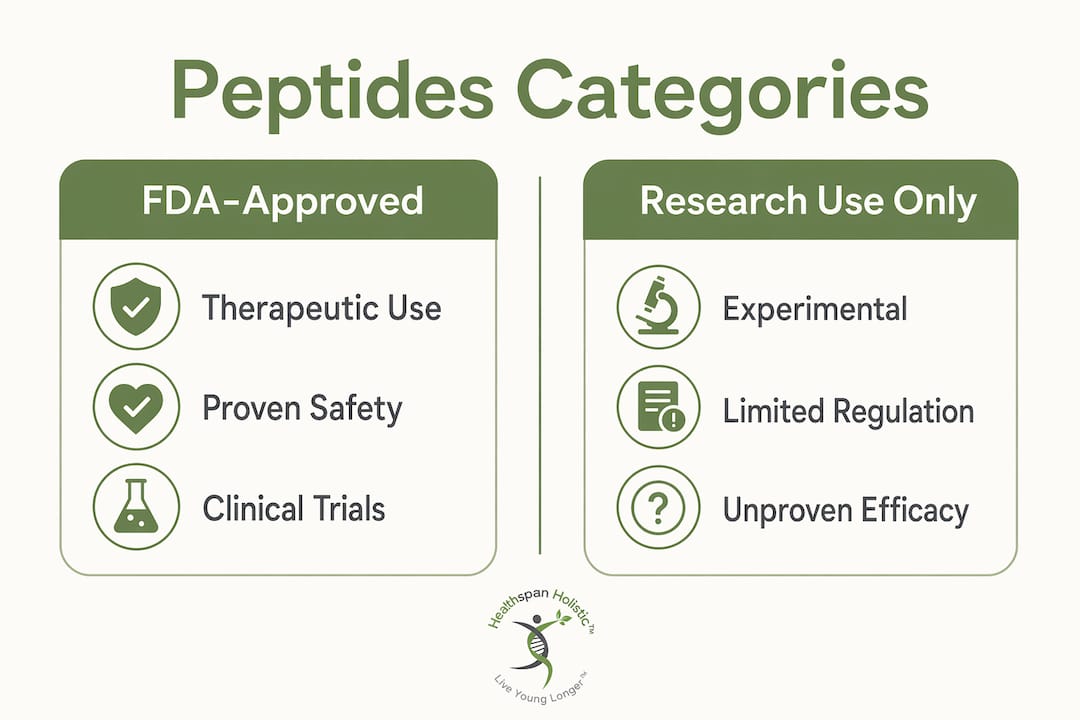
Peptides used in wellness fall into two clear categories, and confusing them is where most people go wrong.
FDA-Approved Therapeutic Peptides are rigorously tested drugs. GLP-1 analogs like tirzepatide and semaglutide have gone through large-scale human trials and carry manufacturing oversight that protects you from contamination and dosing errors. Insulin is another example. These peptides have proven metabolic effects and defined safety profiles. They are prescribed by physicians and dispensed through licensed pharmacies.
Experimental or Research-Use-Only Peptides are a different story. Products labeled “Research Use Only” (RUO) are not approved for human therapeutic use, regardless of how they are marketed. RUO labeling means the FDA has not evaluated the product for safety or efficacy in humans, and enforcement focuses on intended use and marketing rather than the label alone. This distinction matters enormously for your safety.
Here is a quick comparison of the most commonly discussed peptides in wellness circles:
| Peptide | Approval Status | Primary Proposed Use | Human Evidence Level |
|---|---|---|---|
| Tirzepatide | FDA-approved | Metabolic health, weight loss | Strong clinical trial data |
| Semaglutide | FDA-approved | Metabolic health, weight loss | Strong clinical trial data |
| BPC-157 | Not approved (RUO) | Tissue repair, gut health | Mostly animal studies |
| Epitalon | Not approved (RUO) | Longevity, anti-aging | Limited human data |
| GHK-Cu | Not approved (RUO) | Skin repair, wound healing | Early-stage human studies |
| Semax | Not approved (RUO) | Cognitive support | Limited human trials |
The categories that attract the most wellness interest include:
-
Metabolic and regulatory peptides: GLP-1 analogs that affect insulin secretion and appetite
-
Tissue repair peptides: BPC-157 and similar compounds proposed for recovery and gut lining repair
-
Neuroprotective peptides: Semax, studied for cognitive function and stress resilience
-
Hormonal modulators: Epitalon, proposed to influence melatonin and aging biomarkers
-
Skin and connective tissue peptides: GHK-Cu, used in topical formulations and studied for collagen synthesis
Understanding where each peptide sits on this spectrum helps you ask better questions when you speak with a clinician.
What does the science actually say about peptides for health?
The evidence base for peptides in wellness is genuinely uneven, and that unevenness deserves your full attention.

FDA-approved peptides have the strongest foundation. A review of 106 published articles confirmed promising treatment outcomes for metabolic and endocrine conditions using established therapeutic peptides, while also noting that newer peptides lack the human safety data needed for broad wellness use. That gap between “promising in a lab” and “proven in humans” is where most wellness peptides currently live.
For longevity-focused compounds, a Frontiers in Aging review identified nine peptides with diverse aging effects, including tirzepatide, epitalon, GHK-Cu, and BPC-157. The review also flagged that dosing protocols, long-term safety data, and reliable biomarkers for measuring outcomes remain undefined. That means even researchers do not yet agree on how much to use or how to measure whether it is working.
Animal studies do show real biological activity. BPC-157 accelerates tissue repair in rodent models. Epitalon extends lifespan in animal studies. GHK-Cu stimulates collagen production in cell cultures. The problem is that human dosing and long-term effects remain unknown even when animal studies suggest benefit. Translating animal findings to human wellness protocols is not a straight line.
One genuinely exciting development is in delivery technology. A 2026 study published in Nature Scientific Reports found that microneedle patch delivery achieved approximately 100% peptide release and produced measurable muscle improvements in aged mice. This matters because most peptides degrade quickly in the digestive system, making injection the current standard. Microneedle patches could eventually make peptide therapy more practical and accessible for everyday wellness use.
Pro Tip: If you read a study on a wellness peptide, check whether it was conducted in humans or animals. Animal results are a starting point, not a conclusion. Ask your doctor what the human trial data shows before making any decisions.
What are the risks and regulatory challenges?
The risks of using unapproved research peptides are real, and they deserve more attention than they typically get in wellness communities.
The American Medical Association flags several specific concerns about injectable peptide risks for consumers. These include injection site reactions, gastrointestinal distress, contamination from unregulated manufacturing, and dosing errors that can cause unintended hormonal or metabolic effects. Unlike FDA-approved drugs, unregulated peptides do not go through manufacturing oversight that catches these problems before they reach you.
DIY peptide use is widespread in the wellness community, but clinical research lags far behind the marketing claims. NPR’s reporting on the peptide trend found that dosing is often arbitrary, sourced from online forums rather than clinical protocols. That is a meaningful risk when you are injecting a compound that affects hormonal or tissue repair pathways.
The Guardian’s 2026 analysis of online wellness peptide products found wide regulatory, safety, and evidence gaps compared to FDA-approved treatments. The wellness peptide market is difficult to regulate because sellers use RUO labels as a legal shield while marketing products directly to health-conscious consumers.
Here is what you need to watch for before purchasing or using any research peptide:
-
Source verification: Only purchase from licensed compounding pharmacies or manufacturers with third-party testing certificates
-
Medical supervision: Work with a physician who can monitor bloodwork and adjust protocols
-
Realistic expectations: No unapproved peptide has proven human longevity benefits in controlled trials
-
Side effect awareness: Track any new symptoms, including changes in appetite, sleep, mood, or injection site reactions
-
Regulatory updates: The FDA’s stance on compounded peptides is evolving. Stay current with 2026 regulatory changes that may affect access and legality
Pro Tip: Ask any peptide supplier for a Certificate of Analysis (COA) from an independent lab. If they cannot provide one, do not buy from them. Purity and potency verification is non-negotiable.
How do you integrate peptides safely into a wellness routine?
If you are serious about exploring peptide therapy advantages, a structured approach protects you and improves your results. Here is a practical sequence to follow:
-
Start with a clinical consultation. Book an appointment with a physician who specializes in functional or integrative medicine. Bring your health history, current supplements, and specific wellness goals. Medical professionals consistently recommend clinician consultation before starting any injectable peptide protocol.
-
Get baseline lab work done. You cannot measure improvement without a starting point. A comprehensive hormone panel and a metabolic panel give your doctor the data needed to identify which peptides, if any, are appropriate for your biology.
-
Match the peptide to a specific, realistic goal. Peptides for health work best when they address a defined need. Tissue repair after injury, metabolic support, or cognitive function are all specific targets. Vague goals like “anti-aging” make it impossible to measure whether anything is working.
-
Start low and monitor closely. If your doctor approves a peptide protocol, begin with the lowest effective dose. Track symptoms weekly. Adjust only under medical supervision, not based on online forum recommendations.
-
Layer in lifestyle foundations. Peptides are not a replacement for nutrition, sleep, and exercise. They work best as part of a broader wellness strategy. Protein-rich, nutrient-dense eating supports the tissue repair pathways that peptides like BPC-157 are proposed to activate. Quality sleep amplifies the hormonal effects of peptides like epitalon.
-
Stay current on the evidence. The research on regenerative peptides for recovery is moving quickly. What is experimental today may have stronger human data within two years. Revisit the evidence every six months with your healthcare provider.
Key takeaways
Research peptides offer real potential for wellness and longevity, but the gap between FDA-approved drugs and experimental compounds requires informed, medically supervised decision-making.
| Point | Details |
|---|---|
| Two distinct categories exist | FDA-approved peptides have proven safety; RUO peptides lack human clinical validation. |
| Animal data is not human proof | Promising animal results for BPC-157 and epitalon do not confirm safe human dosing or outcomes. |
| Medical supervision is non-negotiable | Consult a physician and get baseline labs before starting any peptide protocol. |
| Source quality determines safety | Only use peptides from licensed compounding pharmacies with independent lab testing certificates. |
| Delivery technology is advancing | Microneedle patches may soon make peptide therapy more practical and accessible for wellness use. |
My honest assessment of the peptide wellness space
I have watched the peptide conversation shift dramatically over the past few years. What started as a niche topic in longevity circles is now all over social media, with influencers injecting compounds they sourced online and calling it biohacking. That concerns me, and I think it should concern you too.
The science on peptide therapy and vitality is genuinely promising in places. GLP-1 analogs have transformed metabolic medicine. The early data on tissue repair peptides is interesting. But “interesting” and “proven safe for you to inject at home” are not the same thing. The Nature analysis put it plainly: minimal human studies exist for most wellness peptides, and long-term data is simply not there yet.
What I tell people is this: the most effective wellness strategy is still the one with the deepest evidence base. Nutrition, sleep, resistance training, stress management, and targeted supplementation based on your actual lab results will outperform any unproven peptide protocol for most people. Peptides may become a meaningful add-on as the research matures. Right now, they are best explored cautiously, with a knowledgeable clinician, not a YouTube tutorial.
The delivery technology advances, especially microneedle patches, give me genuine optimism about where this field is heading. When we can deliver peptides reliably without injection, compliance improves and dosing becomes more precise. That is when the real human trials will follow.
— Chris
Take the next step with healthspan holistic
If you are ready to explore whether peptides or other wellness strategies belong in your health plan, Healthspan Holistic can help you start with the right foundation.
Our approach at Healthspan Holistic is to give you personalized guidance to restore your energy, reduce pain, and build a wellness strategy grounded in your actual biology, not guesswork. Checkout the oral spray, capsules, and skin care peptides that we currently carry. 1st Time Customers can take advantage of our BUY 1 GET 1 50% OFF special offer on all supplements. Start with the data. Build from there.
FAQ
What are research peptides, exactly?
Research peptides are short chains of amino acids that influence specific biological processes in the body, including metabolism, tissue repair, and hormone regulation. The industry term is therapeutic peptides, and they range from FDA-approved drugs to experimental compounds sold for research purposes only.
Are research peptides legal to buy?
Many research peptides are sold legally under “Research Use Only” labels, but this does not mean they are approved or safe for human use. The FDA evaluates intended use and marketing, not just labeling, so purchasing and using RUO peptides for personal wellness carries regulatory and health risk.
How do research peptides differ from regular supplements?
Peptides are biologically active compounds that signal specific cellular pathways, while most supplements provide nutrients the body uses passively. Peptides like GLP-1 analogs require a prescription; experimental peptides are injectable compounds with far more potent and less predictable effects than standard wellness supplements.
Which peptides have the strongest evidence for wellness?
FDA-approved GLP-1 analogs like tirzepatide and semaglutide have the strongest human clinical evidence for metabolic health. Experimental peptides like BPC-157, epitalon, and GHK-Cu show promise in animal and early-stage studies but lack the human trial data needed to confirm safety and efficacy.
Do i need a doctor to use research peptides?
Medical professionals consistently recommend consulting a clinician before using any injectable peptide. A physician can order baseline labs, identify contraindications, recommend appropriate sourcing, and monitor your response, all of which significantly reduce the risks associated with peptide use.
Leave a comment: