

TL;DR:
Thyroid hormone levels, especially T3 and T4, reveal how well your thyroid functions and influence energy and metabolism.
Standard lab ranges are broad, but many adults feel best with TSH between 1.0 and 2.5 mIU/L and higher free T3 levels within the reference range.
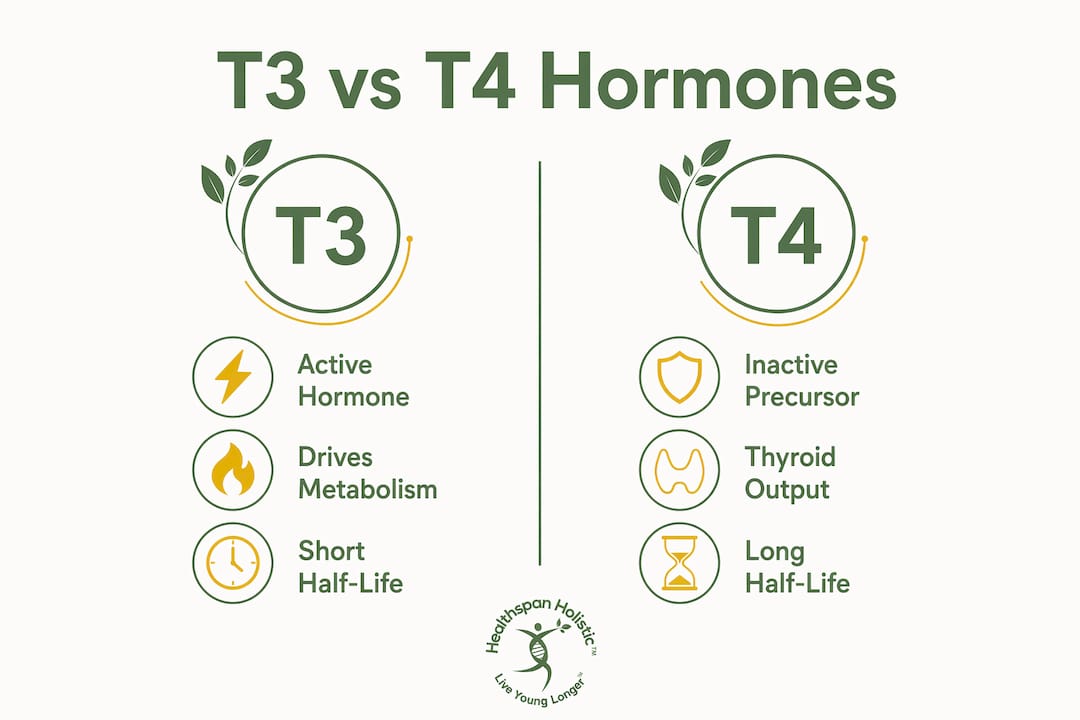
Thyroid hormone levels, specifically T3 (triiodothyronine) and T4 (thyroxine), are the two primary markers that reveal how well your thyroid gland is functioning. T4 is the storage hormone your thyroid produces in large quantities, while T3 is the biologically active form that actually drives your metabolism, energy, and body temperature. Standard laboratory reference ranges set Free T4 at 0.8–1.8 ng/dL and Free T3 at 2.3–4.2 pg/mL, with TSH at 0.4–4.5 mIU/L. The levels of T3 and T4 together tell a story that TSH alone simply cannot. Healthspan Holistic works with adults over 40 who want that full picture, not just a single number.
What are the normal and optimal levels of T3 and T4?
Standard lab reference ranges cover a wide population, and that width is exactly the problem for many adults. A result that lands inside the “normal” window can still leave you feeling exhausted, cold, and mentally foggy. Many patients feel best with TSH values between 1.0 and 2.5 mIU/L, well below the high-normal ceiling of 4.5 mIU/L. That gap matters enormously when you are trying to restore energy and mental clarity after 40.
Functional medicine practitioners take this further. They prioritize Free T3 in the upper half of the reference range and TSH in the lower half for symptom relief and peak metabolism. The table below shows how standard and functional target ranges compare, along with what you may feel at each extreme.
| Marker | Standard lab range | Functional target | Low-end symptoms | High-end symptoms |
|---|---|---|---|---|
| TSH | 0.4–4.5 mIU/L | 1.0–2.5 mIU/L | Fatigue, weight gain | Anxiety, rapid heartbeat |
| Free T4 | 0.8–1.8 ng/dL | 1.1–1.7 ng/dL | Cold sensitivity, hair loss | Heat intolerance, tremor |
| Free T3 | 2.3–4.2 pg/mL | 3.2–4.2 pg/mL | Brain fog, constipation | Insomnia, weight loss |
Age adds another layer of complexity. Thyroid hormone production naturally declines after 50, and the conversion of T4 to T3 becomes less efficient with age. A result that was fine at 45 may feel inadequate at 65.
Pro Tip: Ask your doctor to print your actual numbers, not just a “normal” or “abnormal” flag. Knowing where you land within the range is the only way to assess whether your levels are truly working for you.
How do T3 and T4 function in the body, and why measure both?
T4 is the thyroid’s primary output. It is largely inactive on its own, acting as a reserve that your body draws from as needed. T3 is the active hormone that enters cells and controls metabolism, body temperature, heart rate, and cellular energy production. Think of T4 as the fuel in the tank and T3 as the engine actually running.
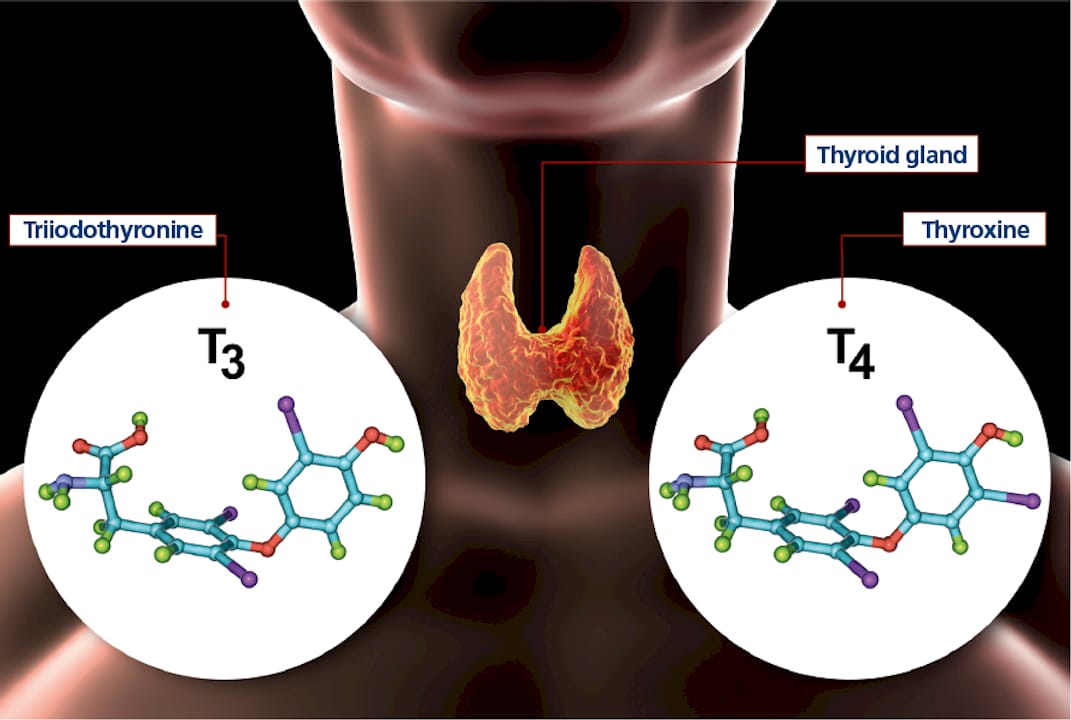
The conversion from T4 to T3 happens mainly outside the thyroid gland. Approximately 80% of circulating T3 comes from peripheral conversion in the liver, kidneys, and other tissues. That means your thyroid can be producing T4 perfectly, yet your cells still starve for active T3 if conversion is impaired.
This is why measuring both hormones matters so much:
-
TSH alone signals the brain’s demand but tells you nothing about actual hormone delivery to cells.
-
Free T4 shows how much storage hormone is available for conversion.
-
Free T3 reveals what your cells are actually receiving and using.
-
Low Free T3 with normal TSH and T4 is the classic sign of a conversion disorder that a basic panel will miss entirely.
-
T3 toxicosis presents with high Free T3, normal or low Free T4, and suppressed TSH, a pattern that requires all three markers to identify.
Pro Tip: If your TSH and T4 are normal but you still feel like you are running on empty, request a Free T3 test. Conversion disorders are far more common than most standard screenings reveal.
What factors affect T3 and T4 levels and their conversion?
T4-to-T3 conversion is not automatic. A range of internal and external factors can slow or block it, leaving you with adequate T4 but insufficient active T3. Chronic stress, selenium deficiency, inflammation, and gut dysbiosis are among the most common conversion blockers. Each one reduces the activity of deiodinase enzymes, which are the proteins responsible for stripping one iodine atom from T4 to create T3.
Protein-binding changes create a separate problem for test accuracy. Total T4 and T3 levels can be misleading when serum binding proteins shift due to pregnancy, estrogen therapy, or certain medications. Free hormone assays measure only the unbound, active fraction and give a far more accurate clinical picture.
Key factors that affect your thyroid hormone profile include:
-
Chronic stress: Elevated cortisol suppresses T4-to-T3 conversion and promotes the production of reverse T3, an inactive form.
-
Selenium deficiency: Selenium is a required cofactor for deiodinase enzymes. Low selenium directly reduces T3 production.
-
Systemic inflammation: Inflammatory cytokines impair conversion efficiency, which is why thyroid symptoms often worsen during illness or autoimmune flares.
-
Gut health: The gut converts a meaningful portion of T4 to T3. Dysbiosis or leaky gut reduces this contribution.
-
Autoimmune disease: Hashimoto’s thyroiditis destroys thyroid tissue over time, reducing T4 output. Graves’ disease drives excess hormone production.
-
Estrogen and medications: Oral contraceptives, hormone replacement therapy, and certain medications raise thyroid-binding globulin, inflating total hormone readings without changing free levels.
-
Age: Conversion efficiency declines with age, making Free T3 testing especially relevant for adults over 50.
Pro Tip: A comprehensive thyroid assessment should include selenium status, inflammatory markers like CRP, and gut health indicators alongside thyroid hormones. Treating the conversion problem often requires addressing these root causes, not just adjusting thyroid medication.
What symptoms come with abnormal T3 and T4 levels?
Symptoms are the reason most people seek thyroid testing in the first place. The pattern of which hormones are high or low points directly to the underlying condition. Recognizing these patterns helps you have a more informed conversation with your healthcare provider.
-
Low T3 and T4, high TSH (hypothyroidism): Fatigue, weight gain, cold sensitivity, hair thinning, constipation, slow heart rate, and depression. The brain is demanding more hormone because the supply is low.
-
High T3 and T4, low TSH (hyperthyroidism): Anxiety, unintentional weight loss, heat intolerance, rapid or irregular heartbeat, tremor, and insomnia. The brain suppresses TSH because hormone levels are already excessive.
-
Normal TSH and T4, low Free T3 (conversion disorder): Fatigue, brain fog, weight gain, and cold sensitivity that mirror hypothyroidism, yet standard tests return “normal.” This pattern is frequently overlooked without Free T3 testing.
-
High Free T3, normal or low Free T4, low TSH (T3 toxicosis): Hyperthyroid symptoms without elevated T4. T3 toxicosis requires all three markers to diagnose correctly and is missed when only TSH and T4 are ordered.
-
Fluctuating T3 and T4 with positive antibodies (Hashimoto’s or Graves’): Symptoms swing between hypothyroid and hyperthyroid states. Antibody testing (TPOAb, TgAb) confirms autoimmune involvement.
The table below summarizes the most common hormone patterns and their associated diagnoses.
| Hormone pattern | Likely diagnosis |
|---|---|
| High TSH, low Free T4, low Free T3 | Primary hypothyroidism |
| Low TSH, high Free T4, high Free T3 | Hyperthyroidism or Graves’ disease |
| Normal TSH, normal Free T4, low Free T3 | T4-to-T3 conversion disorder |
| Low TSH, normal Free T4, high Free T3 | T3 toxicosis |
| Fluctuating levels with positive TPOAb | Hashimoto’s thyroiditis |
Understanding your thyroid health and energy connection starts with recognizing which pattern fits your symptoms.
How are T3 and T4 levels tested and interpreted accurately?
The thyroid panel you order determines what you can and cannot see. A basic TSH-only test is a starting point, not a complete picture. An expanded panel adds Free T4 and Free T3. A comprehensive panel goes further by including autoimmune antibody testing with TPOAb and TgAb to assess Hashimoto’s or Graves’ disease. For adults over 40, the comprehensive panel is almost always the right choice.
Free hormone measurements are clinically superior to total hormone measurements. Total T4 and T3 levels are highly influenced by serum binding proteins and may misrepresent thyroid status, especially in pregnancy, estrogen therapy, or with certain medications. Free assays measure only the unbound, biologically active fraction.
A well-structured thyroid panel includes:
-
TSH: The brain’s demand signal, not a direct measure of hormone supply.
-
Free T4: Available storage hormone ready for conversion.
-
Free T3: Active hormone reaching your cells.
-
Reverse T3 (optional): Inactive form that competes with Free T3 at cell receptors.
-
TPOAb and TgAb: Autoimmune antibodies that identify Hashimoto’s or Graves’ disease.
When reviewing your T3 T4 blood test results, look at where each value falls within its range, not just whether it is flagged as normal or abnormal. A Free T3 at the bottom of the reference range and a TSH near 4.0 mIU/L can both be “normal” on paper while producing significant symptoms in practice.
Pro Tip: Request a comprehensive hormone panel that includes Free T3, Free T4, TSH, and antibodies. This single step gives you and your provider far more to work with than a TSH result alone.
Key Takeaways
Measuring both Free T3 and Free T4, not TSH alone, is the only reliable way to detect conversion disorders, autoimmune thyroid disease, and the full range of thyroid imbalances affecting adults over 40.
| Point | Details |
|---|---|
| Free T3 is the active hormone | Free T3 drives metabolism and energy; low levels cause symptoms even when TSH is normal. |
| 80% of T3 comes from conversion | Peripheral conversion of T4 to T3 can be blocked by stress, selenium deficiency, and inflammation. |
| Functional ranges are narrower | Many adults feel best with TSH between 1.0–2.5 mIU/L, not at the high-normal ceiling of 4.5 mIU/L. |
| Free assays beat total hormone tests | Total T3 and T4 are distorted by protein-binding changes; Free hormone tests give accurate results. |
| Comprehensive panels catch more | Adding TPOAb and TgAb to a standard panel identifies autoimmune thyroid disease that basic tests miss. |
Why I think most thyroid testing stops too soon
I have seen this pattern more times than I can count. Someone comes in with textbook hypothyroid symptoms: bone-deep fatigue, stubborn weight gain, hair falling out in the shower. Their TSH comes back at 3.8 mIU/L, which is technically “normal,” and they are sent home without answers. The problem is that TSH is the brain’s request, not the body’s delivery. It tells you the pituitary wants more thyroid hormone. It does not tell you whether the hormone is actually getting made, converted, or used.
What I have found is that the real story almost always lives in the Free T3 number. You can have a perfectly adequate T4 level and still have a Free T3 sitting at the bottom of the reference range because conversion is impaired. That person feels hypothyroid because, at the cellular level, they are. No amount of reassurance about a “normal” TSH changes that reality.
The other thing I push back on is the idea that reference ranges define optimal. They define average. They are built from population data that includes people who are sedentary, inflamed, and nutrient-depleted. If your goal is to feel genuinely well, not just statistically average, you need to look at where within the range your numbers fall. A Free T3 at 2.4 pg/mL is “normal.” A Free T3 at 3.8 pg/mL is also “normal.” Those two people will feel very different.
My practical advice: get the full panel, know your numbers, and advocate for a conversation about where you land within the range, not just whether you passed or failed.
— Chris
Healthspan Holistic thyroid testing for adults who want real answers
If you have read this far, you already know that a TSH result alone is not enough. Healthspan Holistic offers a Comprehensive Thyroid Panel that includes Free T3, Free T4, TSH, and autoimmune antibodies, giving you the complete thyroid picture that standard screening misses. For adults ready to take a deeper look at their overall health, the 90 Day Journey to Longevity integrates thyroid testing with personalized coaching and targeted supplementation.
Testing is straightforward, and results come with clear guidance on what your numbers mean for your energy, metabolism, and long-term wellness.
1st Time Customers can take advantage of our BUY 1 GET 1 50% OFF special offer on all supplements.
FAQ
What are normal T3 and T4 levels for adults?
Standard reference ranges are Free T3 at 2.3–4.2 pg/mL and Free T4 at 0.8–1.8 ng/dL, with TSH at 0.4–4.5 mIU/L. Many adults feel best when Free T3 is in the upper half of its range and TSH falls between 1.0 and 2.5 mIU/L.
Can TSH be normal while T3 or T4 is abnormal?
Yes. Normal TSH with low Free T3 is the hallmark of a T4-to-T3 conversion disorder, a condition that a TSH-only test will miss entirely. Free T3 testing is required to detect it.
What causes high T3 but low T4 symptoms?
T3 toxicosis is defined by elevated Free T3 with normal or low Free T4 and suppressed TSH. It produces hyperthyroid symptoms and requires all three markers to diagnose correctly.
What factors lower T3 levels even when T4 is adequate?
Chronic stress, selenium deficiency, systemic inflammation, and poor gut health all impair the peripheral conversion of T4 to T3. Addressing these root causes is often as important as any medication adjustment.
How do I maintain healthy T3 and T4 levels naturally?
Reducing chronic stress, correcting selenium and iodine deficiencies, managing inflammation, and supporting gut health all improve T4-to-T3 conversion. Regular testing with a comprehensive thyroid panel helps you track whether lifestyle changes are working.
Leave a comment: