

TL;DR:
- Taurine levels decline by about 80% from youth to old age, making supplementation a targeted strategy for aging adults. It provides measurable cardiovascular and metabolic health benefits, including reduced blood pressure, improved heart function, and better insulin sensitivity. Supplementing with 1.5 to 3 grams daily is effective and safe for most adults over 45 seeking to support healthy aging.
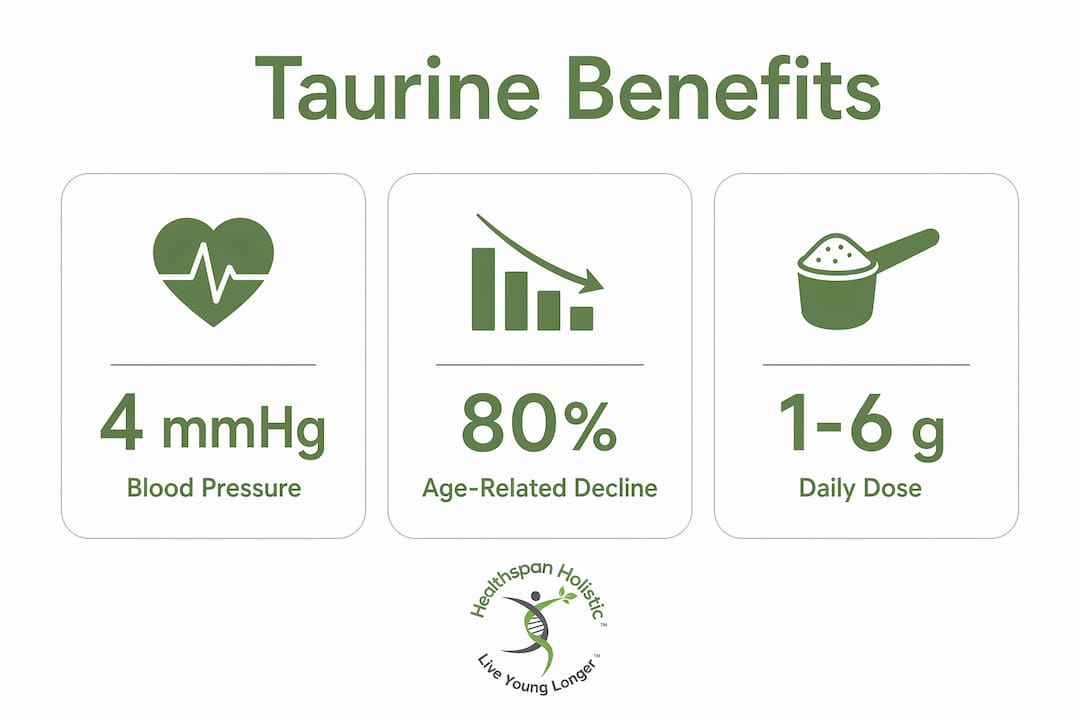
Taurine is defined as a sulfur-containing, non-protein amino acid that serves as one of the most abundant free amino acids in metabolically active tissues, including the heart, brain, skeletal muscle, and retina. For adults over 45, the taurine benefits that matter most are cardiovascular protection, restored energy metabolism, and reduced systemic inflammation. What makes taurine especially relevant to your age group is a striking biological fact: taurine declines by about 80% from youth to old age. That single statistic reframes taurine supplementation not as a trend, but as a targeted strategy to restore what your body has gradually lost.
What are the cardiovascular benefits of taurine?

Taurine delivers measurable, clinically documented improvements to heart health. A 2024 meta-analysis of 20 RCTs with 808 participants found that taurine supplementation reduced systolic blood pressure by 4 mmHg, diastolic blood pressure by 1.4 mmHg, and resting heart rate by 3.6 beats per minute. Left ventricular ejection fraction, a direct measure of how effectively your heart pumps blood, improved by 5 percentage points. That kind of multi-marker improvement from a single supplement is rare.
Taurine also reduces LDL oxidation and supports vascular elasticity, two factors that directly lower your risk of atherosclerosis. For adults already managing borderline blood pressure or mild cardiac concerns, these effects are clinically meaningful, not just statistical noise. The cardiovascular taurine health effects work through several mechanisms: improved calcium handling in heart muscle cells, reduced oxidative stress in arterial walls, and better regulation of electrolyte balance.
| Cardiovascular Marker | Effect of Taurine Supplementation |
|---|---|
| Systolic blood pressure | Reduced by 4 mmHg |
| Diastolic blood pressure | Reduced by 1.4 mmHg |
| Resting heart rate | Reduced by 3.6 bpm |
| Left ventricular ejection fraction | Improved by 5 percentage points |
| LDL oxidation | Significantly reduced |
Pro Tip: If you are already on blood pressure medication, discuss taurine supplementation with your physician before starting. The additive effect on blood pressure reduction can be significant.
How does taurine support metabolic health, energy, and aging?
Taurine acts on multiple metabolic pathways, including AMPK and PI3K/Akt, improving insulin sensitivity, lipid profiles, and mitochondrial function while lowering oxidative stress. This is not a single-target compound. It works more like a metabolic conductor, coordinating several systems at once. For adults over 45 who feel their energy fading or their waistline expanding despite reasonable effort, this multi-pathway action is exactly what the research supports.
Clinical evidence shows that taurine supplementation at 1.5 to 3 grams per day reduces fasting glucose, triglycerides, and liver enzyme elevations in people with metabolic syndrome. These are not minor improvements. Elevated triglycerides and liver enzymes are early warning signs of metabolic dysfunction that accelerate aging. Correcting them with a well-tolerated supplement is a practical win.
Here is where taurine’s role in aging becomes especially compelling:
-
Mitochondrial protection: Taurine reduces mitochondrial reactive oxygen species, the cellular “exhaust” that damages energy-producing structures over time. Healthy mitochondria are the foundation of sustained energy. You can read more about this connection at mitochondrial health and longevity.
-
Anti-inflammatory action: Taurine reduces NF-κB signaling and macrophage activation, directly addressing “inflammaging,” the low-grade chronic inflammation that drives most age-related decline.
-
Glucose regulation: By improving insulin receptor sensitivity, taurine helps your cells use glucose more efficiently, reducing the energy crashes and brain fog that many adults over 50 accept as normal.
-
Lipid balance: Taurine supports bile acid conjugation in the liver, improving fat digestion and cholesterol clearance.
The interplay between taurine and mitochondrial pathways makes it especially relevant for aging individuals seeking to maintain energy and cardiovascular health. Think of it as restoring the spark plugs of your cellular engine to their original efficiency.
Pro Tip: Pair taurine supplementation with a 20-minute walk after meals. Research shows the combination improves insulin sensitivity more than either approach alone, making your supplement work harder for you.
What are the safest and most effective taurine supplementation practices?
The standard supplementation range supported by clinical trials and longevity protocols is 1 to 6 grams per day. Most cardiovascular and metabolic benefits appear in the 1.5 to 3 gram range. Higher doses up to 6 grams have been used in specific research contexts, but they require medical supervision, particularly for individuals with kidney disease or those taking diuretics.
| Goal | Suggested Daily Dose | Notes |
|---|---|---|
| General wellness and energy | 1–2 g/day | Well tolerated, good starting point |
| Cardiovascular support | 2–3 g/day | Backed by RCT evidence |
| Metabolic syndrome management | 1.5–3 g/day | Combine with dietary changes |
| Athletic performance recovery | 2–4 g/day | Take pre or post workout |
| High-dose therapeutic use | Up to 6 g/day | Requires physician oversight |
Taurine supplementation is well tolerated with few reported side effects across the standard dosage range. That said, high-dose use in vulnerable populations must be carefully monitored. Supplementation is not a substitute for comprehensive medical care, especially if you are managing heart failure, diabetes, or chronic kidney disease.
Common supplement forms include:
-
Free-form taurine powder: The most bioavailable and cost-effective option. Mix into water or a protein shake.
-
Taurine capsules: Convenient for precise dosing, typically 500 mg to 1,000 mg per capsule.
-
Dietary sources: Shellfish, dark poultry meat, beef, and fish provide taurine naturally, though food sources alone rarely reach therapeutic doses.
For most adults over 45, starting at 1 gram twice daily with meals is a practical entry point. Adjust based on your response and any lab results from a metabolic panel that tracks glucose, lipids, and liver enzymes.
How does taurine compare to other longevity supplements?
Taurine uniquely targets multiple nodes of chronic inflammation and metabolic dysfunction, unlike many supplements that address only one pathway. This is its defining advantage over single-target compounds. Resveratrol, for example, primarily activates SIRT1 pathways. Berberine focuses on AMPK activation for glucose control. Alpha-lipoic acid targets oxidative stress. Taurine does all three, plus cardiovascular and mitochondrial support.
This does not mean taurine replaces other supplements. It means it fills a different role. Consider how taurine fits within a broader longevity supplement protocol:
-
Alongside CoQ10 or PQQ: Taurine’s mitochondrial protection complements CoQ10’s role in electron transport chain support.
-
With omega-3 fatty acids: Both reduce cardiovascular inflammation through different mechanisms, making them genuinely additive.
-
With magnesium: Taurine and magnesium both support cardiac rhythm and vascular tone. Together, they address electrolyte-dependent heart function from two angles.
-
With berberine: For adults managing blood sugar, taurine’s insulin-sensitizing effects work through different receptors than berberine, offering complementary glucose control.
Experts recommend viewing taurine as an adjunct to lifestyle and medical treatments, not a primary therapy. The most effective approach is always a personalized protocol that accounts for your specific lab values, health history, and lifestyle. You can explore how taurine fits within functional supplement strategies for vitality and longevity.
Key takeaways
Taurine’s most significant value for adults over 45 lies in its simultaneous support of cardiovascular function, metabolic resilience, and mitochondrial energy production, making it one of the most practical supplements for healthy aging.
| Point | Details |
|---|---|
| Cardiovascular protection | Taurine reduces blood pressure, heart rate, and LDL oxidation based on 20-RCT meta-analysis data. |
| Metabolic energy support | Doses of 1.5–3 g/day improve fasting glucose, triglycerides, and liver enzyme levels in metabolic syndrome. |
| Age-related decline | Taurine drops by about 80% from youth to old age, making supplementation a targeted restoration strategy. |
| Exercise synergy | Combining taurine with physical activity reduces insulin resistance more than either approach alone. |
| Safety profile | Taurine is well tolerated at 1–6 g/day; doses above 3 g/day warrant physician guidance. |
My honest perspective on taurine for adults over 45
I have reviewed a lot of supplement research over the years, and taurine stands out for one reason: the evidence is specific, not vague. Most longevity supplements come with animal studies and hopeful extrapolations. Taurine has 20 randomized controlled trials showing measurable cardiovascular improvements in real humans. That is a meaningful distinction.
What I find most compelling is the 80% decline in taurine levels with age. That is not a minor fluctuation. It is a near-total depletion of a compound your heart, brain, and muscles depend on. Restoring it to youthful ranges is not biohacking. It is basic physiological maintenance.
That said, I want to be direct about one thing: human interventional evidence on taurine for lifespan extension is still preliminary. The longevity headlines are getting ahead of the science. What we do have solid evidence for is healthspan improvement, specifically better heart function, improved metabolic markers, and reduced inflammation. For adults over 45, that is the goal anyway.
My practical advice is this: start with 1 gram twice daily, pair it with regular movement, and get a baseline metabolic panel before you begin. Track your fasting glucose, triglycerides, and blood pressure over 90 days. The data will tell you whether taurine is working for your specific biology. Supplements without measurement are just guesswork.
— Chris
How Healthspan Holistic can support your taurine wellness plan
Knowing taurine matters is one thing. Knowing whether your body actually needs it, and in what dose, is where personalized testing changes everything.
At Healthspan Holistic, we help adults over 45 move from guesswork to precision. Our cellular micronutrient test reveals how your body is actually absorbing and utilizing key compounds, giving you a real baseline before you start any supplement protocol. Pair that with our 90 Day Journey to Longevity program and you get a personalized plan that integrates taurine, exercise, and nutrition to restore your energy and protect your heart.
1st Time Customers can take advantage of our BUY 1 GET 1 50% OFF special offer on all supplements.
Start with the data. Build the plan. Feel the difference.
FAQ
What are the main taurine benefits for adults over 45?
Taurine supports cardiovascular health, metabolic function, and mitochondrial energy production. Clinical trials show it reduces blood pressure, improves heart pump efficiency, and lowers fasting glucose and triglycerides in adults with metabolic syndrome.
How much taurine should you take per day?
The clinically supported range is 1 to 6 grams per day, with most cardiovascular and metabolic benefits appearing at 1.5 to 3 grams daily. Doses above 3 grams per day are best taken under physician supervision.
Does taurine actually help with energy levels?
Yes. Taurine improves mitochondrial function and reduces oxidative stress in energy-producing cells, which translates to more sustained physical and mental energy. Its effect on insulin sensitivity also reduces the blood sugar swings that cause afternoon fatigue.
Is taurine safe to take long term?
Taurine is well tolerated with few reported side effects at standard doses of 1 to 6 grams per day. Long-term safety data is strong, though individuals with kidney disease or those on diuretics should consult a physician before supplementing.
Does taurine work better when combined with exercise?
Research confirms that taurine combined with exercise produces superior metabolic benefits compared to either alone, particularly for reducing insulin resistance. Even moderate daily movement amplifies taurine’s glucose and lipid benefits significantly.
Leave a comment: