

TL;DR:
- Integrative health combines conventional medicine with evidence-based complementary therapies to promote whole-person wellness. It focuses on root causes and long-term resilience, emphasizing patient-partner collaboration. Properly chosen therapies improve chronic conditions and support overall health for adults aged 45 to 75.
Integrative health is defined as a whole-person approach that combines conventional biomedical treatments with evidence-informed complementary therapies to address physical, emotional, mental, and spiritual wellness. Recognized by institutions like the Mayo Clinic, the World Health Organization, and the National Center for Integrative Medicine, this approach goes far beyond managing symptoms. If you are between 45 and 75 and feel like conventional healthcare keeps treating your lab numbers instead of you, understanding what is integrative health may be the turning point you have been looking for.
What is integrative health and how does it differ from conventional medicine?
Conventional medicine defines health as the absence of disease. Integrative medicine defines health as optimal balance and resilience of body, mind, and spirit. That single difference in definition changes everything about how care is delivered.
Conventional care is built around identifying a diagnosis and suppressing its symptoms. Integrative care asks a deeper set of questions: What made you vulnerable to this condition? What triggered it? What is keeping it going? This is the predisposed, precipitated, and perpetuating framework that integrative practitioners use to map the true drivers of chronic illness.
Here is what that looks like in practice. A 58-year-old woman with persistent fatigue might receive a thyroid prescription from a conventional doctor. An integrative practitioner would also assess her sleep quality, nutrient status, stress hormones, gut function, and emotional wellbeing before building a care plan. The goal is not just to get her numbers in range. The goal is to restore her energy and resilience.
The key philosophical differences are worth spelling out clearly:
-
Conventional medicine: Focuses on organs, diagnoses, and symptom suppression
-
Integrative medicine: Focuses on root causes, whole-person balance, and long-term resilience
-
Conventional medicine: Practitioner prescribes; patient receives
-
Integrative medicine: Practitioner and patient work as partners with shared goals
-
Conventional medicine: Health equals no disease
-
Integrative medicine: Health equals optimal function across body, mind, and spirit
Pro Tip: Ask your doctor not just “What do I have?” but “Why do I have it and what can we change?” That shift in questioning is the first step toward integrative thinking.
What therapies are used in integrative health care?
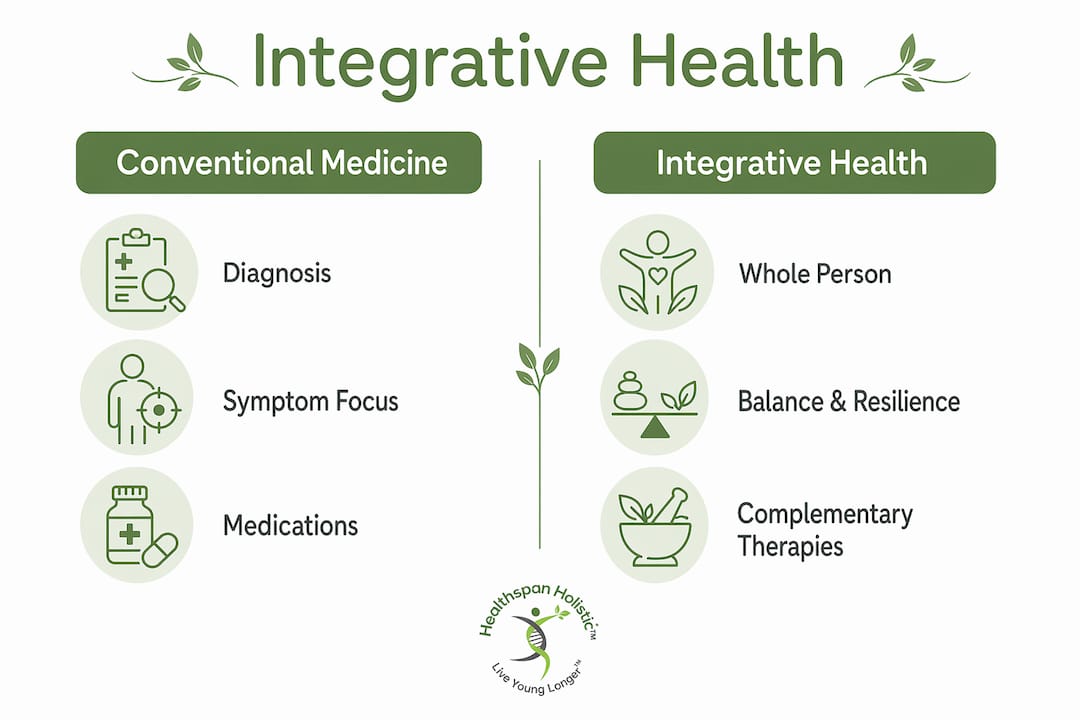
Integrative medicine incorporates therapies like mindfulness meditation, acupuncture, yoga, massage, and specialized nutrition to improve long-term quality of life and resilience. These are not fringe treatments. Many are now supported by clinical research and used in major hospital systems across the United States.
The most commonly used modalities include:
-
Acupuncture: Widely used for chronic pain, migraines, and chemotherapy-related nausea
-
Mindfulness-based stress reduction (MBSR): Developed at the University of Massachusetts, now used globally for anxiety, depression, and chronic pain
-
Therapeutic nutrition: Targeted dietary changes to reduce inflammation, support gut health, and restore energy
-
Yoga and movement therapy: Shown to improve flexibility, balance, and mood in adults over 50
-
Massage therapy: Used for musculoskeletal pain, fibromyalgia, and stress-related tension
-
Mind-body practices: Breathing exercises, guided imagery, and biofeedback for stress and sleep
These therapies work best when they are chosen based on your specific needs, not applied as a generic wellness menu. A good integrative practitioner will match the therapy to your biology, your history, and your goals.
Safety matters here. Not all complementary therapies are equally safe, and “natural” does not automatically mean effective or risk-free. Scientific evidence varies significantly across products and practices. This is why working with a qualified integrative clinician matters. They evaluate both the evidence and your individual health profile before recommending any therapy.
Here is a practical way to evaluate any complementary therapy before you try it:
-
Ask whether clinical trials support its use for your specific condition
-
Check for known interactions with any medications you take
-
Confirm the practitioner is licensed or certified in their specialty
-
Start with one change at a time so you can track what is working
-
Report everything to your primary care provider so your full care team stays informed
Pro Tip: The holistic therapies guide from Healthspan Holistic breaks down which modalities are most relevant for adults in the 45–75 age range, with practical guidance on getting started.
How does integrative health manage chronic conditions?
Chronic conditions are where integrative care truly shines. Pain, fatigue, cancer survivorship, cardiovascular disease, and metabolic disorders are all areas where conventional medicine often reaches its limits. Integrative care fills those gaps by addressing the layers that standard treatment misses.

Integrative practitioners assess health at multiple biological levels, from subcellular structures like mitochondria, to cellular immune function, to systemic nervous system regulation, all the way up to whole-person emotional and spiritual wellbeing. This systems-biology framework is more thorough than focusing on a single organ or symptom. It means your fatigue might be traced back to mitochondrial dysfunction, poor sleep architecture, chronic low-grade inflammation, and unresolved stress, all at once.
The table below shows how integrative care approaches common chronic conditions differently from conventional treatment:
| Condition | Conventional focus | Integrative additions |
|---|---|---|
| Chronic pain | Pain medication, surgery | Acupuncture, movement therapy, mindfulness, nutrition |
| Fatigue | Rule out thyroid, anemia | Mitochondrial support, sleep optimization, stress reduction, nutrient testing |
| Cancer survivorship | Monitoring for recurrence | Nutrition, exercise, emotional support, integrative oncology |
| Cardiovascular disease | Statins, blood pressure meds | Anti-inflammatory diet, stress management, targeted supplementation |
| Metabolic syndrome | Medication management | Dietary intervention, movement, gut health, hormone balance |
The integrative approach to chronic conditions follows a clear sequence. First, a thorough assessment identifies all contributing factors. Second, a personalized plan addresses those factors in priority order. Third, the patient commits to lifestyle and behavioral changes as core treatment pillars, not optional add-ons. Fourth, progress is tracked and the plan is adjusted over time.
Strengthening the body’s capacity for self-regulation is the long-term goal. This means building resilience so your body handles stress, infection, and aging more effectively. That is a fundamentally different outcome than simply keeping symptoms under control.
How can adults 45–75 start an integrative health approach?
Starting an integrative health approach does not require overhauling your life overnight. The most effective entry point is a thorough personal assessment that maps where you are right now across all dimensions of health.
Here is what a practical starting path looks like:
-
Find a qualified integrative practitioner. Look for board-certified integrative medicine physicians, naturopathic doctors, or functional medicine practitioners with verifiable credentials. The Academy of Integrative Health and Medicine and the Institute for Functional Medicine both maintain practitioner directories.
-
Get a baseline assessment. This includes standard labs plus deeper markers like inflammatory proteins, nutrient levels, hormone panels, and gut health indicators. You cannot personalize a plan without real data.
-
Build a multidisciplinary care team. Integrative care works best when your primary care doctor, nutritionist, mental health provider, and any specialists communicate with each other. Fragmented care undermines the whole-person approach.
-
Start with daily lifestyle practices. Mindfulness, nutrient-dense eating, consistent movement, and quality sleep are the foundation of any integrative plan. These are not supplementary. They are primary treatment.
-
Track your progress. Use a journal, a wearable device, or regular lab retesting to see what is shifting. Active patient participation is what separates integrative care from passive conventional treatment.
The holistic approach after 45 is not about rejecting your doctor. It is about expanding the conversation to include everything that affects your health, not just what shows up on a standard blood panel.
Integrative medicine has matured into a sophisticated discipline that respects biomedical science while addressing the care gaps that conventional medicine leaves open. You deserve care that meets you at that level.
Key takeaways
Integrative health is the most thorough approach to chronic disease management available to adults over 45 because it addresses root causes, not just symptoms, across every dimension of health.
| Point | Details |
|---|---|
| Definition matters | Integrative health treats the whole person, not just the diagnosis or the symptom. |
| Root cause focus | Practitioners ask what predisposed, triggered, and perpetuates your condition before building a plan. |
| Evidence-based therapies | Acupuncture, mindfulness, nutrition, and movement are clinically supported additions to conventional care. |
| Patient partnership | Success requires your active commitment to lifestyle and behavioral changes, not passive treatment. |
| Start with data | A thorough baseline assessment, including labs and lifestyle factors, is the foundation of any integrative plan. |
Why I believe integrative health is the most important shift in medicine right now
I have spent years watching people in their 50s and 60s cycle through specialist after specialist, collecting diagnoses but never feeling better. The frustration is real. You follow the prescriptions, you do the follow-ups, and yet the fatigue, the pain, and the sense that something is off never fully resolves.
What integrative medicine gets right is something deceptively simple: it treats you as a whole person, not a collection of malfunctioning parts. The moment a clinician starts asking about your sleep, your stress, your relationships, and your sense of purpose alongside your cholesterol numbers, the entire dynamic of care changes. You stop being a patient waiting for answers and start becoming a partner in your own recovery.
The biggest misconception I see is that integrative health means abandoning conventional medicine. It does not. It means using conventional medicine as one powerful tool within a broader, more personalized strategy. Statins have their place. So does acupuncture. So does a targeted nutrition plan built around your specific lab results.
The other pitfall worth naming is the assumption that all natural products are safe and effective. They are not. Scientific evidence varies significantly across supplements and therapies, and working with a qualified practitioner who evaluates the evidence is non-negotiable.
My honest encouragement to anyone in the 45–75 age range: do not wait until a crisis forces the conversation. Start asking bigger questions about your health now. The body has a remarkable capacity to restore balance when given the right conditions. Integrative care is how you create those conditions.
— Chris
How Healthspan Holistic supports your integrative health goals
If you are ready to move beyond symptom management and into a truly personalized approach to your health, Healthspan Holistic is built for exactly that.

Our 90 Day Journey to Longevity program is a one-on-one holistic health coaching program designed to help adults over 40 restore energy, reduce pain, and build long-term resilience. It combines advanced lab testing, including the Cellular Micronutrient Test and the Basic Heart Health Test, with personalized coaching to address the root causes of what is holding you back.
1st Time Customers can take advantage of our BUY 1 GET 1 50% OFF special offer on all supplements. Browse the full collection at Healthspan Holistic and find professional-grade support for cardiovascular health, mitochondrial function, hormone balance, and more.
FAQ
What is integrative health in simple terms?
Integrative health is a whole-person approach that combines conventional medical treatments with evidence-based complementary therapies like acupuncture, nutrition, and mindfulness. The goal is to address root causes of illness, not just manage symptoms.
How is integrative medicine different from alternative medicine?
Integrative medicine coordinates with conventional treatments rather than replacing them, while alternative medicine is used instead of conventional care. Integrative medicine requires scientific evidence to support the therapies it incorporates.
What chronic conditions benefit most from integrative health care?
Chronic pain, fatigue, cardiovascular disease, metabolic syndrome, and cancer survivorship all respond well to integrative care. These conditions involve multiple contributing factors that a whole-person, systems-based approach is uniquely equipped to address.
Do I need to leave my current doctor to pursue integrative health?
No. Integrative health works best when your conventional care team and integrative practitioners communicate and collaborate. The goal is to expand your care, not replace it.
How do I know if a complementary therapy is safe for me?
Work with a qualified integrative clinician who evaluates both the clinical evidence and your individual health profile. As the Mayo Clinic notes, “natural” does not automatically mean safe, and individual safety evaluation is a core part of responsible integrative practice.
Leave a comment: