

TL;DR:
- Many adults over 45 are at risk of vitamin D deficiency due to aging and lifestyle factors.
- Supplementation is recommended mainly for deficient or high-risk individuals, especially over 75.
- Testing blood levels first ensures safe, targeted supplement use to support bone, immune, and cellular health.
Vitamin D supplements line the shelves of almost every pharmacy and wellness store, and the message seems simple: take it, feel better, live longer. But the reality is more nuanced. Not every adult over 45 needs to supplement vitamin D, and taking it without knowing your actual levels can mean wasting money at best, or creating new health problems at worst. The latest guidelines from leading health institutions now make a clearer distinction between who genuinely benefits and who may not. This article breaks down the science, the risks, and the practical steps so you can make a truly informed decision for your health.
Key Takeaways
| Point | Details |
|---|---|
| Supplement if deficient or 75+ | Most adults 75 and older, or anyone with proven low vitamin D, benefit from daily supplementation. |
| Benefits are specific | Evidence supports fall, fracture, and some cancer mortality risk reduction mainly in deficient or high-risk individuals. |
| Dosing and safety matter | Stick with 1000-2000 IU daily, avoid excess, and combine vitamin D with K2 and calcium for optimal bone health. |
| Holistic strategies work best | Test your blood, optimize diet and sun, and use supplements thoughtfully—not automatically. |
Understanding vitamin D: function, sources, and deficiency risk
Vitamin D is often called the “sunshine vitamin,” and for good reason. Your skin produces it when exposed to ultraviolet B rays from sunlight. Yet food and supplements can also supply it, particularly through fatty fish, fortified dairy, eggs, and mushrooms. Most Americans, however, get far less sun than their ancestors did, and dietary sources alone rarely fill the gap.
This vitamin does far more than support bone health. It regulates calcium and phosphorus absorption, which directly affects bone density and the risk of fractures. It plays a central role in immune regulation, helping your body fight infections while keeping inflammation in check. It also supports muscle function, which becomes increasingly important as you age and fall risk rises. More recently, researchers have connected vitamin D levels to cell aging, finding that lower levels correlate with faster biological aging at the cellular level.
For adults over 45, several factors stack up to increase deficiency risk. Aging skin produces vitamin D less efficiently under sunlight. Spending more time indoors, living in northern latitudes, having darker skin tone, carrying excess body weight, and managing chronic illnesses like kidney disease or malabsorption disorders all suppress vitamin D status. Some common medications, including certain cholesterol drugs and steroids, also interfere with how your body processes it.
Up to 61% of older U.S. adults are vitamin D deficient, with roughly 50% of older adults globally falling short. That is a striking number, and it underlines the importance of blood testing rather than guessing.
Main risk factors for vitamin D deficiency in adults 45+:
- Age over 65 and reduced skin synthesis
- Limited sun exposure or use of sunscreen
- Darker skin pigmentation
- Obesity (vitamin D gets stored in fat tissue and becomes less available)
- Chronic kidney or liver disease
- Malabsorption conditions such as Crohn’s disease or celiac disease
- Use of medications like corticosteroids or anticonvulsants
- Living at high latitudes, especially during winter months
Should you supplement? Current guidelines for adults 45-75 and beyond
Now that you understand why vitamin D is important and who’s at risk, it’s worth asking when supplementation truly makes sense for you personally.

In 2024, the Endocrine Society released updated guidance that surprised many in the wellness world. Empiric supplementation is recommended for adults aged 75 and older, but not routinely for healthy adults under 75 who have no specific risk factors. This is a meaningful distinction. It shifts the conversation from “everyone should supplement” to “those who genuinely need it should supplement.”
For adults between 45 and 74, the guidance centers on targeted supplementation. If you are deficient based on a blood test, have multiple risk factors, or spend very little time outdoors, supplementation makes practical sense. If you eat a varied diet, get some sun regularly, and have no risk factors, the evidence for routine supplementation is less compelling.
| Age group | Deficiency present | Risk factors present | Routine supplement recommended |
|---|---|---|---|
| 45-74, healthy | No | No | Not routinely |
| 45-74, at-risk | No | Yes | Consider with testing |
| 45-74, deficient | Yes | Any | Yes, targeted |
| 75 and older | Any | Any | Yes, empiric |
Start by testing your vitamin D level with a 25(OH)D blood test, which is the most reliable measure of your status. If your level is below 20 ng/mL, you’re deficient. Between 20 and 29 ng/mL is considered insufficient by many clinicians.
Pro Tip: If you do supplement, choose 2000 IU vitamin D3 supplements taken with a fat-containing meal. Vitamin D is fat-soluble, meaning your body absorbs it far better alongside healthy fats like avocado, olive oil, or nuts.
Evidence-based benefits of vitamin D supplementation in adults 45+
Having explored when to supplement, it’s worth taking an honest look at what benefits you can realistically expect, and what the research says is overhyped.
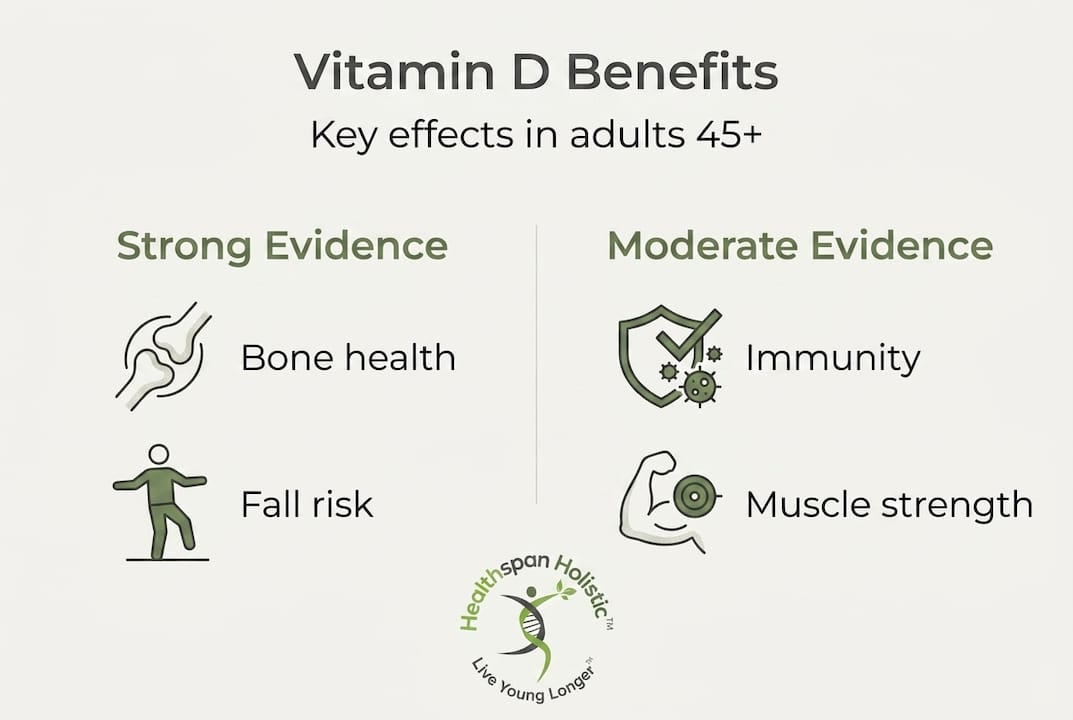
The strongest evidence centers on fall and fracture prevention in older or deficient adults. When vitamin D levels are restored in those who are truly low, muscle strength and balance improve, which directly reduces the risk of dangerous falls. This is one of the most consistent findings across clinical trials.
Cancer outcomes offer a more nuanced picture. A major Harvard-led analysis found that supplementation reduces cancer mortality in deficient adults, particularly for those who develop cancer, but it does not appear to reduce the overall incidence of cancer or cardiovascular events in generally healthy adults. That is an important distinction.
On the aging front, 2000 IU daily slowed telomere shortening in adults aged 50 and older. Telomeres are the protective caps on your DNA strands; shorter telomeres are associated with faster biological aging. This is promising for longevity-focused adults, though it remains an area of active research.
“Vitamin D supplementation in deficient older adults reduces falls, slows cellular aging, and provides some cancer mortality benefit, but does not appear to reduce cardiovascular disease or overall cancer incidence.” — Harvard Health, 2026
What the evidence actually supports:
- Reduced fall risk in deficient or elderly adults: Strong evidence
- Improved bone density when combined with calcium: Strong evidence
- Lower cancer mortality in deficient adults: Moderate evidence
- Slower biological aging (telomere data): Emerging evidence
- Preventing heart disease in healthy adults: Weak evidence
- Reducing overall cancer rates in non-deficient adults: Weak evidence
| Outcome | Evidence strength | Who benefits most |
|---|---|---|
| Falls and fractures | Strong | Deficient, elderly adults |
| Cancer mortality | Moderate | Deficient adults |
| Cellular aging | Emerging | Adults 50+ |
| Cardiovascular disease | Weak | Limited benefit seen |
| Overall cancer incidence | Weak | Minimal benefit in non-deficient |
Vitamin D also contributes to boosting your immune system when levels are adequate, and pairing it with vitamin D and K2 with calcium creates a more complete bone-protective strategy.
How to supplement safely: Choosing dose, timing, and avoiding pitfalls
You know the evidence-based benefits. Now here’s how to actually put that knowledge into practice without overstepping.
The upper safe daily intake for adults is 4000 IU per day. Consistently exceeding 4000 IU daily raises the risk of hypercalcemia (too much calcium in the blood), kidney stones, and paradoxically, increased fall risk. More is not better here. Most adults benefit from 1000 to 2000 IU daily, with higher amounts only under medical supervision.
Safe steps for starting vitamin D supplementation:
- Test first. Get a 25(OH)D blood test to know your baseline before choosing a dose.
- Choose the right form. Vitamin D3 (cholecalciferol) is the preferred form because your body uses it more efficiently than D2.
- Take it with food. Since vitamin D is fat-soluble, take it with your largest meal of the day to maximize absorption.
- Check for interactions. Talk with your doctor if you take thiazide diuretics, digoxin, or certain cholesterol medications, as vitamin D can interact with these.
- Retest after 3 months. Follow up with a blood test to confirm your levels have normalized and adjust your dose accordingly.
Common mistakes to avoid:
- Megadosing without a confirmed deficiency or medical guidance
- Taking large weekly or monthly bolus doses instead of daily consistent amounts
- Swallowing your supplement with water on an empty stomach
- Ignoring dietary sources like fatty fish, eggs, and fortified foods
- Forgetting to account for calcium and magnesium intake alongside D3
For those at risk of osteoporosis, combining calcium with D3 and K2 is the smartest approach. Research confirms that calcium and magnesium with D3 work together to protect bone structure and reduce fracture risk more effectively than vitamin D alone.
Pro Tip: Look for D3 2000 IU softgels that contain vitamin K2. K2 helps direct calcium into your bones rather than your arteries, making the combination significantly more protective for cardiovascular and skeletal health.
The real-world nuance: Why vitamin D isn’t a magic fix, and what most people miss
Here’s what we rarely say loudly enough: vitamin D has been one of the most overhyped supplements of the past two decades. Wellness media and social influencers have portrayed it as near-universal health insurance. The evidence simply does not back that up for most healthy adults under 75.
We’ve seen many people in their 50s and 60s taking 5000 IU daily without ever testing their levels, convinced it was protecting their heart, joints, and immune system against everything. When they finally do test, some are actually above optimal range, and at that point, supplementation adds risk rather than benefit.
The real benefit is targeted: it’s for those who are deficient, over 75, or carry specific risk factors. For everyone else, the priority should be the value of personal testing, eating a nutrient-dense diet, and building a complete picture with calcium, magnesium, and K2 alongside any vitamin D you take. That holistic view is what moves the needle on your actual healthspan.
Find vitamin D and holistic supplements that fit your needs
If today’s article helped you realize you might benefit from vitamin D support, we want to make your next step easy and effective.
Our store features professional-grade Vitamin D3 + K2 supplements designed to optimize absorption and bone protection together. If you need broader bone support, our calcium and D3 formula pairs essential minerals with the right cofactors. Before starting anything new, we always recommend consulting with a knowledgeable wellness professional. Explore our full supplement selection and find formulas built for adults who are serious about their healthspan.
Frequently asked questions
How much vitamin D should adults aged 45-75 take daily?
If you are deficient, 1000-2000 IU daily is safe and effective for most adults. Those over 75 may benefit from empiric supplementation, but it’s always wise to confirm with your doctor before adjusting your dose.
Can you get enough vitamin D without supplements?
Regular sun exposure and a diet rich in fortified foods can cover your needs in theory. In practice, up to 61% of older U.S. adults still develop deficiency, especially during winter or with limited time outdoors.
Is vitamin D toxic in high doses?
Yes. Consistently taking more than 4000 IU daily can cause elevated blood calcium, kidney stones, and other serious health risks, even without symptoms at first.
Does vitamin D really prevent chronic diseases like cancer or heart problems?
Vitamin D may lower cancer death risk in deficient adults who develop cancer, but it does not reduce the overall rate of cancer or cardiovascular disease in the general population.
Should you routinely test your vitamin D levels?
Routine screening isn’t necessary for everyone, but testing is valuable if you have risk factors, symptoms like fatigue or bone pain, or are considering starting supplementation.
Recommended
- How to boost your immune system: holistic steps that work | Healthspan Holistic
- Calcium with Vitamins D3 & K2 90 Capsules | Healthspan Holistic
- D3 5000 90 Softgels | Support Immune & Bone Health
- Why test your blood? Unlock wellness and longevity at any age | Healthspan Holistic
- Vitamin D Importance – Impact on Health and Fitness - Dietium
Leave a comment: