

A coronary calcium score (Agatston score) is a CT-derived number that shows calcified plaque buildup in your artery walls. A score of 0 signals very low short-term heart risk, while higher numbers point to more calcified plaque and often shift prevention choices, including whether to start a statin.
TL;DR:
- A coronary calcium score above 400 indicates extensive calcified plaque and often leads to more aggressive lipid management, regardless of symptoms.
- Scores of 0 or very low (1 to 10) suggest minimal immediate risk, and typically, lifestyle changes are enough, with follow-up testing considered every 3 to 7 years.
- The test is most valuable for intermediate-risk adults aged 40 to 75 when cholesterol levels alone do not clarify whether to start statins.
- The calcium score does not detect soft or non-calcified plaque and does not measure artery narrowing or blood flow restriction.
- Pairing the score with targeted lab testing and personalized coaching enhances prevention strategies beyond imaging alone.
What A Coronary Calcium Score Actually Measures
A coronary calcium score comes from a non-contrast CT scan of your heart. The scanner detects calcium deposits in the artery walls and calculates the Agatston score by multiplying the area of each calcified spot by its density. No dye, no needle. Just a picture that quantifies calcified plaque, which is calcium that has settled into artery walls over years of low-grade inflammation and cholesterol deposition.
The result lands somewhere on a well-established scale. Mayo Clinic outlines the standard bands clinicians use to interpret coronary artery calcification:
- 0: no detectable calcium
- 1 to 10: minimal calcified plaque
- 11 to 100: mild plaque burden
- 101 to 400: moderate plaque burden
- Above 400: extensive plaque, and scores can climb past 1,000 in advanced cases
Statistic Callout: A score above 400 places someone in a category that most cardiologists treat as extensive coronary artery calcification, often prompting more aggressive lipid management even without symptoms.
One thing this test does not do: it cannot see soft, non-calcified plaque or tell you how narrowed an artery actually is. It measures calcium, not blood flow.
Who Should Actually Get This Test
The coronary calcium score test isn’t for everyone, and that’s by design. It works best as a tiebreaker, not a routine checkup item.
- Best candidates: asymptomatic adults roughly 40 to 75 years old sitting in intermediate cardiovascular risk, where standard risk calculators leave the statin decision genuinely unclear
- Poor candidates: people already at very low risk (the test rarely changes anything for them) or very high risk (they usually need statin therapy regardless of the number)
- Skip it if: you already have diagnosed coronary artery disease or active chest pain. Those situations call for different tests entirely, not a calcium scan
The American Heart Association frames coronary calcium testing as most valuable exactly at that decision point, when a patient and clinician are weighing prevention options and need more data than cholesterol numbers alone provide. Family history, diabetes, and younger age all change how a given score should be read too. A moderate score in someone in their 40s often carries more weight than the same score in someone in their 70s, since some calcification becomes more common with age regardless of risk.
How To Read Your Score And What Happens Next
Numbers on a page mean little without context, so here’s how the bands typically translate into action.
- Score of 0: strong reassurance for the next several years; usually lifestyle-focused prevention, no medication needed yet
- 1 to 10: minimal plaque; lifestyle remains the priority, statin conversation stays open
- 11 to 100: mild plaque; many clinicians start discussing statin therapy here, especially with other risk factors present
- 101 to 400: moderate plaque; statin therapy is commonly recommended
- Above 400: extensive plaque; often prompts high-intensity statin therapy and closer monitoring
Statistic Callout: Mayo Clinic notes that percentile ranking by age, sex, and ethnicity adds a second layer of interpretation. Someone scoring above the 75th percentile for their demographic is often flagged as higher risk even when the raw number looks unremarkable on its own.
That percentile piece matters most for younger patients. A score of 50 might sound modest, but if it puts a 45-year-old in the top quarter of their age group, that context can move the needle toward earlier treatment rather than a wait and see approach.
What Happens During The Scan
The logistics are refreshingly simple compared to most cardiac testing.
- No special prep required. You typically don’t need to fast or adjust medications beforehand.
- The scan itself takes just a few minutes. You lie still while the CT machine captures images of your heart.
- No contrast dye and low radiation exposure. Cleveland Clinic confirms this is a noninvasive, low-dose test with a total visit time around 10 to 15 minutes.
- Bring your medication list and any recent lipid panel results. This helps your provider interpret the score in context rather than in isolation.
- Results typically return within a few days, often reviewed alongside your existing risk factors during a follow-up conversation.
You resume normal activity immediately afterward. There’s no recovery period to plan around.
How A Calcium Score Changes Treatment Decisions
This is where the coronary calcium score earns its clinical weight. It’s not just a number for your records. It actively shapes what your doctor recommends next.
- Clarifying the statin decision: for someone in intermediate risk territory, a score of 0 might support holding off on medication, while a score of 150 often tips the conversation toward starting therapy
- Escalating existing treatment: patients already on a moderate statin dose with an extensive score may see their clinician push toward high-intensity therapy or add additional lipid-lowering medication
- Triggering further testing: very high scores sometimes prompt stress testing or CT angiography to check whether narrowing has become significant
The American Heart Association describes coronary calcium scoring as a complement to the ACC/AHA pooled cohort risk calculators, not a replacement. It fills in a gap those formulas can’t close on their own.
Pro Tip: If your score comes back at 0, ask your doctor when a repeat scan actually makes sense. Cleveland Clinic points to a 3 to 7 year window for many zero-score patients, though once you’re already on high-intensity treatment, repeating the scan rarely changes anything.
What The Score Doesn’t Tell You
A coronary calcium score is powerful, but it has real blind spots that deserve equal attention.
- It doesn’t see soft plaque. RSNA points out that the test detects calcified deposits only, missing the non-calcified plaque that can also trigger cardiac events.
- It doesn’t measure stenosis. A high score tells you plaque exists; it doesn’t tell you how narrow the artery has become. That requires a different test, like CT angiography.
- It’s not built for acute symptoms. If you’re having chest pain right now, this is not the test your emergency room reaches for.
- A zero score isn’t a free pass. Smoking, uncontrolled blood pressure, and poor lipid numbers still matter even with reassuring imaging.
Next steps depend heavily on where your number lands: a 0 or minimal score usually means sticking with lifestyle habits and rechecking lipids periodically, while a moderate or extensive score usually means a direct conversation about medication, along with advanced lipid testing to see exactly which particles are driving your risk.
How Healthspan Holistic Fits Into A CAC-Informed Plan
A calcium score tells you where you stand on artery calcification. It doesn’t tell you why your cholesterol is behaving the way it is, whether inflammation is running hot, or whether a micronutrient gap is quietly working against your heart. That’s where targeted lab work fills the gap.
- Blood panels covering lipids, inflammation markers, and micronutrient status help explain what’s driving a moderate or high score
- Healthspan Holistic’s Basic Heart Health Test and Vitamin D, Omega 3, & Magnesium Test build a fuller picture alongside your CAC result
- A Cellular Micronutrient Test can flag deficiencies that quietly undercut cardiovascular resilience
- Personalized coaching can translate lab and imaging data into a nutrition and lifestyle plan that can be followed
Statistic Callout: A calcium score of zero still carries strong predictive value for up to a decade or more in many patients, but that window is exactly when targeted lab tracking pays off most.
Does A High Score Cause Anxiety, And Is That A Problem?
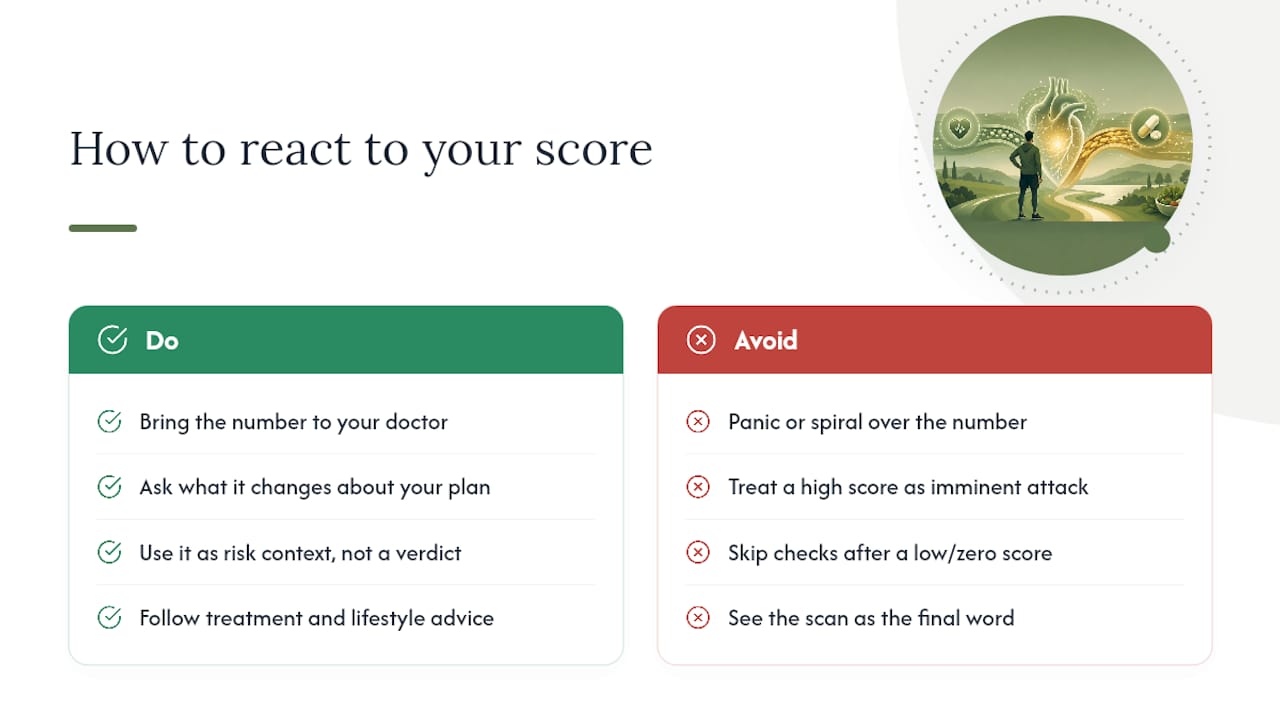
Getting handed a number that supposedly quantifies your risk of a heart attack is unsettling, and pretending otherwise does readers a disservice. A moderate or extensive score can trigger genuine worry, sometimes disproportionate to the actual near-term risk the number represents.
Here’s the nuance that gets lost in most explainer articles: a high coronary calcium score is a prognostic flag, not a diagnosis of impending disease. It tells your clinician where to focus prevention efforts. It does not mean a heart attack is imminent, and it rarely means you need an invasive procedure right away. Most elevated scores lead to a statin conversation and lifestyle adjustments, not a trip to the cath lab.
That distinction matters for how you process the result emotionally. Patients who understand the score’s actual function, a risk-refinement tool rather than a verdict, tend to handle the news with less spiraling and more constructive follow-through on treatment recommendations. The opposite pattern shows up too: some people fixate on a low or zero score as permanent immunity, which can lead to skipping cholesterol checks or ignoring blood pressure creep because “the scan said I was fine.”
The healthiest response to either extreme is the same one: bring the number to your doctor, ask what it changes about your specific plan, and resist treating a single scan as the final word on your cardiovascular future. Context, not the raw number alone, is what should shape how you feel about it.
What Major Health Organizations Recommend
The guidance on coronary calcium scoring has matured considerably, and the major bodies now largely agree on where it fits.
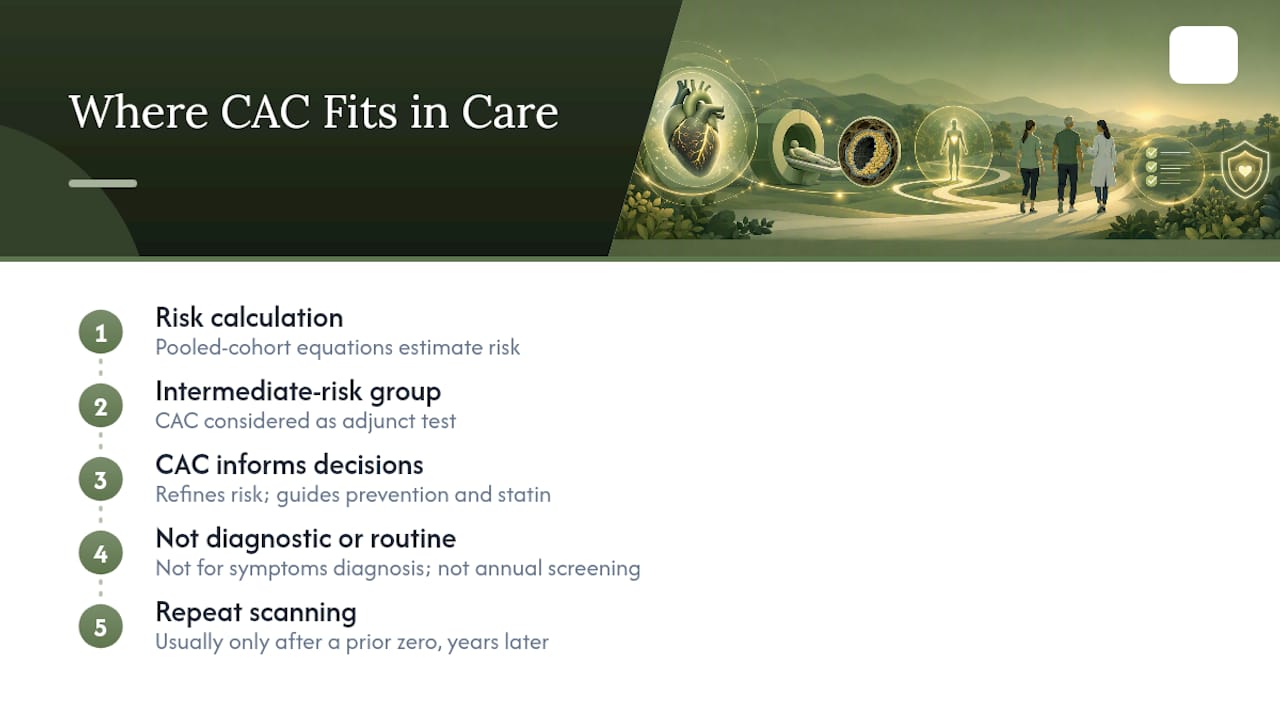
The American Heart Association positions coronary artery calcium testing as a tool for people in the intermediate risk category, where the standard pooled cohort equations don’t give a confident enough answer about statin therapy. It’s explicitly framed as an adjunct to existing risk calculators, not a replacement for them, according to the American Heart Association.
Cleveland Clinic and Mayo Clinic both echo this intermediate-risk framing in their patient guidance, while adding practical detail on frequency: testing is not recommended as an annual screening tool, and repeat scans are typically reserved for patients with a prior score of zero who are being reassessed years later, according to Cleveland Clinic.
RSNA’s clinical commentary reinforces the same message from the imaging side: coronary calcium scoring is prognostic, meant to refine future risk estimates, not diagnostic imaging meant to replace stress testing or angiography when symptoms are present, per RSNA. None of the major organizations recommend universal screening for low-risk, asymptomatic adults. The consensus holds firm: this test earns its value at a specific decision point, for a specific group of people, not as a blanket wellness checkup.
A Practical Read On Where This Test Actually Helps
Most explainers treat the coronary calcium score like a report card. It isn’t. It’s closer to a compass reading that only makes sense once you already know roughly where you’re standing.
Here’s what the conventional advice tends to underplay: the test’s real value shows up in the messy middle, not at the extremes. If you’re already low risk or already on high-intensity statins for known disease, this scan probably won’t change your plan much. Its power is concentrated in that intermediate-risk group where a clinician genuinely doesn’t know whether to recommend a statin. That’s a narrower use case than most marketing around heart scans suggests.
What gets underestimated is how much the score depends on what you do with it. A moderate score paired with no follow-up bloodwork and no lifestyle change is just a number sitting in a chart. Paired with targeted lab testing, that same score becomes a genuine roadmap. If you get one thing right, make it this: treat the scan as the start of a conversation about your lipids, your inflammation markers, and your daily heart health supplement routine, not the end of one.
— Chris
Your Next Step After A Calcium Score Result
Whatever your coronary calcium score comes back showing, the smartest move is pairing it with lab work that explains the “why” behind the number. Healthspan Holistic’s Basic Heart Health Test checks the lipid and inflammation markers most closely tied to calcified plaque, while the Vitamin D, Omega 3, & Magnesium Test flags nutrient gaps that quietly influence cardiovascular resilience. If you want a fuller picture of where your risk stands and what’s driving it, the Cellular Micronutrient Test adds another layer clinicians rarely check during a standard physical.

1st Time Customers can take advantage of our BUY 1 GET 1 50% OFF special offer on all supplements. If your results point toward a structured prevention plan, the 90 Day Journey to Longevity pairs lab data with one-on-one coaching to turn a calcium score into an actual action plan. Starting with lab testing can provide a clearer read on the numbers behind your score.
This article is general information, not a substitute for advice from a qualified doctor. Consult a qualified healthcare professional about your own circumstances before acting on anything here.
Sources
- Coronary calcium scan - Mayo Clinic
- Coronary Artery Calcium Test - American Heart Association
- Calcium Score Test - Cleveland Clinic
- Radiological Society of North America (RSNA) commentary on CAC utility
- Peer-reviewed review on the negative predictive value (‘power of zero’) of CAC
FAQ
What Is A Good Calcium Score By Age?
A score of 0 is ideal at any age, but percentile context matters: a moderate score that’s unremarkable in your 70s can be concerning in your 40s, according to Mayo Clinic.
Which Is Worse, High Cholesterol Or A High Calcium Score?
They measure different things and work together rather than competing. High cholesterol is a risk factor that can lead to calcified plaque, while a high calcium score shows that plaque has already formed, which is why clinicians often use both together for prevention decisions.
Can You Lower Your Calcium Score?
Existing calcified plaque generally doesn’t reverse, but statin therapy and lifestyle changes can slow further calcification and meaningfully reduce your risk of future cardiac events even without changing the number itself.
What Is An Alarming Calcium Score?
Scores above 400 are generally considered extensive and often prompt high-intensity statin therapy and closer monitoring, though your specific risk factors and percentile ranking shape how your clinician interprets any single number.
Dejar un comentario: