

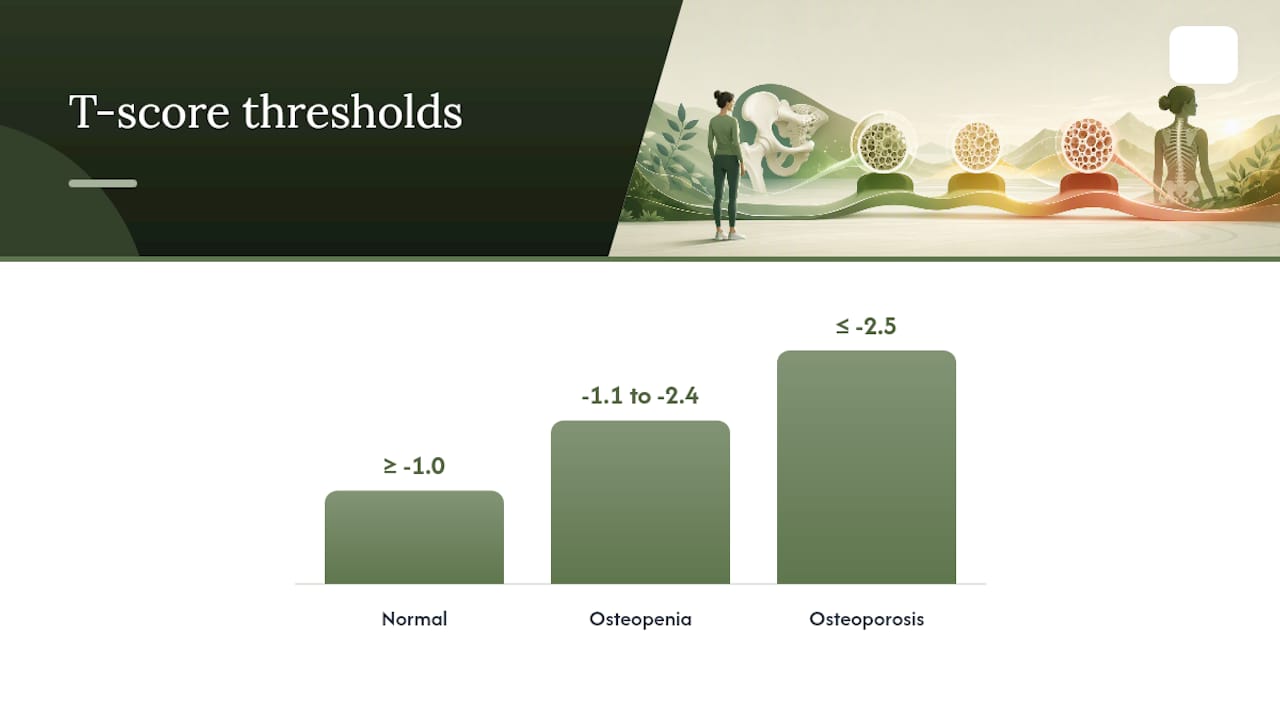
A T-score at or above the normal threshold is normal. Between just below normal and a moderate decrease signals low bone mass, known as osteopenia. A score of −2.5 or below means osteoporosis. If your result falls into either of the lower two categories, the single most important next move is booking time with your clinician to review the number in context and talk through a fracture-risk assessment.
Here’s the quick version:
-
Normal: T-score at or above the normal threshold
-
Osteopenia (low bone mass): T-score between just below normal and a moderate decrease
-
Osteoporosis: T-score of −2.5 or lower
Immediate action: if your score lands below −1.0, ask your clinician for a fracture-risk calculation (FRAX) before your next visit ends. That single step turns a number on a report into a real plan.
Key Takeaways
Bone density test results below a T-score of −1.0 call for a clinician conversation and a fracture-risk calculation, not just a wait-and-see approach.
| Point | Details |
|---|---|
| Know your thresholds | Normal is ≥ −1.0, osteopenia is −1.1 to −2.4, osteoporosis is ≤ −2.5. |
| T-score vs. Z-score | T-scores apply to postmenopausal women and men 50+; Z-scores apply to younger adults and children. |
| Risk doubles per SD | Fracture risk approximately doubles with each standard deviation drop below the young-adult mean, affecting treatment decisions… |
| Use FRAX for context | Ask your clinician to calculate absolute 10-year fracture risk before deciding on treatment. |
| Build a full plan | Healthspan Holistic combines lab testing, coaching, and targeted supplements like Osteo Px to support bone health. |
This article is general information, not a substitute for advice from a qualified doctor. Consult a qualified healthcare professional about your own circumstances before acting on anything here.
What Is a Bone Density Test Results Report Measuring?
A bone density test, also called a DXA or DEXA scan, uses low-dose X-rays to measure bone mineral content. It’s the clinical gold standard for this job, and it’s what your doctor means when they order a “bone density test.”
Most scans focus on the hip and lumbar spine because those sites carry the highest fracture consequences, and some scans add the forearm for people whose hip or spine can’t be read accurately. The whole thing is quick and painless, with radiation exposure far below a standard chest X-ray.
-
Hip: predicts risk of hip fracture, often the most serious osteoporotic break
-
Spine: catches vertebral bone loss early, before a compression fracture happens
-
Forearm: used when hip/spine results are unreliable (severe arthritis, hardware, obesity)
T-Score vs. Z-Score: Which One Applies to You?
Your report will show one or both of these numbers, and they answer different questions. A T-score compares your bone density to a healthy young adult of the same sex at peak bone mass. A Z-score compares you to people your own age, sex, and ethnicity.
Clinicians lean on different scores depending on who’s sitting in front of them:
-
T-score: used for postmenopausal women and men age 50 and older, since this is the population where age-related bone loss and fracture risk are established
-
Z-score: used for premenopausal women, men under 50, and children, where comparing against “young adult peak bone mass” wouldn’t make clinical sense
The logic here matters. A 35-year-old and a 75-year-old lose bone through different mechanisms, so measuring them against the same yardstick would distort the picture for one of them.
What Do Different T-Score Ranges Actually Mean?
Every point below zero on your T-score reflects a real, measurable drop in bone strength, and the ranges break down into three clinical categories.
-
≥ −1.0 (normal): bone density is within one standard deviation of peak young-adult bone mass. No specific bone-related intervention needed beyond general prevention.
-
−1.1 to −2.4 (osteopenia/low bone mass): bone is thinner than ideal but hasn’t crossed into disease territory. This is often when clinicians start talking lifestyle changes and monitoring.
-
≤ −2.5 (osteoporosis): bone density has dropped enough to substantially raise fracture risk and typically prompts a conversation about treatment.
Here’s the number that makes those categories matter clinically: fracture risk roughly doubles with each standard deviation drop below the young-adult mean. Going from a T-score of −1.0 to −2.0 doesn’t just look worse on paper. It reflects a meaningfully higher chance of a broken hip, wrist, or vertebra down the line.
One more term worth knowing: when a T-score of −2.5 or lower shows up alongside an actual fragility fracture (a break from a fall that shouldn’t have caused one), clinicians call this “severe” or “established” osteoporosis. That distinction shifts the conversation from prevention to active treatment.
When Is a Low Z-Score a Red Flag?
A Z-score below −2.0 in a premenopausal woman, a man under 50, or a child is unusual enough that it shouldn’t be chalked up to normal aging, because age isn’t the explanation for that group. Something else is often driving it.
Common culprits include secondary causes like hyperthyroidism, celiac disease, chronic steroid use, eating disorders, or other metabolic bone conditions.
-
Persistent low Z-score with no obvious cause
-
History of low-trauma fractures at a young age
-
Medications known to affect bone (long-term corticosteroids, certain anticonvulsants)
Pro Tip: If your Z-score is below −2.0 and you’re under 50, ask specifically for secondary-cause screening. Finding a treatable root cause often matters more than the number itself.
How Does FRAX Fit Into Bone Density Test Interpretation?
Your T-score is one input, not the whole equation. The FRAX tool combines your bone density with clinical risk factors to estimate your 10-year probability of a major fracture, giving your clinician an absolute risk number instead of just a relative one.
Factors that feed into that calculation include:
-
Age and sex
-
Prior fragility fracture
-
Parental hip fracture history
-
Smoking and alcohol use
-
Glucocorticoid (steroid) use
-
History of falls
Pro Tip: If your T-score falls in the osteopenia range, ask your clinician to run a FRAX score before deciding whether medication makes sense. Two people with identical T-scores can have very different treatment needs once other risk factors are factored in.
What Should You Do After a Low Bone Density Result?
A low score isn’t a diagnosis you manage alone. It’s a starting point for a conversation and a plan.
-
Schedule a follow-up with your clinician to review the T-score, Z-score, and any FRAX calculation together.
-
Ask where you fall on absolute fracture risk, not just the raw bone density number.
-
Prioritize bone-loading exercise like resistance training and weight-bearing activity, which stimulates bone remodeling.
-
Check your calcium and vitamin D status and correct any deficiency before assuming you need medication.
-
Address fall risk directly. Falls remain a major contributor to hip and other fractures, and multifactorial fall evaluations covering vision, balance, strength, and gait catch problems a bone scan never will.
-
Discuss medication only if your absolute risk warrants it. Antiresorptive drugs (which slow bone breakdown) and anabolic agents (which build new bone) are both clinician-prescribed and chosen based on your specific risk profile, not self-selected.
Statistic to remember: because fracture risk roughly doubles per standard deviation drop, even a modest shift in your T-score over a few years can change which of these options makes sense for you.
Refer to a specialist if you have a vertebral compression fracture, a Z-score well below −2.0, or a suspected secondary cause that your primary clinician isn’t equipped to fully investigate.
How Accurate Is a DXA Scan, and How Often Should You Repeat One?
The scan itself takes about about a quarter of an hour to a bit more, involves lying still on a table, and exposes you to a small fraction of the radiation from a standard X-ray. It’s about as low-friction as a diagnostic test gets.
What trips people up is precision. Machine measurement error means small year-to-year shifts in your score may not reflect real bone loss at all. Meaningful change typically takes a few years to detect reliably, which is why most clinicians space repeat scans two years apart unless you’re starting treatment or have a high-risk profile.
-
Degenerative arthritis or spinal hardware can artificially inflate spine readings
-
Prior fractures at a scan site distort results at that location
-
Body size and machine calibration differences can shift comparisons between facilities
Pro Tip: Get repeat scans on the same machine whenever possible. Switching facilities introduces variability that can look like bone loss or gain when nothing actually changed.
What Other Tests Come With a Low Bone Density Result?
A low BMD score often triggers a broader lab workup to rule out treatable causes rather than assuming primary osteoporosis. Common orders include serum calcium, 25-hydroxy vitamin D, TSH, kidney and liver function, a complete blood count, and sex hormones (testosterone or estradiol) when clinically indicated.
Some clinicians also add a vertebral fracture assessment or bone turnover markers for a fuller picture.
-
Vitamin D and calcium: rule out deficiency as a contributing factor
-
TSH: catches thyroid disease affecting bone turnover
-
Bone turnover markers: track how actively bone is being broken down or built
Pro Tip: If your Z-score surprised you, ask specifically which of these labs your clinician is ordering and why. Not every low score needs the full panel.
Why Early Interpretation Changes the Whole Trajectory
Reading your bone density test results early, and acting on them before a fracture happens, is the difference between proactive bone health and reactive fracture care. Most people treat a DXA report like a grade to accept rather than a data point to use.
The number itself doesn’t fix anything. Pairing it with fall prevention, targeted nutrition, and the right follow-up timeline does.
How Healthspan Holistic Supports Your Bone Health Plan
Getting the number is only step one. Healthspan Holistic builds the rest of the plan around it, starting with lab testing that checks vitamin D, hormone levels, and other markers tied to bone health, then layering in personalized coaching to turn those results into a real strategy.
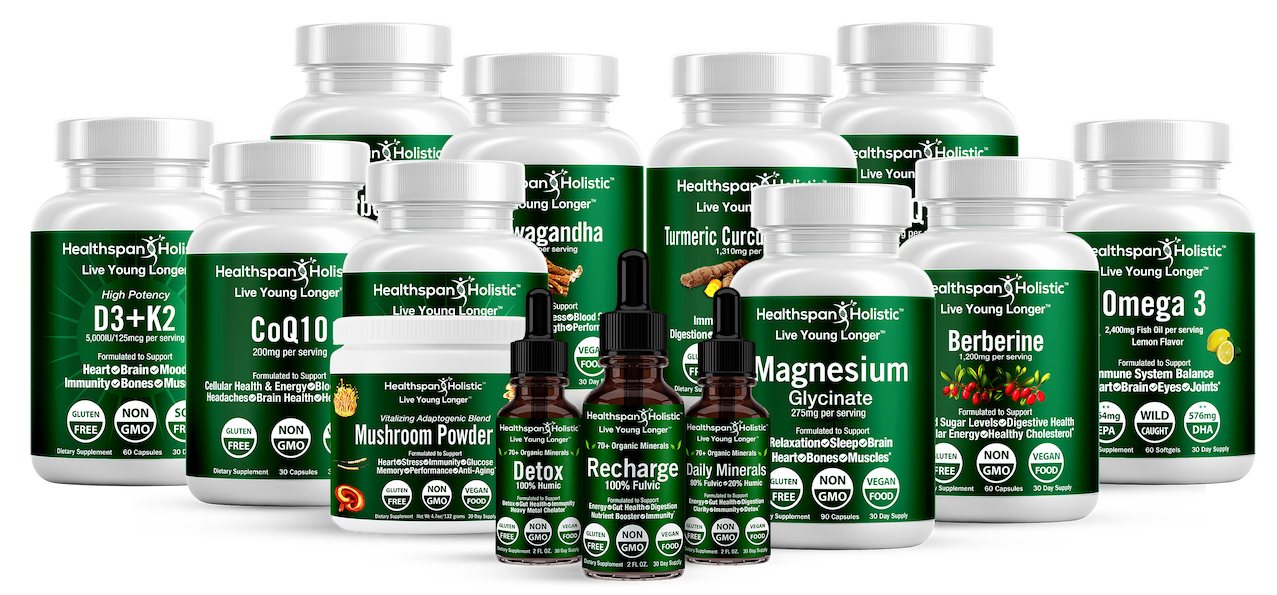
Our 90 Day Journey to Longevity program pairs diagnostics with one-on-one coaching, so a low T-score doesn’t just sit in a folder. It becomes a structured plan covering nutrition, movement, and supplementation. For direct bone support, our Osteo Px capsules are formulated to complement the lifestyle changes your clinician recommends.
Sources
FAQ
What Is a Good Bone Density Score for a 70-Year-Old Woman?
The same T-score thresholds apply regardless of age: −1.0 or higher is normal, but many older women fall into the osteopenia or osteoporosis range simply due to postmenopausal bone loss, which is why the Z-score isn’t used for this age group.
Can You Improve Your Bone Density T-Score?
Yes, weight-bearing exercise, adequate calcium and vitamin D, and, when indicated, prescription medication can slow bone loss and in some cases modestly increase density, though results depend heavily on your starting point and consistency.

How Do I Read My Bone Density Test Results?
Look at your T-score first if you’re a postmenopausal woman or a man 50 or older: −1.0 or above is normal, −1.1 to −2.4 is osteopenia, and −2.5 or below is osteoporosis, then discuss the number with your clinician.
What Is a Bad Score for Bone Density?
A T-score of −2.5 or lower is classified as osteoporosis, and a Z-score below −2.0 in a younger adult or child is considered unusually low and worth investigating for secondary causes.
Leave a comment: