

KLOW is a four-peptide research blend, combining GHK-Cu, BPC-157, TB-500, and KPV, marketed for tissue recovery, skin regeneration, and inflammation control. The most important thing to understand before anything else: no controlled clinical trial has ever tested this specific combination in humans. It has been sold almost exclusively as a research-use-only (RUO) compound, which means clinical use requires a licensed provider willing to take on that oversight. Healthspan Holistic does offer it via clinical use via a licensed physician and produced at a compounding pharmacy in the USA. Sign in to our Rx portal to view our KLOW and the rest of our full line of peptides.
That single fact should shape every decision you make about it.
-
What it is: A fixed 80 mg blend of four distinct peptides, each with its own chemistry and research history.
-
What’s proven: GHK-Cu has the strongest human evidence, mostly for topical skin applications.
-
What’s not proven: The blend itself, as a combination, has zero published trials behind it.
-
What to do next: Ask any provider or vendor for component-level Certificates of Analysis (COAs) before you consider moving forward.
The bottom line: KLOW’s individual ingredients carry real, if uneven, scientific support. The combination itself is a marketing construct, not a studied protocol. Treat those as two separate questions.
Key Takeaways
KLOW combines four peptides with real but uneven individual evidence, and no published trial has tested the combination itself in humans.
| Point | Details |
|---|---|
| Composition | KLOW blends GHK-Cu, BPC-157, TB-500, and KPV in a fixed 50/10/10/10 ratio per 80 mg vial. |
| Strongest evidence | GHK-Cu has the most human data, mostly for topical skin and collagen effects. |
| Major safety caveat | No combination trials exist; long-term multi-peptide interactions remain unstudied. |
| Sourcing checklist | Verify component-specific COAs, lot numbers, and storage conditions before use. |
| Healthspan Holistic’s role | Offers diagnostic testing and provider-guided peptide consultation. |
This article is general information, not a substitute for advice from a qualified doctor. Consult a qualified healthcare professional about your own circumstances before acting on anything here.
What Is KLOW Peptide? Composition and Origin
KLOW is not a peptide in the traditional sense. It’s a blend name, an acronym built from the first letters of its four components, packaged into a single lyophilized vial. Vendors commonly describe the standard formulation as an 80 mg vial split across a 50/10/10/10 composition:
-
GHK-Cu (copper tripeptide): 50 mg
-
BPC-157 (body protection compound): 10 mg
-
TB-500 (thymosin beta-4 fragment): 10 mg
-
KPV (lysine-proline-valine tripeptide): 10 mg
If that first three-peptide combination sounds familiar, it should. KLOW is essentially an evolution of the older GLOW stack, which combined GHK-Cu, BPC-157, and TB-500 for skin and soft-tissue recovery. KLOW simply adds KPV to that foundation, layering in a compound with a more specific anti-inflammatory, gut-focused rationale.
Here’s the distinction worth sitting with: KLOW is a marketing label for a fixed mixture, not a molecule that anyone has synthesized and studied as a single entity. Each of the four components has distinct chemistry, distinct half-life, and distinct research literature.
| Feature | KLOW | GLOW |
|---|---|---|
| Core peptides | GHK-Cu, BPC-157, TB-500, KPV | GHK-Cu, BPC-157, TB-500 |
| Primary added target | Gut and immune inflammation | Skin and soft-tissue repair |
| Combination trials | None published | None published |
Quick definition box: RUO means a compound is sold for laboratory or research purposes only, not for human consumption, and it has not gone through FDA review for safety or effectiveness in people. Any clinical use happens under a provider’s own judgment and liability, not under an approved indication.
How Does KLOW Peptide Work? Mechanisms by Component
Each peptide in KLOW targets a different biological system, and the strength of the evidence behind each one varies dramatically. Understanding this peptide by peptide is the only way to separate legitimate biological rationale from marketing copy.
GHK-Cu is a copper-binding tripeptide studied mainly for dermal remodeling and wound signaling. A 2015 review of copper peptide biology documents its effects on gene expression, collagen synthesis, and tissue remodeling, findings that underpin most of the topical and cosmetic products built around it. GHK-Cu is the one component of KLOW with meaningful human data, largely because it’s been formulated into topical skincare products and studied that way for decades.
BPC-157 is a synthetic peptide fragment derived from a protein found in gastric juice, studied for soft-tissue and gut healing. Rodent and cell-model research shows consistent effects on tendon, ligament, and gastrointestinal repair, but there’s no adequately powered randomized trial in humans for systemic injected use. That gap matters more than most marketing pages admit.
TB-500 is derived from thymosin beta-4, a naturally occurring protein involved in cell migration and blood vessel formation. Preclinical models show it promoting angiogenesis and wound-healing pathways, which is the mechanistic case for including it in recovery-focused stacks. Controlled human data for TB-500 as an injected recovery agent remains sparse.
KPV is a tripeptide fragment of alpha-melanocyte-stimulating hormone, studied almost exclusively for gut inflammation. Multiple mouse-model studies show it reducing colitis severity through anti-inflammatory mechanisms. Again, that evidence comes from animal models, not people.
| Peptide | Primary target | Evidence level | Common research route |
|---|---|---|---|
| GHK-Cu | Skin, connective tissue | Human (topical), animal, cell | Topical, subcutaneous |
| BPC-157 | Tendon, ligament, gut lining | Animal, cell | Subcutaneous, oral |
| TB-500 | Vascular tissue, wound sites | Animal, cell | Subcutaneous |
| KPV | Gut mucosa, immune cells | Animal | Subcutaneous, oral |
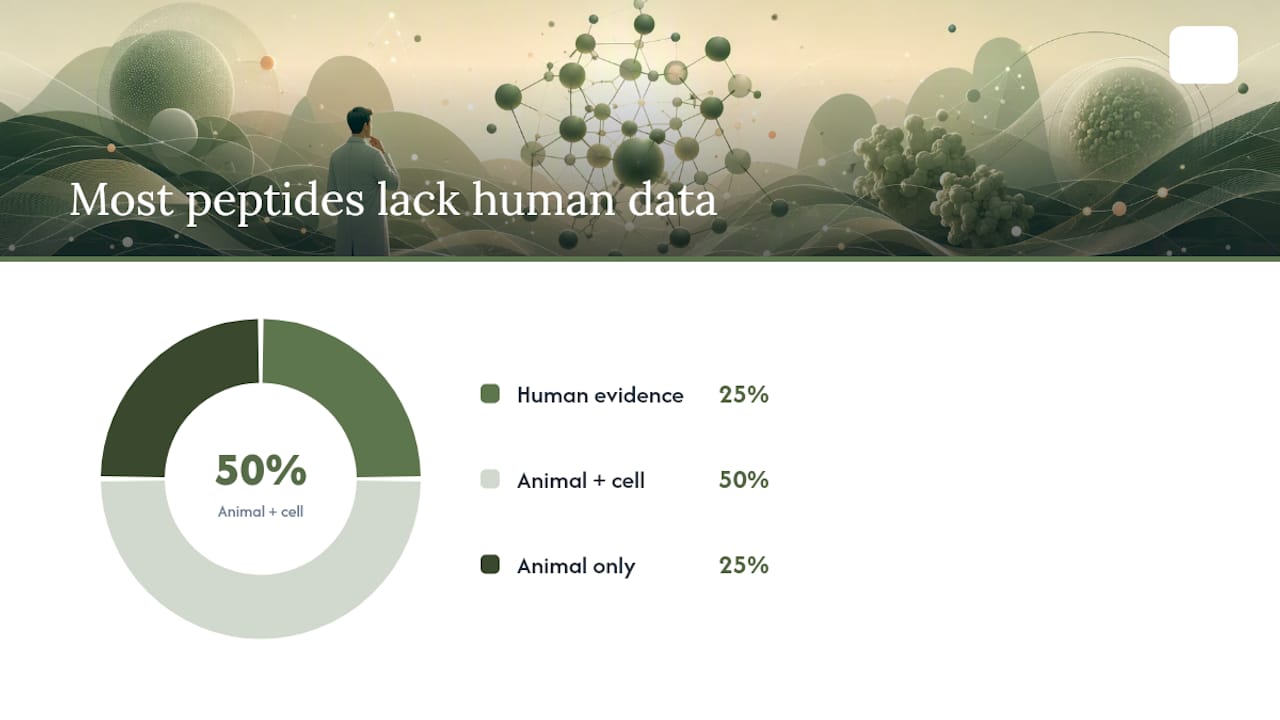
Not one of these four has a combination trial backing the claim that mixing them produces additive or synergistic effects. Each mechanism is real on its own terms; the blend’s overall effect is inferred, not measured.
Klow Peptide Benefits: Realistic Use Cases vs. Marketing Claims
The most supported use case for components in KLOW is skin and cosmetic improvement, mainly from GHK-Cu’s topical evidence. Speculative claims include systemic tendon or ligament repair from injected BPC-157 and TB-500, for which human data is lacking.
Here’s how the common claims break down by evidence strength:
-
Skin rejuvenation and collagen support (evidence strength: moderate to strong) — backed by decades of topical GHK-Cu research in human skin models.
-
Soft-tissue repair after injury (evidence strength: limited) — plausible mechanism from BPC-157 and TB-500 animal studies, but no controlled human trials for injected use.
-
Gut barrier and inflammatory support (evidence strength: limited) — KPV’s colitis-reduction data comes entirely from mice, not clinical populations.
-
General anti-inflammatory support (evidence strength: limited) — inferred from separate mechanisms across all four peptides, never tested together.
-
Post-injury recovery timelines (evidence strength: limited to moderate) — anecdotal clinic reports exist, but they don’t substitute for trial data.
KPV is the piece that meaningfully differentiates KLOW from the older GLOW formula. Whereas GLOW leans almost entirely on skin and connective-tissue repair, KPV’s gut-focused, anti-inflammatory rationale gives KLOW a broader pitch, aimed at immune and digestive complaints rather than pure aesthetics or athletic recovery. Whether that broader pitch holds up in practice is a separate question the current literature can’t answer yet.
How Is KLOW Peptide Administered? Dosing and Timeline
KLOW is almost always administered as a subcutaneous injection after reconstitution, with community and clinic protocols typically following a loading phase followed by a maintenance phase. This isn’t an oral supplement you take off a shelf. It requires reconstituting a lyophilized powder with bacteriostatic water, then dosing it with a small-gauge insulin syringe.
Vial math, in plain terms: A common reconstitution pattern uses 2 mL of bacteriostatic water for an 80 mg vial, producing a 40 mg/mL working solution. On a standard U-100 insulin syringe, that translates to roughly 5 to 10 units per dose, or about 2 to 4 mg of the total blend per injection. Because the 50/10/10/10 ratio is fixed, you can’t adjust one peptide’s dose without proportionally changing the other three, a real limitation if your goal calls for more of one component than the blend delivers.
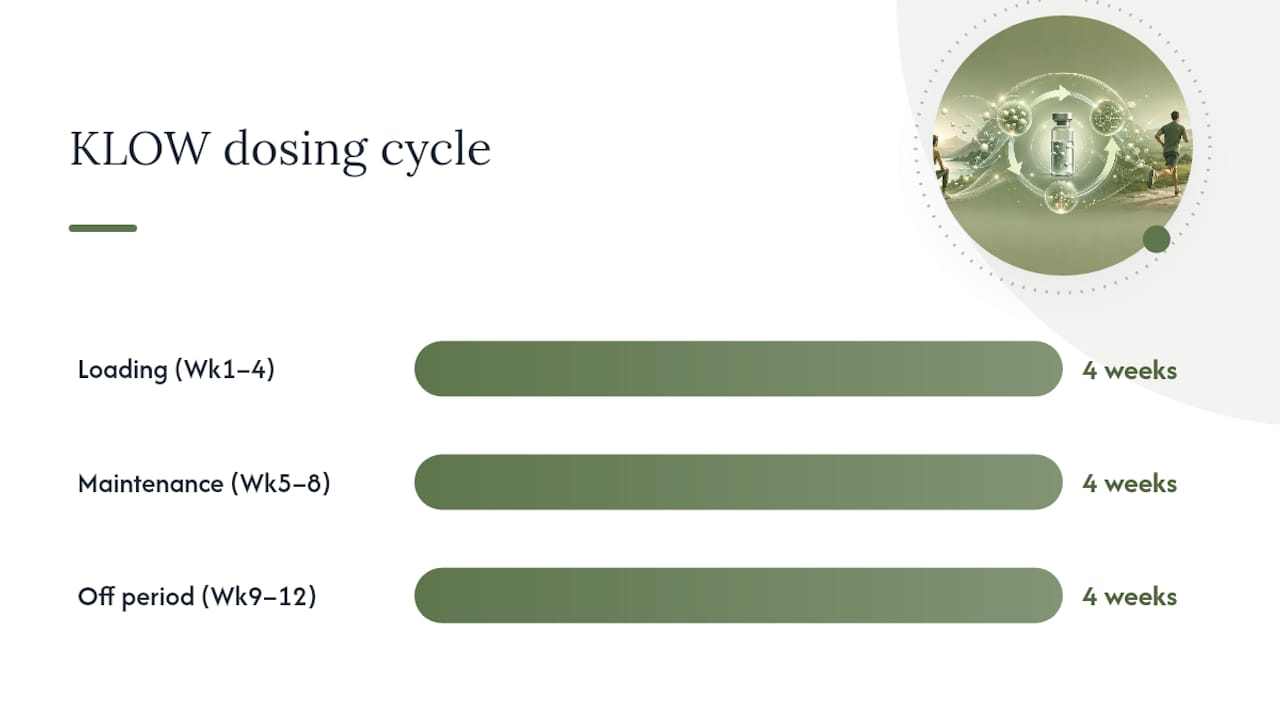
A typical cycle reported across clinic and community sources looks something like this:
-
Weeks 1–4 (loading): More frequent dosing, often daily or every other day, to establish tissue response.
-
Weeks 5–8 (maintenance): Reduced frequency, commonly two to three times per week.
-
Weeks 9–12 (evaluation/off period): A pause to assess results before deciding whether to continue.
These windows come from clinic-reported patterns, not standardized trial protocols, so treat them as a starting framework rather than a fixed prescription.
Common dosing formats include:
-
Standalone vials reconstituted at the point of use.
-
Pre-measured syringes prepared by a compounding provider.
-
Combination protocols alongside other peptides or hormone therapies.
Pro Tip: Get baseline blood work before you start anything. Inflammatory markers, liver and kidney function, and a full metabolic panel give you and your provider something concrete to compare against once you’re a few weeks into a protocol. Without a baseline, you’re guessing whether anything actually changed. If you’re weighing peptide therapy more broadly, Healthspan Holistic’s guide to peptide therapy support for adults 35 to 60 walks through what that provider relationship should look like.
Is KLOW Peptide Safe? Side Effects and Regulatory Status
The most commonly reported issues with KLOW are injection-site reactions, redness, mild swelling, and occasional bruising, while the long-term effects of running four peptides together remain entirely unstudied. That’s not a minor caveat. Interaction risk across peptides isn’t something anyone has formally measured, so any protocol built on this blend carries a layer of uncertainty that single-peptide approaches don’t.
The FDA has flagged several research peptides for safety concerns and maintains guidance on human drug compounding that directly affects whether a clinic can legally prepare an injectable blend like KLOW at all. If a vendor or clinic can’t explain how their sourcing and compounding fits within that framework, that’s a red flag worth taking seriously.
Red flags and contraindications to watch for:
-
Vendors who won’t provide component-specific COAs or lot numbers.
-
Any claim that the blend has been “clinically proven” as a combination, since no such trial exists.
-
Use during pregnancy or breastfeeding, where safety data is absent across all four peptides.
-
Active autoimmune disease, where added immune-modulating peptides like KPV could theoretically complicate an existing condition.
-
Products shipped without proper cold-chain handling or storage instructions.
KLOW’s RUO status means it hasn’t gone through FDA review for human safety or efficacy. That doesn’t automatically make it dangerous, but it does mean the burden of verification, sourcing, purity, dosing, and provider oversight, falls entirely on you and whoever administers it. Healthspan Holistic’s breakdown of recent FDA activity on peptides is worth reading if you want more context on where regulation is headed.
Who Is a Good Candidate for KLOW Peptide?
KLOW tends to make sense for motivated adults with specific recovery or inflammatory goals who also have access to genuine medical oversight, not for anyone hoping to self-administer based on a vendor’s marketing page. It’s not appropriate if you’re pregnant, breastfeeding, or managing an active autoimmune condition, given the complete absence of safety data in those populations.
Before you even consider a consultation, run through this checklist:
-
You have a specific, named goal (skin quality, soft-tissue recovery, gut symptoms), not a vague sense that “peptides sound good.”
-
You’ve had recent blood work and understand your current inflammatory and metabolic baseline.
-
You’re not currently on medications that suppress or stimulate the immune system without your prescriber’s knowledge.
-
You understand this is not an FDA-approved treatment and accept that the evidence for the combination is thin.
-
You have realistic expectations, this is not a guaranteed fix, and results (if any) build gradually over weeks.
Questions worth bringing to a provider consultation:
-
Can you show me component-specific COAs for every peptide in this vial?
-
What baseline labs do you require before starting, and will you recheck them mid-protocol?
-
What’s your experience with adverse reactions to this specific blend?
-
Would a single-peptide protocol better match my actual goal instead of the fixed ratio?
-
How do you source and verify the compounding pharmacy or vendor you use?
KLOW Peptide vs. GLOW: How Do They Compare?
KLOW is essentially GLOW plus KPV, and while that addition gives it a genuine anti-inflammatory and gut-focused rationale, it doesn’t close any of the existing evidence gaps for the shared components. If your goal is purely skin quality or soft-tissue support, GLOW’s three-peptide formula covers that ground without adding a fourth variable to track. Healthspan Holistic also offers GLOW. Sign in to our Rx portal to view our GLOW and the rest of our full line of peptides.
Practical differences worth weighing:
-
Primary target: GLOW leans toward skin and connective tissue; KLOW extends into gut and immune inflammation.
-
Evidence level: Neither blend has combination trials; both rely entirely on single-peptide research extrapolated to a mixture.
-
Dosing complexity: KLOW’s fixed ratio makes it harder to titrate one peptide without shifting the others proportionally.
-
Titration flexibility: Single-peptide protocols let you adjust dose based on response, something a fixed blend can’t offer.
When should you prefer one path over the other?
-
Choose an individual peptide protocol if your goal is narrow and well-matched to one mechanism, say, BPC-157 alone for a specific tendon injury.
-
Choose a blend like KLOW or GLOW only if your goals genuinely span multiple mechanisms (skin plus soft tissue, or soft tissue plus gut inflammation) and you’re comfortable with the fixed-ratio tradeoff.
-
Default to single peptides first if you’re new to peptide therapy, since isolating variables makes it far easier to identify what’s actually working. Healthspan Holistic’s guide on balancing functional peptides covers this decision in more depth.
What Does the Evidence Actually Say About KLOW Peptide?
GHK-Cu carries the strongest topical and human cosmetic evidence of the four; BPC-157 and TB-500 have robust preclinical results in animal and cell models; KPV has focused, reproducible animal evidence for gut inflammation. No trial has ever tested these four peptides together, in any dose, in any population.
That last point deserves repeating because it’s the one fact vendor pages tend to bury. Animal models tell you a mechanism is plausible. They don’t tell you what happens when four different mechanisms run simultaneously in a human body over twelve weeks.
Experts studying peptide marketing broadly caution that claims about a blend being “superior” to single-peptide protocols routinely outpace what any combination study has actually shown. A stack forces fixed ratios onto peptides that may need very different doses to reach their individually studied effective ranges.
Practitioner cautions worth internalizing:
-
Don’t assume additive effects just because four mechanistically distinct peptides are in the same vial.
-
Insist on COAs and third-party lab verification for every batch, not just a general purity claim.
-
Track your own response with objective markers (labs, imaging, symptom logs), not just how you feel.
-
Recognize that a fixed-ratio blend removes your ability to adjust dose to match the evidence for each component individually.
The GHK-Cu literature and BPC-157 research each stand on their own. KPV’s evidence, meanwhile, remains almost entirely confined to gut-inflammation models rather than the broader recovery claims often attached to it.
How to Source KLOW Peptide Safely
Use a licensed clinic or a vendor that publishes component-specific COAs and offers lot-specific testing, and never accept a generic purity claim without documentation to back it up. This is where the majority of real-world risk with KLOW actually lives, not in the biology of the peptides themselves, but in what’s actually in the vial you receive.
Before you purchase or accept an injection, verify:
-
A current COA for each of the four peptides individually, not just one for the finished blend.
-
Lot numbers that match what’s printed on the vial you’re holding.
-
Documented storage conditions (most peptides require refrigeration or freezing before reconstitution).
-
A clear reconstitution procedure, including bacteriostatic water volume and stability window after mixing.
-
Whether the seller or clinic can explain their compounding source in relation to current FDA guidance.
Pro Tip: Photograph every vial and COA the moment you receive them, and ask your provider for a written treatment plan you can keep on file. If anything goes sideways, or if you simply want to compare batches over time, that paper trail is the only real record you’ll have.
Healthspan Holistic’s Take on Peptide Stacks
We think blends like KLOW deserve real scrutiny, not dismissal and not blind enthusiasm. A four-peptide combination can make sense when someone’s goals genuinely span multiple mechanisms, gut inflammation and skin quality, for instance, and when that person has done the diagnostic homework to justify it. What we don’t support is reaching for a fixed-ratio blend simply because it sounds comprehensive.
At Healthspan Holistic, we believe that every peptide conversation should start with data: a full blood panel, wearable and genetic data where relevant, and a clear picture of what’s actually driving your symptoms before considering which peptide, or which combination, might help. That sequencing matters. Guessing your way into a four-peptide stack skips the step that tells you whether you need all four in the first place.
We also believe in ongoing monitoring, not a one-time injection and a hope for the best. If a stack is worth starting, it’s worth tracking with follow-up labs and honest reassessment of whether it’s doing what you hoped.
Where Healthspan Holistic Fits Into Your Peptide Decision
If you’ve read this far, you already understand why a blend like KLOW deserves more scrutiny than a product page usually gives it. Healthspan Holistic approaches peptide decisions the way this article does: start with real diagnostics, not guesswork. Our lab testing and personalized coaching identify what’s actually driving your inflammation, recovery struggles, or skin concerns before anyone discusses a specific peptide protocol.
If you feel ready to take the next step in ordering KLOW or GLOW, then Sign in to our Rx portal to view our KLOW, GLOW, and the rest of our full line of peptides.
FAQ
What is KLOW peptide used for?
KLOW is marketed for skin regeneration, soft-tissue recovery, and inflammation control, drawing on the separate research histories of GHK-Cu, BPC-157, TB-500, and KPV.
How long should you be on KLOW peptide?
Most reported protocols run a loading phase of about four weeks followed by a maintenance phase of four to eight weeks, though these come from clinic and community reports rather than standardized trials.
What are the side effects of KLOW peptide?
The most commonly reported effects are injection-site redness, swelling, and bruising; long-term risks from combining four peptides together have not been formally studied.
What is the most powerful peptide for fat loss?
KLOW is not formulated or studied for fat loss, and none of its four components have strong evidence in that specific area; peptides marketed for fat loss belong to an entirely different research category with their own separate safety profile.
Is KLOW peptide legal to buy?
KLOW is sold as research-use-only, meaning it hasn’t been reviewed by the FDA for human use; legal clinical administration requires a licensed provider operating within current compounding guidance.
Can Healthspan Holistic help me decide if KLOW is right for me?
Healthspan Holistic’s diagnostic testing and coaching process can identify whether your goals point toward a peptide protocol at all.
Leave a comment: