

TL;DR:
- Magnesium deficiency may cause symptoms like muscle cramps and fatigue, especially when risk factors are present. A serum magnesium test can confirm a deficiency, but it may not reflect total body stores, especially intracellular levels. Proper diagnosis involves testing, understanding the cause, and managing through diet, supplements, or medical intervention.
You can tell you may be magnesium deficient when recognizable symptoms — fatigue, muscle cramps, numbness, or irregular heartbeat — appear alongside known risk factors such as GI disease, chronic alcohol use, or long-term diuretic use, and a clinical serum magnesium test confirms a low level. The clinical standard for hypomagnesemia is a serum magnesium below the lab’s typical reference range, though symptoms often become pronounced when levels fall below a certain low threshold. Here is what to do right now:
-
Get a serum magnesium test. Ask your clinician to order one alongside calcium and potassium panels. Bring your full medication list — certain drugs directly cause magnesium loss.
-
Go to the ER immediately if you experience a seizure, difficulty breathing, fainting, chest pain, or a very fast or irregular heartbeat. These signs cannot wait for an outpatient appointment.
-
Support your levels through diet first (leafy greens, nuts, seeds, legumes) while you await test results. Start a supplement only after discussing it with your clinician.
Pro Tip: Write down every symptom you’ve noticed and when it started, plus every medication and supplement you currently take. That list alone can cut your diagnostic visit time significantly.
What magnesium actually does — and why running low matters
Magnesium is involved in more than 300 enzyme reactions in the body. It drives nerve conduction, muscle contraction, protein synthesis, blood glucose regulation, and bone formation. Think of it as one of the spark plugs of your cellular engine — without it, the whole system misfires.

Critically, magnesium works in close partnership with calcium and potassium. When magnesium drops, those electrolytes often follow. Severe magnesium deficiency can disrupt mineral balance and cause hypocalcemia (low calcium) and hypokalemia (low potassium) simultaneously, which is why clinicians often correct magnesium first when they find stubborn low potassium that won’t respond to potassium replacement alone.
About 99% of your body’s magnesium lives inside cells and bone. Less than 1% circulates in blood serum, which is exactly why a serum test, while useful, can miss significant depletion. Your body tightly defends serum levels, sometimes at the expense of cellular stores.
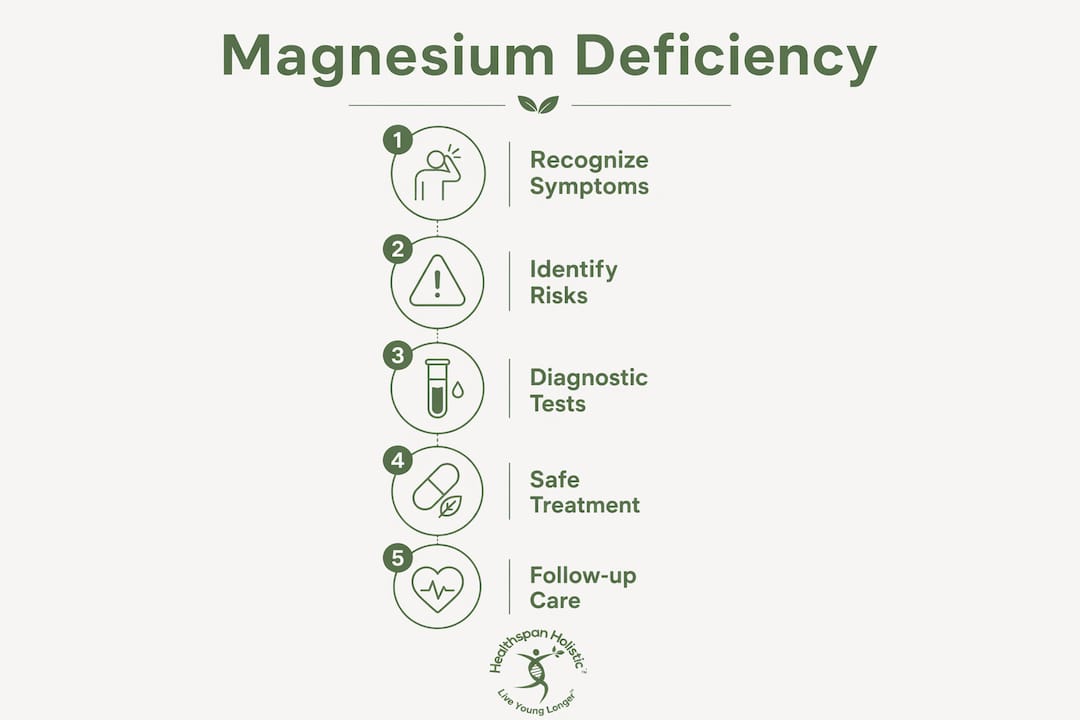
How do you know if you are deficient in magnesium: symptoms by severity
Symptoms of magnesium deficiency follow a fairly predictable progression from mild to life-threatening. Knowing where your symptoms fall on that spectrum helps you decide how urgently to act.
Mild to moderate signs (early deficiency)
-
Loss of appetite
-
Nausea or vomiting
-
Persistent fatigue and general weakness
-
Difficulty sleeping
These early signs are easy to dismiss as stress or poor diet. They often appear before any dramatic lab finding.
Moderate neuromuscular signs
-
Muscle cramps, especially at night
-
Tremors or muscle twitching
-
Numbness or tingling in the hands, feet, or face
-
Personality changes or increased anxiety
Severe and emergency signs
-
Tetany (sustained, painful muscle spasms)
-
Seizures
-
Pronounced cardiac arrhythmia, including the dangerous rhythm called torsades de pointes
-
Difficulty breathing
Symptoms typically become pronounced when serum magnesium falls below approximately 1.2 mg/dL (0.5 mmol/L). Severe deficiency can escalate to life-threatening arrhythmias quickly, so the emergency signs above warrant a 911 call, not a wait-and-see approach.
Who is at risk and what causes magnesium to drop
In otherwise healthy adults, the kidneys are remarkably efficient at conserving magnesium when dietary intake dips. True symptomatic deficiency in a healthy person eating a varied diet is uncommon. When it does appear, it almost always signals an underlying condition, a medication effect, or both.
Common causes of magnesium deficiency:
-
Chronically low dietary intake (heavily processed food diets, very low-calorie diets)
-
Gastrointestinal malabsorption from Crohn’s disease, celiac disease, or short bowel syndrome
-
Chronic diarrhea or prolonged vomiting
-
Chronic alcohol use (alcohol increases urinary magnesium excretion)
-
Kidney wasting conditions where the tubules fail to reabsorb magnesium
-
Long-term use of loop or thiazide diuretics
-
Certain chemotherapy agents
-
Poorly controlled type 2 diabetes (glucose-driven urinary magnesium loss)
Higher-risk groups:
-
Adults over 60 (absorption decreases and excretion increases with age)
-
People with type 2 diabetes
-
Those with chronic GI disease
-
Long-term alcohol users
-
Anyone on diuretics, proton pump inhibitors, or certain cancer medications
Clinicians routinely review the full medication list when investigating deficiency, because drug-induced magnesium loss is one of the most correctable causes.
How clinicians diagnose magnesium deficiency: tests and what they mean
The primary diagnostic tool is a serum magnesium blood draw, but a complete picture usually requires more than one test. Here is what your clinician may order and why.

| Test | What it measures | Typical reference range |
|---|---|---|
| Serum magnesium | Magnesium in blood plasma | lab’s typical reference range (some labs use 1.46–2.68 mg/dL) |
| Comprehensive metabolic panel | Electrolytes, kidney function, glucose | Varies by component |
| Serum calcium | Calcium level (often low with Mg deficiency) | typical calcium reference range |
| Serum potassium | Potassium level (often low with Mg deficiency) | typical potassium reference range |
| 24-hour urine magnesium | Total daily magnesium excretion | Varies; used to detect renal wasting |
| ECG | Cardiac rhythm and QT interval | Assessed by clinician |
If renal wasting is suspected, a clinician may calculate the fractional excretion of magnesium from a random urine sample. A fractional excretion above 2% in someone with normal kidney function suggests the kidneys are losing magnesium rather than conserving it.
Limitations of serum magnesium testing:
-
Serum reflects less than 1% of total body magnesium stores
-
A normal serum result does not rule out intracellular depletion
-
No widely available, standardized ionized magnesium test exists for routine clinical use
-
Results must always be interpreted within the specific lab’s reference range, not a universal number
Pro Tip: Ask your clinician to order calcium and potassium alongside serum magnesium. If all three are low, the clinical picture becomes much clearer and treatment can address all three together.
Can you test your magnesium levels at home?
Consumer finger-prick kits and over-the-counter urine test strips marketed for magnesium screening are available, but their clinical accuracy is limited. Here is an honest look at what they can and cannot tell you.
Potential benefits of at-home options:
-
Convenient for initial screening if you cannot access a clinician quickly
-
May prompt you to seek formal testing sooner
-
Some at-home lab services (where you order a blood draw at a local lab) offer more reliable serum results
Significant limitations:
-
Consumer urine strips measure total urinary magnesium, not serum or intracellular levels
-
Finger-prick kits have limited clinical validation for magnesium specifically
-
None measure ionized or intracellular magnesium, which is where most depletion occurs
-
Collection errors (hydration status, timing) can skew results significantly
-
A normal home result can coexist with meaningful cellular depletion
The bottom line: if a home test flags a low result, treat it as a reason to book a clinical serum test promptly, not as a confirmed diagnosis. And if your symptoms are severe, skip the home test entirely and go straight to your clinician or the ER.
How to raise magnesium safely: diet, supplements, and cautions
Start with food
Whole foods deliver magnesium alongside cofactors that support absorption. High-magnesium options include:
-
Pumpkin seeds (1 oz): approximately 156 mg
-
Almonds (1 oz): approximately 80 mg
-
Spinach, cooked (½ cup): approximately 78 mg
-
Black beans (½ cup): approximately 60 mg
-
Edamame (½ cup): approximately 50 mg
-
Dark chocolate, 70–85% cacao (1 oz): approximately 64 mg
Supplement forms compared
| Form | Bioavailability | Best for | Notes |
|---|---|---|---|
| Magnesium glycinate | High | General deficiency, sleep, muscle cramps | Gentle on the GI tract; well tolerated |
| Magnesium citrate | Moderate-high | Constipation-prone individuals | Can have a mild laxative effect |
| Magnesium L-threonate | Moderate | Cognitive support | Crosses blood-brain barrier more readily |
| Magnesium oxide | Low | Short-term antacid use | Poor absorption; high laxative potential |
Typical supplemental doses for adults vary and should be adjusted by your clinician based on lab results and kidney function.
Safety cautions:
-
People with kidney disease must not supplement without medical supervision — impaired kidneys cannot excrete excess magnesium, and toxicity is a real risk.
-
High doses cause diarrhea in many people; start low and increase gradually.
-
Magnesium can reduce absorption of certain antibiotics (tetracyclines, fluoroquinolones) and bisphosphonates. Space these medications at least 2 hours apart from your magnesium dose.
-
Clinicians often prefer magnesium glycinate or citrate for oral repletion because of their higher bioavailability compared to oxide.
Pro Tip: If your clinician prescribes a specific magnesium salt, there is usually a reason tied to your GI tolerance, kidney function, or co-occurring medications. Ask why that form was chosen — the answer will help you stay consistent.
Routine supplementation without a confirmed or strongly suspected deficiency is generally not recommended. Harvard Health notes that most people without a diagnosed condition have no compelling reason to take high-dose magnesium supplements.
How long does it take to feel better after correcting magnesium?
Recovery timelines depend heavily on how depleted you are and how you replenish.
-
Mild deficiency with oral supplementation: Many people notice improvement in muscle cramps, sleep quality, and fatigue within days to a few weeks of consistent supplementation and dietary improvement.
-
Moderate deficiency: Serum levels typically normalize within 2–4 weeks of oral repletion, though intracellular stores take longer to fully recover.
-
Severe deficiency requiring IV magnesium: Hospitalized patients receiving parenteral magnesium may see rapid symptom stabilization within hours, but inpatient monitoring of electrolytes, cardiac rhythm, and kidney function continues until levels are stable.
After starting treatment, your clinician will typically recheck serum magnesium, calcium, and potassium within 1–2 weeks for outpatient cases. If an ECG showed arrhythmia, a follow-up tracing confirms resolution. Addressing the underlying cause — whether that means adjusting a medication, managing a GI condition, or reducing alcohol intake — is what prevents recurrence.
When to seek urgent care and what to bring to your appointment
Go to the ER or call 911 immediately if you have:
-
A seizure or convulsion
-
Difficulty breathing or shortness of breath at rest
-
Fainting or loss of consciousness
-
Chest pain or pressure
-
A very fast, irregular, or pounding heartbeat
These signs require rapid stabilization and cannot wait for home testing or an outpatient slot. Severe electrolyte disturbances can escalate within minutes.
For a non-emergency clinician visit, bring:
-
A written timeline of your symptoms (when they started, how they’ve changed)
-
Your complete medication and supplement list, including doses
-
Notes on recent GI issues (diarrhea, vomiting, malabsorption symptoms)
-
An honest account of alcohol use
-
Any prior lab results showing low calcium or potassium
Ask your clinician about:
-
Serum magnesium, calcium, and potassium drawn together
-
A 24-hour urine magnesium if renal wasting is suspected
-
An RBC (red blood cell) magnesium test if serum comes back normal but symptoms persist
-
An ECG if you have palpitations or arrhythmia symptoms
At the visit, expect a physical exam, a review of your medication list, and possibly an ECG. Severe cases may lead to same-day IV magnesium in an infusion setting or hospital admission.
What the research says: interpreting your lab values
Understanding your numbers puts you in a stronger position to have a productive conversation with your clinician.
| Serum magnesium level | Interpretation | Typical clinical response |
|---|---|---|
| 1.6–2.6 mg/dL (MedlinePlus typical reference range; lab ranges vary) | Normal range | Monitor if symptomatic; consider alternative tests |
| Approximately 1.2 mg/dL | Mild hypomagnesemia | Oral repletion; recheck in 1–2 weeks |
| Below 1.2 mg/dL | Moderate to severe hypomagnesemia | Prompt treatment; consider IV if symptomatic |
| Below approximately 1.2 mg/dL | Severe; potentially life-threatening | Urgent/inpatient IV magnesium; ECG monitoring |
Sources: Cleveland Clinic, MedlinePlus, StatPearls
A normal serum result does not fully rule out deficiency. Because serum is tightly regulated, your body can maintain a “normal” serum level while intracellular stores are meaningfully depleted. When clinical suspicion remains high despite a normal serum result, clinicians may use an RBC magnesium test, a 24-hour urine collection, or in specialized settings, a magnesium-loading tolerance test — where urinary excretion after a parenteral magnesium infusion reveals how much the body retains.
Key Takeaways
Magnesium deficiency is confirmed by a combination of recognizable symptoms, known risk factors, and a serum magnesium test below your lab’s reference range, with emergency signs requiring immediate care regardless of test results.
| Point | Details |
|---|---|
| Symptoms signal the need to test | Fatigue, cramps, numbness, and arrhythmia alongside risk factors warrant a serum magnesium draw. |
| Serum testing has real limits | Less than 1% of body magnesium is in serum; a normal result does not rule out cellular depletion. |
| Always check calcium and potassium | Low magnesium frequently causes concurrent low calcium and potassium, which amplifies symptoms. |
| Emergency signs mean call 911 | Seizures, breathing trouble, and irregular heartbeat require ER care, not home testing. |
| Healthspan Holistic offers targeted support | Advanced lab panels, RBC magnesium testing, and professional-grade magnesium supplements are available through Healthspan Holistic for adults ready to take a proactive approach. |
My take on magnesium deficiency
Most articles on magnesium deficiency focus on the symptoms checklist and jump straight to supplement recommendations. That approach skips the most important step: figuring out why magnesium is low in the first place.
If you are losing magnesium through your kidneys because of a medication you have been on for years, adding a supplement without addressing that root cause is like filling a bucket with a hole in it. You may feel marginally better for a while, but the underlying drain continues. The same logic applies to undiagnosed celiac disease, poorly managed type 2 diabetes, or chronic alcohol use — all of which impair magnesium retention at a level that diet and supplements alone cannot fully overcome.
There is also a real risk on the other side: people with kidney disease who self-supplement with high-dose magnesium can develop hypermagnesemia, which carries its own serious cardiac risks. The supplement aisle does not come with a kidney function test.
My honest recommendation is this: treat the symptom checklist as a reason to get tested, not as a diagnosis. Use the test results and your clinician’s assessment to guide whether you supplement, what form you use, and at what dose. That sequence — symptoms → test → clinician-guided correction → address the root cause — is what actually produces lasting improvement. Supplements are a tool, not a shortcut.
- Chris
Healthspan Holistic supports your magnesium health from test to treatment
If your symptoms and risk factors have you wondering about your magnesium status, Healthspan Holistic gives you a clear path from question to answer. The Vitamin D, Omega-3, and Magnesium lab test package lets you order clinical-grade testing directly, and the Magnesium RBC test goes a step further by measuring magnesium inside red blood cells rather than just in serum, giving you a more complete picture of your cellular stores.

Once you have your results, Healthspan Holistic’s one-on-one health coaching helps you interpret them and build a personalized plan — whether that means dietary changes, targeted supplementation, or a referral conversation with your physician. The supplement store carries professional-grade options including:
-
Magnesium Glycinate 90 Capsules — a highly absorbable form that is gentle on the GI tract, ideal for daily repletion
-
Magnesium Glycinate 180 Capsules — for longer-term maintenance
-
Magnesium Citrate 240 Capsules — a good option if you also deal with constipation
-
Magnesium Gummies — for those who prefer a non-pill format
1st Time Customers can take advantage of our BUY 1 GET 1 50% OFF special offer on all supplements.
Visit Healthspan Holistic’s supplement collection to browse all available magnesium products, or book a coaching session to get personalized guidance based on your actual lab results.
This article is for general informational purposes only and is not a substitute for professional medical advice. Always consult a qualified clinician for diagnosis and treatment decisions specific to your situation.
Useful sources and further reading
These are the primary sources used throughout this article. Bringing them to your clinician visit can support a productive conversation about testing and treatment.
-
NIH Office of Dietary Supplements — Magnesium Health Professional Fact Sheet: ods.od.nih.gov/factsheets/Magnesium-HealthProfessional — the most comprehensive U.S. government summary of magnesium physiology, deficiency, and dietary reference intakes.
-
NIH Office of Dietary Supplements — Magnesium Consumer Fact Sheet: ods.od.nih.gov/factsheets/Magnesium-Consumer — a plain-language version of the above, useful for sharing with family members.
-
Cleveland Clinic — Hypomagnesemia: my.clevelandclinic.org — clinical overview of diagnosis, reference ranges, and treatment pathways.
-
StatPearls / NCBI Bookshelf — Hypomagnesemia: ncbi.nlm.nih.gov/books/NBK500003 — detailed clinical reference covering testing methods, diagnostic limits, and management.
-
MedlinePlus — Magnesium Deficiency: medlineplus.gov — accessible summary of normal lab ranges and when to seek care.
-
Merck Manual Professional — Hypomagnesemia: merckmanuals.com — professional-level guidance on treatment tiers, from outpatient oral repletion to inpatient IV therapy.
FAQ
What are the most common signs your body needs magnesium?
The most recognizable magnesium deficiency signs are muscle cramps, persistent fatigue, poor sleep, numbness or tingling, and loss of appetite. As deficiency progresses, symptoms can include tremors, anxiety, and in severe cases, cardiac arrhythmia or seizures.
How can you test magnesium levels without a doctor’s visit?
Some at-home lab services allow you to order a serum magnesium blood draw at a local collection site without a physician’s order. Consumer urine strips exist but have limited accuracy. The Magnesium RBC test from Healthspan Holistic measures magnesium inside red blood cells, offering more insight than a standard serum draw alone.
What do you crave if magnesium is low?
Cravings for chocolate are commonly linked to low magnesium, since dark chocolate is one of the richer dietary sources of the mineral. Some people also report cravings for nuts and seeds. That said, cravings alone are not a reliable diagnostic signal — a lab test is the only way to confirm a deficiency.
How do you raise magnesium levels quickly?
For mild deficiency, increasing intake of magnesium-rich foods (pumpkin seeds, spinach, black beans) combined with a well-absorbed supplement form like magnesium glycinate or citrate typically improves levels within days to a few weeks. Severe deficiency requires IV magnesium administered in a clinical setting, which can stabilize levels within hours under medical supervision.
Is magnesium deficiency common in the United States?
True symptomatic magnesium deficiency is not common in otherwise healthy U.S. adults, because healthy kidneys conserve magnesium efficiently. However, inadequate intake is widespread, and deficiency becomes significantly more likely in older adults, people with type 2 diabetes, chronic GI conditions, or those on long-term diuretics or other magnesium-depleting medications.
Leave a comment: