

The magnesium RBC test measures magnesium inside your red blood cells, giving clinicians a window into your intracellular magnesium stores rather than just what’s circulating in your bloodstream. As MedlinePlus explains, this test may be better at finding low magnesium than a standard serum magnesium test, precisely because it captures what’s happening at the cellular level. If you’ve been dealing with persistent symptoms despite a “normal” magnesium result, this distinction matters.
Common reasons to consider asking your clinician about RBC magnesium testing:
-
Unexplained muscle cramps, twitching, or weakness
-
Fatigue that doesn’t improve with rest
-
Heart palpitations or irregular heartbeat
-
Persistent headaches or migraines
-
Anxiety, poor sleep, or mood changes
-
Use of diuretics, proton pump inhibitors, or certain diabetes medications
-
Diagnosed GI conditions (Crohn’s disease, celiac disease, chronic diarrhea)
-
Poorly controlled type 2 diabetes
Key Takeaways
The magnesium RBC test is a more sensitive marker for intracellular magnesium deficiency than serum magnesium, and it requires careful specimen handling and clinical correlation to be clinically useful.
| Point | Details |
|---|---|
| What it measures | Magnesium inside red blood cells, a proxy for intracellular stores that serum testing often misses |
| Reference ranges vary | Quest lists 4.0–6.4 mg/dL; LabCorp lists 3.7–7.0 mg/dL — always use your lab’s own range |
| Specimen handling is critical | Plasma must be separated within 4 hours; hemolysis causes falsely low results and specimen rejection |
| Retest after 3–6 months | Allow a full red blood cell cycle before retesting to confirm intracellular repletion from supplementation |
| Healthspan Holistic | Offers RBC magnesium testing, advanced panels, and coaching to interpret results and build a personalized plan |
What does the magnesium RBC test actually measure?
The RBC magnesium test samples magnesium inside erythrocytes (red blood cells), which serves as a proxy for intracellular magnesium stores throughout the body. This is a fundamentally different measurement than serum or plasma magnesium, which reflects only the small fraction of total body magnesium circulating in your blood.
Here’s how your body distributes magnesium across compartments:
-
Serum/plasma: Roughly 1% of total body magnesium; tightly regulated by the kidneys
-
Red blood cells (intracellular): A more stable reflection of cellular magnesium status over weeks to months
-
Bone: Stores approximately 60% of total body magnesium
-
Soft tissue and organs: The remaining intracellular pool, including muscle and heart tissue
Because the kidneys work hard to keep serum magnesium within a narrow range, your blood levels can look perfectly normal on a standard panel even when your cells are quietly running low. RBC magnesium captures a more meaningful slice of that intracellular picture.
Reference ranges vary by laboratory and analytic method. Quest Diagnostics lists a typical reference range for RBC magnesium, while LabCorp documents a laboratory-specific reference range for RBC magnesium using atomic absorption spectroscopy (AAS) or inductively coupled plasma mass spectrometry (ICP-MS). Always interpret your result against the specific reference range printed on your lab report.
Why would a clinician order an RBC magnesium test?
Not every clinician routinely includes RBC magnesium in a standard panel. It becomes most useful when symptoms or risk factors point toward deficiency that a serum test might miss.
Clinical indications that often prompt this test:
-
Muscle cramps, spasms, or tetany without an obvious cause
-
Cardiac arrhythmias, especially when potassium is also low (refractory hypokalemia)
-
Chronic fatigue or unexplained weakness
-
Persistent hypertension not responding well to treatment
-
Malabsorption syndromes (celiac disease, Crohn’s disease, short bowel syndrome)
-
Long-term diuretic use (thiazides, loop diuretics)
-
Chronic diarrhea or laxative overuse
-
Uncontrolled type 2 diabetes (urinary magnesium losses are elevated)
-
Alcohol use disorder
Risk groups who benefit most from RBC testing over serum alone:
-
Adults over 60, who absorb less dietary magnesium and excrete more through the kidneys
-
People with inflammatory bowel disease or other GI conditions affecting absorption
-
Renal transplant patients on calcineurin inhibitors
-
Anyone on long-term proton pump inhibitors
-
Individuals with poor dietary variety or very low caloric intake
Magnesium deficiency is also one of the most overlooked drivers of poor sleep and nighttime muscle restlessness, making this test worth discussing if sleep quality is a concern alongside other symptoms.
Pro Tip: When raising this test with your clinician, frame it specifically: “My serum magnesium has come back normal, but I’m still having muscle cramps and fatigue. Would an RBC magnesium test give us a better picture of my intracellular stores?” That clinical framing makes it a reasonable, evidence-supported ask rather than a patient-driven request for an unusual test.
RBC magnesium versus serum magnesium: which test tells you more?
The core difference comes down to physiology. Serum magnesium is tightly regulated by renal handling, meaning your kidneys will pull magnesium from bone and soft tissue to maintain circulating levels within a narrow range. You can be significantly depleted at the cellular level while your serum result sits comfortably in the normal range.
A PMC clinical review confirms this directly: serum magnesium often does not reflect total body or intracellular magnesium status, and combining multiple measures gives a clearer picture.
Serum magnesium strengths and limits:
-
Fast, inexpensive, and widely available
-
Useful for detecting acute, severe derangements (hypermagnesemia, frank hypomagnesemia)
-
Poor sensitivity for subclinical or chronic intracellular depletion
-
Affected by albumin levels, time of day, and recent dietary intake
RBC magnesium strengths and limits:
-
More sensitive for detecting subclinical, chronic intracellular deficiency
-
Reflects magnesium status over the lifespan of a red blood cell (roughly 90–120 days)
-
Pre-analytical errors (hemolysis, delayed separation) can cause falsely low results
-
Does not capture bone stores or total body magnesium directly
-
Reference ranges vary across labs, which complicates comparison over time
When to order both: If you have symptoms of deficiency but a normal serum result, ordering serum and RBC magnesium together gives your clinician the most useful comparison. Adding a 24-hour urinary magnesium test helps identify whether your kidneys are wasting magnesium, which is a separate and important clinical question.
A combined approach using serum, urinary, and cellular measures provides a clearer assessment of magnesium status than any single test alone. For readers interested in a broader mineral picture, a toxic and essential minerals panel can complement RBC magnesium testing.
How the test is performed and how you should prepare
Specimen collection
The RBC magnesium test requires a venous blood draw. Most labs use a trace-metal free EDTA or heparin tube (typically a royal blue or lavender-top tube) to avoid contaminating the sample with external minerals. After collection, the specimen must be centrifuged and the plasma separated promptly. Cleveland Clinic Laboratories requires separation within 4 hours of collection; delayed processing can cause red blood cell lysis (hemolysis), which releases intracellular magnesium into the plasma and produces a falsely low RBC result.
Analytic methods
LabCorp uses AAS and ICP-MS to analyze RBC magnesium, with a typical turnaround time of 2–4 days. ICP-MS is particularly precise for trace-element analysis and is increasingly the standard at major reference labs. The CPT code commonly associated with this test is 83735.
Patient preparation
| Preparation step | Guidance |
|---|---|
| Magnesium supplements | Withhold for the period your lab or clinician advises (often 24 hours before draw) |
| Multivitamins/minerals | Quest Diagnostics recommends withholding vitamins and mineral supplements before collection in some circumstances |
| Medications | Note diuretics, antacids, PPIs, and diabetes medications — do not stop without clinician guidance |
| Fasting | Not universally required, but check with your ordering lab |
| Hydration | Stay normally hydrated; dehydration can affect specimen quality |
| Timing | Morning draws are often preferred to minimize circadian variation in mineral levels |
Pro Tip: Bring a written list of every supplement and medication you take to your blood draw appointment. The phlebotomist and your clinician need this information to interpret your result accurately, especially if you’ve recently started or stopped a magnesium supplement.
How to interpret your RBC magnesium results
What low results typically mean
A result below your lab’s reference range suggests intracellular magnesium depletion, which often precedes the kind of frank deficiency that shows up on a serum test. Common contributing factors include poor dietary intake, GI malabsorption, chronic diuretic use, or high urinary losses from diabetes. For context on dietary intake targets and clinical implications, the NIH Office of Dietary Supplements provides authoritative guidance that helps interpret lab findings alongside diet history.
If your result is low, reasonable next steps include:
-
Review your dietary magnesium sources with a clinician or health coach
-
Check renal function (eGFR and serum creatinine) before starting supplementation
-
Assess medications that deplete magnesium (diuretics, PPIs, certain antibiotics)
-
Consider a trial of magnesium supplementation at a clinician-guided dose, then retest in 3–6 months
-
Add a 24-hour urinary magnesium test if renal wasting is suspected
For supplementation support, forms like magnesium glycinate are well-tolerated and commonly used for sleep and muscle support, while magnesium L-threonate is often chosen for cognitive support. Supplement choice should align with your specific symptoms and clinician guidance.
What elevated results typically mean
High RBC magnesium is uncommon. When it occurs, the most likely explanations are excessive supplementation or impaired renal clearance. MedlinePlus notes that hypermagnesemia is rare but serious and typically occurs in the setting of impaired renal function or excess supplement or medication exposure.
Pro Tip: Always check kidney function (eGFR) before starting high-dose magnesium supplementation. If your kidneys aren’t clearing magnesium efficiently, supplementing aggressively can push levels into a range that affects heart rhythm and neuromuscular function.
Test limitations and when to repeat or add complementary tests
No single test captures the full picture of magnesium status, and the RBC assay has specific vulnerabilities worth knowing.
Key limitations:
-
Hemolysis: If red blood cells lyse during or after collection, intracellular magnesium leaks into the sample, causing a falsely low result. Labs will often reject hemolyzed specimens.
-
Delayed separation: Plasma must be separated from packed RBCs promptly. Processing delays are a common cause of specimen rejection at major labs including Cleveland Clinic and Quest.
-
Reference range variability: Ranges differ across labs and methods, which makes comparing results from different facilities unreliable without knowing which method was used.
-
No direct bone store measurement: RBC magnesium reflects cellular status, not the large reservoir stored in bone.
-
Frozen specimens: Some labs reject frozen samples for this test, so specimen transport conditions matter.
Complementary tests to consider:
-
Serum magnesium: Still useful for detecting acute, severe derangements and as a baseline comparison
-
24-hour urinary magnesium: Identifies renal magnesium wasting, a key cause of chronic deficiency
-
Dietary assessment: A 3-day food diary or dietitian review helps contextualize lab findings
-
Combined vitamin D, omega-3, and magnesium panel: Useful when multiple nutrient deficiencies are suspected simultaneously
Retesting guidance: After starting supplementation, allow 3–6 months of consistent dosing before retesting RBC magnesium. Red blood cells live roughly 90–120 days, so earlier retesting may not reflect true intracellular repletion.
How Healthspan Holistic supports your magnesium testing and next steps
Knowing your RBC magnesium result is one thing. Knowing what to do with it, given your medications, diet, sleep patterns, and health history, is where personalized support makes a real difference.
Healthspan Holistic offers:
-
RBC magnesium testing with clear result interpretation and clinician-informed context
-
Advanced diagnostic panels that combine magnesium with other key biomarkers for a fuller picture of your metabolic and mineral health
-
One-on-one health coaching to build a supplementation and nutrition plan based on your actual lab results, not generic recommendations
-
Coordinated retesting plans so you know exactly when to recheck your levels and what changes to look for
-
Professional-grade supplements selected to match your specific deficiency pattern and health goals
Pro Tip: Before your lab-focused appointment, prepare a one-page summary: list every supplement and medication with doses, note your top three symptoms and when they started, and include any recent lab results you have. This gives your coach or clinician the context they need to make your RBC magnesium result genuinely useful.
My take on what the RBC magnesium test reveals that most standard panels miss
The most common mistake I see in magnesium assessment is stopping at serum. A normal serum result is reassuring for ruling out severe, acute derangements, but it tells you almost nothing about what’s happening inside your cells, where magnesium actually does its work — activating enzymes, supporting ATP production, regulating muscle contraction, and stabilizing heart rhythm.
The RBC test changes the clinical question from “is there a magnesium crisis?” to “are your cells adequately supplied?” That’s a more useful question for anyone over 40 who is proactively managing their health rather than waiting for a crisis to appear.
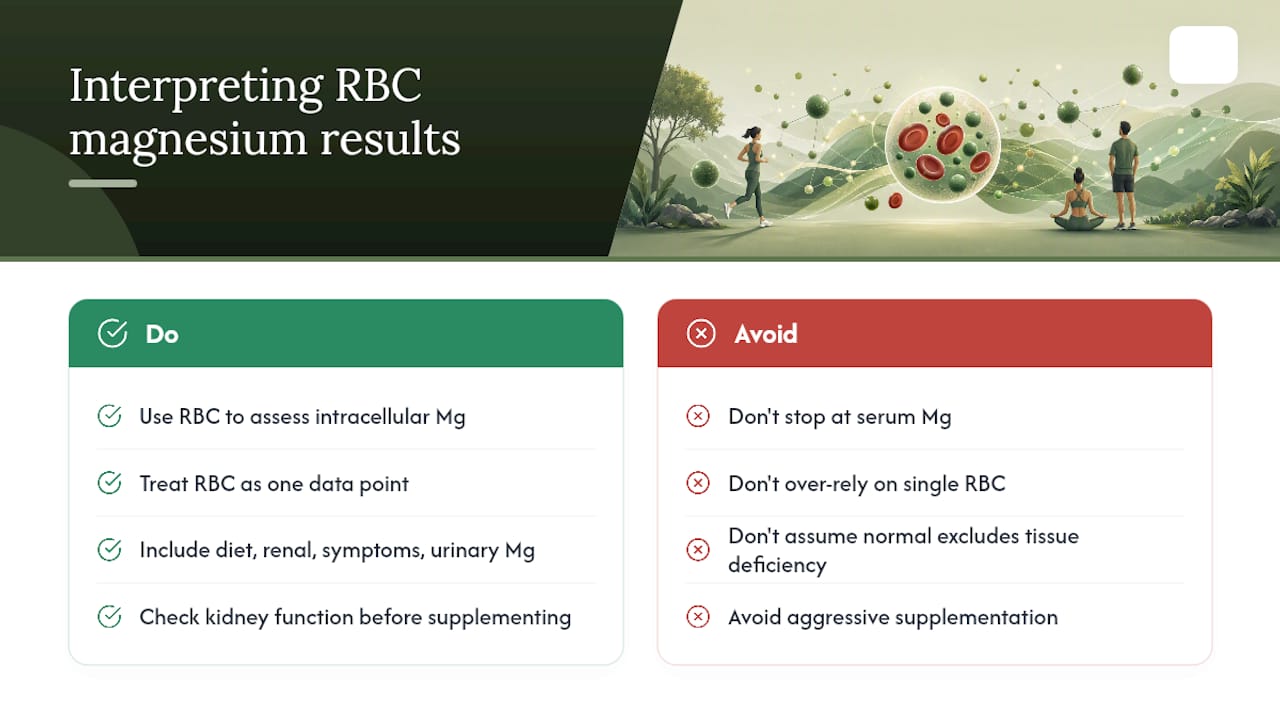
That said, I’d caution against over-relying on a single RBC result. A low number without clinical context can lead to aggressive supplementation that isn’t warranted, and a normal number doesn’t rule out localized tissue deficiencies in bone or heart muscle. The most defensible approach is to treat the RBC result as one data point in a broader picture that includes dietary history, renal function, symptoms, and ideally a urinary magnesium assessment.
The other thing worth saying plainly: if your result is low, please check your kidney function before supplementing heavily. Magnesium is cleared by the kidneys, and impaired clearance turns a well-intentioned supplement into a cardiac risk. That one step protects you.
Healthspan Holistic can help you act on your results
Getting your RBC magnesium tested is the first step. What comes next, reading the result in the context of your full health picture and building a plan that actually moves the needle, is where most people get stuck.

The 90 Day Journey to Longevity at Healthspan Holistic bundles advanced lab testing, AI-powered health data integration, and personalized one-on-one coaching into a single, structured program. You get your RBC magnesium and other key biomarkers tested, then work directly with a health coach to interpret results, select the right supplement forms, and build a retesting schedule that confirms real progress. It’s a concrete, guided path from “I have a lab result” to “I know what to do and I’m doing it.”
1st Time Customers can take advantage of our BUY 1 GET 1 50% OFF special offer on all supplements.
Sources
These are the primary sources used in this article. Bringing them to a clinical appointment can support a productive conversation about testing strategy:
This article provides general health information and is not a substitute for professional medical advice. Discuss any abnormal lab results with a qualified clinician, and confirm current testing and supplementation recommendations with your healthcare provider.
FAQ
What causes high RBC magnesium?
Elevated RBC magnesium is uncommon and most often linked to excessive magnesium supplementation or impaired kidney function that reduces magnesium clearance. If your result is high, your clinician will typically check renal function (eGFR) as the first step.
How do you treat low RBC magnesium?
Low RBC magnesium is usually addressed through dietary changes to increase magnesium-rich foods, clinician-guided supplementation (commonly magnesium glycinate or magnesium L-threonate), and correction of any underlying cause such as diuretic use or GI malabsorption. Retest after 3–6 months of consistent supplementation to confirm intracellular repletion.
Why would a doctor order a magnesium blood test?
A clinician orders a magnesium test to investigate symptoms like muscle cramps, fatigue, arrhythmias, or persistent low potassium, or to monitor patients on diuretics, PPIs, or diabetes medications that deplete magnesium. The RBC version is specifically useful when serum magnesium appears normal but symptoms or risk factors still suggest deficiency.
What is a concerning magnesium level?
A result below your lab’s reference range (for example, below 4.0 mg/dL on Quest’s scale) suggests intracellular depletion and warrants clinical follow-up. On the high end, elevated magnesium combined with impaired kidney function is the more urgent concern, as it can affect heart rhythm and neuromuscular function.
How is the magnesium RBC test different from a standard magnesium blood test?
A standard serum magnesium test measures magnesium in the liquid portion of blood and can appear normal even when cellular stores are low. The RBC magnesium test measures magnesium inside red blood cells, offering a more sensitive indicator of chronic intracellular deficiency, as confirmed by MedlinePlus and peer-reviewed clinical literature.
Leave a comment: