

TL;DR:
- A personalized holistic health plan addresses body, mind, emotions, and lifestyle to improve energy and extend wellness. It emphasizes assessing current health, setting meaningful goals, and layering habits gradually over time for sustainable change. Integrative health combines evidence-based practices with individual focus to support long-term well-being after age 45.
A step by step holistic health plan is a personalized framework that addresses your whole wellness — body, mind, emotions, and lifestyle — to restore energy, reduce chronic symptoms, and extend the years you spend feeling genuinely well. The medical term for this approach is integrative medicine, defined by the World Health Organization as an evidence-based synthesis of biomedical and traditional practices that places the person and their values at the center. For adults aged 45–75, this matters more than ever. The goal is not just a longer life. The goal is a longer healthy life, what Healthspan Holistic calls your healthspan.
What does a step by step holistic health plan actually include?
A complete wellness plan addresses at least four core pillars: physical health, emotional balance, nutrition, and lifestyle habits. Neglecting any one pillar causes the others to compensate temporarily, which leads to eventual decline. Balanced strengthening across all four produces compounding benefits over time. Think of it like a four-legged table. Remove one leg and the whole structure becomes unstable.
The integrative health framework shifts focus from disease management to helping people live meaningful lives through personalized, interdisciplinary care. That shift is significant. It means your plan is built around what thriving looks like for you, not around a generic checklist. For a deeper look at why this matters after 45, the case for this approach is worth reading before you start.
How do you assess your current health status effectively?
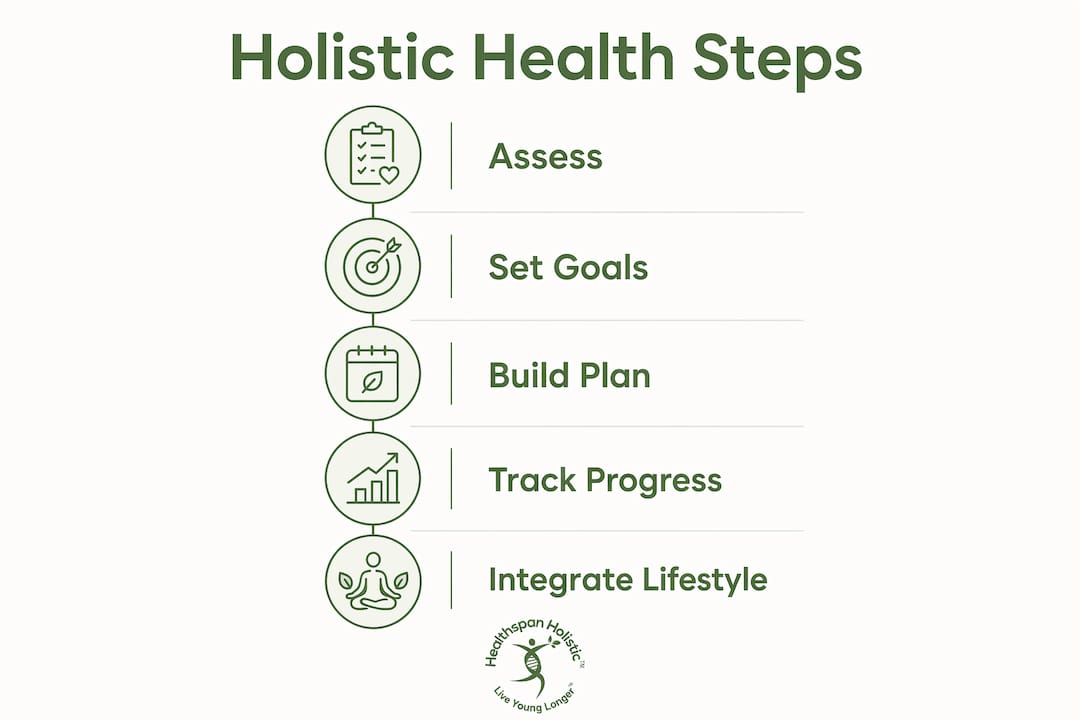
You cannot build a useful plan without knowing your starting point. A thorough self-assessment covers six domains: physical health, nutrition quality, sleep patterns, emotional well-being, stress levels, and social connections. Each domain gives you a different window into what is working and what needs attention.
Start with these practical tools:
- Symptom and energy journal: Log your energy levels, mood, and physical symptoms daily for two weeks. Note time of day, meals eaten, and sleep hours.
- Sleep quality log: Record not just hours slept but how rested you feel on waking, and any patterns like waking at 3 a.m. or difficulty falling asleep.
- Nutrition diary: Track what you eat and how you feel two hours later. Note bloating, energy crashes, or mental fog.
- Stress trigger map: Write down what triggered stress each day and how your body responded. Tightness in the chest? Fatigue? Irritability?
- Social connection check: Rate your sense of connection and belonging weekly on a simple 1–10 scale.
Detailed qualitative logs of dietary triggers, stress events, and sleep quality scores provide higher-quality data than general symptom descriptions. That means your journal entries are more diagnostic than a standard intake form at a doctor’s office.
Pro Tip: Bring your two-week journal to any health consultation. Specific patterns like “I crash every day at 2 p.m. after lunch” are far more useful than “I feel tired sometimes.” Specificity is what separates a plan that works from one that guesses.
A holistic health checklist tailored to adults 45–75 can help you structure this assessment phase so nothing important gets missed.
What are the steps to set clear, meaningful wellness goals?
Goals without personal meaning fade fast. Before writing a single goal, spend ten minutes answering this question: “What does thriving look like for me at this stage of life?” The answer might be hiking with your grandchildren, sleeping through the night, or simply getting through a workday without pain. That vision becomes your north star.
Once you have your vision, translate it into goals using the SMART framework adapted for wellness:
- Specific: “I will eat a nutrient-dense breakfast with protein and vegetables five days a week” beats “I will eat better.”
- Measurable: Attach a number or frequency so you know when you have succeeded.
- Achievable: Choose goals that stretch you without breaking you. For adults new to structured wellness, small wins build momentum.
- Relevant: Every goal should connect directly to your personal vision of thriving.
- Time-bound: Set a four-week review date for each goal so you can assess and adjust.
Focusing on one primary area at a time is the single most effective strategy for adults aged 45–75 beginning a wellness plan. Depth before breadth. Spend one month improving sleep before adding a new nutrition protocol. That sequencing prevents the overwhelm that causes most people to quit within six weeks.
Short-term goals might include sleeping seven hours four nights this week or walking 20 minutes three times this week. Long-term goals might include reducing inflammatory markers in a blood panel within 90 days or building a consistent morning routine within three months.
How do you build a personalized plan integrating nutrition, movement, sleep, and emotional care?
This is where your assessment and goals become a living plan. The key is layering habits gradually rather than overhauling everything at once. Adding one or two new wellness habits per week builds sustainable routines without burning out your willpower.

Nutrition
Whole foods form the foundation of metabolic health after 45. Prioritize nutrient-dense vegetables, quality proteins, healthy fats, and fiber-rich carbohydrates. Reduce ultra-processed foods, refined sugars, and seed oils. Circadian rhythms also affect digestion, so eating your largest meal earlier in the day supports better metabolic function.
Movement
Age-appropriate movement means consistency over intensity. Aim for 150 minutes of moderate activity per week, split across walking, swimming, cycling, or yoga. Add two sessions of resistance training weekly to protect muscle mass and bone density, both of which decline after 50 without deliberate effort.
Sleep
Sleep hygiene for midlife adults centers on three practices: a consistent bedtime and wake time seven days a week, a cool and dark bedroom, and a 30-minute wind-down routine that removes screens and introduces calm. Magnesium is one of the most common deficiencies affecting sleep quality in adults over 45. A magnesium RBC test can confirm whether deficiency is contributing to your sleep issues.
Emotional well-being
Mindfulness, breathwork, and gratitude journaling are not soft extras. They are evidence-based practices that regulate the nervous system and reduce cortisol. Five minutes of box breathing (inhale four counts, hold four, exhale four, hold four) before bed is a practical starting point.
Pro Tip: Do not try to add all four pillars in week one. Start with sleep. Everything else, your energy, your food choices, your mood, improves when sleep improves first.
Here is a simple four-week layering schedule to get started:
| Week | Focus area | Daily habit to add |
|---|---|---|
| 1 | Sleep | Set a consistent bedtime; start wind-down routine |
| 2 | Nutrition | Add one nutrient-dense meal per day |
| 3 | Movement | Add three 20-minute walks per week |
| 4 | Emotional care | Add five minutes of breathwork or journaling |
What strategies help you track progress and stay consistent long-term?
Tracking is what separates a plan you follow for three weeks from one you follow for three years. Monthly wellness reviews normalize inconsistency and strengthen long-term success. Schedule a 30-minute review on the first of each month to assess what is working, what is not, and what needs adjusting.
Common pitfalls to watch for:
- Trying too much too soon: If you added three new habits in week one and feel exhausted, pull back to one. Sustainability beats speed every time.
- Measuring only outcomes: Track behaviors, not just results. Did you walk three times this week? That is a win, regardless of what the scale says.
- Expecting linear progress: Energy, sleep, and mood all fluctuate. A bad week does not erase three good ones.
- Losing sight of your “why”: Return to your personal vision of thriving when motivation drops. Post it somewhere visible.
- Skipping the review: Without a monthly check-in, small drift becomes large derailment. Protect that 30 minutes.
Recalibrate your goals every 90 days. What felt ambitious at the start may feel easy by month three. Raise the bar gradually and celebrate the distance you have traveled, not just the distance remaining.
How does an integrative health approach enhance your plan after age 45?
Integrative medicine addresses biological, psychological, social, and behavioral dimensions simultaneously. That matters most for adults over 40 managing chronic conditions like cardiovascular disease, metabolic syndrome, or joint pain, where no single intervention is enough on its own.
Key elements of an integrative approach include:
- Personalized lab testing: Blood panels measuring inflammation markers, hormone levels, nutrient status, and metabolic function give you objective data to guide your plan. A basic heart health test is a practical starting point for cardiovascular risk assessment.
- Evidence-based supplements: Targeted supplementation fills nutritional gaps that diet alone cannot always address, particularly for mitochondrial function, bone density, and hormone balance.
- Collaborative care: Working with a health coach alongside your primary care provider creates a team approach that addresses the full picture.
- Mind-body connection: Practices like yoga, tai chi, and meditation are not alternatives to medicine. They are complements that reduce inflammatory markers and improve quality of life.
“A Whole Health approach empowers people as active participants in care, shifting healthcare from reactive disease focus to proactive, values-driven wellness.” — Southern California University of Health Sciences
Lifestyle medicine focuses on sustainable changes in nutrition, exercise, sleep, and stress that can prevent or reverse chronic disease. That is not a promise of a cure. It is a recognition that the body has a remarkable capacity to restore itself when given the right conditions.
Key takeaways
A step by step holistic health plan works best when you assess your baseline honestly, focus on one pillar at a time, and review your progress every 30 days.
| Point | Details |
|---|---|
| Assess before you plan | Log energy, sleep, stress, and nutrition for two weeks before setting any goals. |
| One pillar at a time | Focus on sleep, then nutrition, then movement to build habits that last. |
| Use SMART goals | Attach specific numbers and review dates to every wellness goal you set. |
| Layer habits weekly | Add one or two new practices per week to avoid burnout and early dropout. |
| Review monthly | A 30-minute monthly check-in keeps your plan aligned with your evolving needs. |
What I have learned from watching people build these plans
I have seen a consistent pattern over the years. The people who succeed with a wellness plan are almost never the ones who overhaul everything at once. They are the ones who pick one thing, do it consistently for four weeks, and then add the next thing. It sounds almost too simple. But that simplicity is the point.
The biggest mistake I see adults in their 50s and 60s make is treating a wellness plan like a project with a finish line. They go hard for 30 days, see some results, and then ease off because they feel “done.” Health is not a project. It is a practice. The goal is not to complete it. The goal is to keep showing up.
I also want to say something about data. Wearables, blood panels, and lab tests are genuinely useful. They give you objective information that your subjective experience cannot always provide. But they are tools, not the plan itself. The plan lives in your daily choices. The data just helps you make better ones.
If you are starting from a place of low energy, chronic pain, or years of neglect, please be patient with yourself. The body responds to consistent care. It just takes longer than a 30-day program promises. Start with holistic living tips built specifically for your age group, and build from there.
— Chris
Ready to put your plan into action with Healthspan Holistic?
Healthspan Holistic’s 90 Day Journey to Longevity gives you a structured, coach-supported program designed specifically for adults over 40 who are ready to build lasting wellness. It combines personalized health coaching, lab-based diagnostics, and targeted supplementation into one cohesive plan.

The supplement store at Healthspan Holistic carries professional-grade formulas supporting energy, cardiovascular health, mitochondrial function, and nutritional optimization. Products like ActivNutrients multivitamin capsules are formulated for the specific needs of adults 45 and older.
1st Time Customers can take advantage of our BUY 1 GET 1 50% OFF special offer on all supplements.
FAQ
What is a holistic health plan?
A holistic health plan is a personalized wellness framework that addresses physical health, nutrition, sleep, emotional well-being, and lifestyle habits together. The WHO defines integrative medicine as placing the whole person and their values at the center of care.
How long does it take to see results from a holistic wellness plan?
Most people notice meaningful changes in energy and sleep within four to eight weeks of consistent practice. Deeper improvements in inflammation, metabolic health, and chronic symptoms typically require 90 days or more of sustained effort.
What is the best first step for adults over 45 starting a wellness plan?
Start with a two-week self-assessment covering sleep, nutrition, stress, and energy. Detailed qualitative logs of triggers and patterns give you better data than general symptom descriptions and make every subsequent step more targeted.
How is integrative medicine different from conventional medicine?
Integrative medicine combines evidence-based biomedical care with lifestyle, nutritional, and mind-body practices. It focuses on prevention and whole-person wellness rather than treating symptoms after they appear.
How do I stay consistent with a holistic health plan long-term?
Schedule a 30-minute monthly wellness review to assess progress and adjust habits. Normalizing setbacks and focusing on incremental improvements rather than perfection is the most reliable strategy for long-term consistency.
Leave a comment: