

For optimal thyroid function, request this core panel: TSH, Free T4, Free T3, Reverse T3, TPO Antibodies, and Thyroglobulin Antibodies, plus key cofactors including ferritin, vitamin D, B12, and morning cortisol. The American Thyroid Association confirms that TSH alone can miss clinically relevant dysfunction when symptoms persist, making a multi-marker approach the standard for anyone pursuing true thyroid optimization labs.
Your immediate panel checklist:
-
TSH (target optimal within a narrower range than standard lab references, often between 1.0 and 2.0 mIU/L in functional contexts)
-
Free T4 (target optimal generally above the lower standard lab reference, often around 1.1 to 1.8 ng/dL in functional contexts)
-
Free T3 (target optimal typically in the higher portion of the standard lab range, often around 3.2 to 4.2 pg/mL in functional contexts)
-
Reverse T3 (target optimal generally considered to be below a moderate cutoff, commonly around 15 ng/dL according to some clinicians)
-
TPO Antibodies (target below typical upper laboratory normal limits)
-
Thyroglobulin Antibodies (target below typical upper laboratory normal limits)
-
Ferritin (target often higher than deficiency thresholds to support thyroid function)
-
Vitamin D (25-OH) (target often in the upper range of sufficiency for optimal thyroid support)
-
Morning cortisol (target within a normal physiological range in the morning)
When to seek urgent referral: TSH above 10 mIU/L, TSH below 0.1 mIU/L, or Free T4 outside the reference range entirely warrants prompt endocrinology evaluation rather than watchful waiting.
Key Takeaways
A comprehensive thyroid hormone assessment requires at minimum six core markers plus targeted cofactor labs; TSH alone routinely misses conversion problems, autoimmune activity, and nutrient-driven dysfunction.
| Point | Details |
|---|---|
| Order six core markers | TSH, Free T4, Free T3, RT3, TPO Ab, and TgAb together reveal patterns a single TSH cannot. |
| Target optimization ranges | Free T3 optimal target is 3.2–4.2 pg/mL; TSH optimal target is 1.0–2.0 mIU/L, narrower than lab normals. |
| Include cofactor labs | Ferritin, vitamin D, and morning cortisol should accompany every thyroid panel to avoid misinterpretation. |
| Prepare before your draw | Stop biotin 48–72 hours prior, delay levothyroxine until after the draw, and test between 7–9 AM. |
| Healthspan Holistic next step | The 90 Day Journey to Longevity combines full panel ordering, AI data integration, and personalized coaching. |
1. What each thyroid optimization lab test actually measures
A complete thyroid hormone assessment goes well beyond a single TSH number. Each marker tells a different part of the story, and understanding what each one measures helps you have a more productive conversation with your provider.
TSH (Thyroid-Stimulating Hormone)
TSH is the pituitary’s signal to the thyroid gland, rising when the body senses low thyroid hormone and falling when levels are adequate. It is the most sensitive early-warning marker for primary thyroid dysfunction, and the ATA recommends it as the appropriate first test. The standard lab reference range is roughly 0.4–4.5 mIU/L, but some clinicians target a narrower range for symptomatic patients to better capture optimal thyroid function. TSH reflects pituitary output, not tissue-level thyroid hormone activity, so a “normal” TSH does not guarantee adequate Free T3 at the cellular level.
Free T4 and Free T3
Free T4 is generally preferred over total T4 because only the unbound fraction can enter tissues. Binding-protein changes from pregnancy, estrogen therapy, or liver disease shift total T4 without changing actual hormone availability. Free T4 (optimal target generally above the lower standard lab reference) reflects the thyroid gland’s output. Free T3 (optimal target generally in the higher portion of the lab range) is the biologically active hormone at the tissue level; the body converts T4 to T3 through deiodinase enzymes, and this conversion step is where many symptomatic patients with “normal” TSH actually have a problem. For a deeper look at T3 and T4 physiology, the conversion process and what affects it are worth understanding before your appointment.
Reverse T3 (RT3)
Reverse T3 is an inactive metabolite produced when the body converts T4 through an alternate pathway, essentially blocking T3 receptor sites. Elevated RT3 can signal chronic stress, caloric restriction, acute illness, or iron deficiency. Cleveland Clinic Laboratories notes that RT3 is not recommended for routine thyroid screening and is sensitive to specimen handling, but it can be informative in specific clinical contexts, particularly when Free T3 is low despite adequate T4. The target is generally below a moderate cutoff commonly considered around 15 ng/dL, with a Free T3:RT3 ratio above 20 (using pg/mL and ng/dL respectively) considered favorable by many optimization-focused clinicians.
Thyroid Antibodies: TPO Ab and TgAb
TPO (thyroid peroxidase) antibodies and Thyroglobulin antibodies identify autoimmune thyroid activity, the underlying mechanism in Hashimoto’s thyroiditis. You can have elevated antibodies with completely normal hormone levels for years before overt dysfunction appears. Running antibodies matters because a positive result changes management: it prompts closer monitoring intervals, lifestyle modifications (gluten sensitivity screening, selenium support), and a lower threshold for treatment if symptoms emerge.
Optional markers
Total T4 and Total T3 add value mainly when binding-protein abnormalities are suspected. Thyroglobulin (the protein, not the antibody) is used primarily for thyroid cancer surveillance after thyroidectomy, not for general optimization panels.
Optimal ranges vs. standard lab normals:
Note: Optimal ranges above reflect targets used in functional and integrative medicine contexts. They are not universally adopted by all endocrinology guidelines. Interpret alongside symptoms and clinical context.
Pro Tip: If cost or access limits your panel, prioritize TSH + Free T3 + Free T4 first. Add RT3 and antibodies on the second draw if results are discordant or symptoms persist.
2. How to read common result patterns and what they usually mean
Lab numbers only become useful when you read them as a pattern, not as isolated values. Hypothyroidism can present with subtle or nonspecific symptoms like fatigue, brain fog, cold intolerance, and weight gain, and those symptoms can persist even when initial screening looks “normal.” Here are the patterns that matter most.
Pattern 1: High TSH + Low Free T4 This is classic primary hypothyroidism. The pituitary is signaling urgently because the thyroid gland is not producing enough T4. TSH above 10 mIU/L with low Free T4 warrants prompt treatment and endocrinology referral. TSH between 4.5 and 10 mIU/L with symptoms (subclinical hypothyroidism) is a judgment call that depends on symptom burden, antibody status, and patient preference.
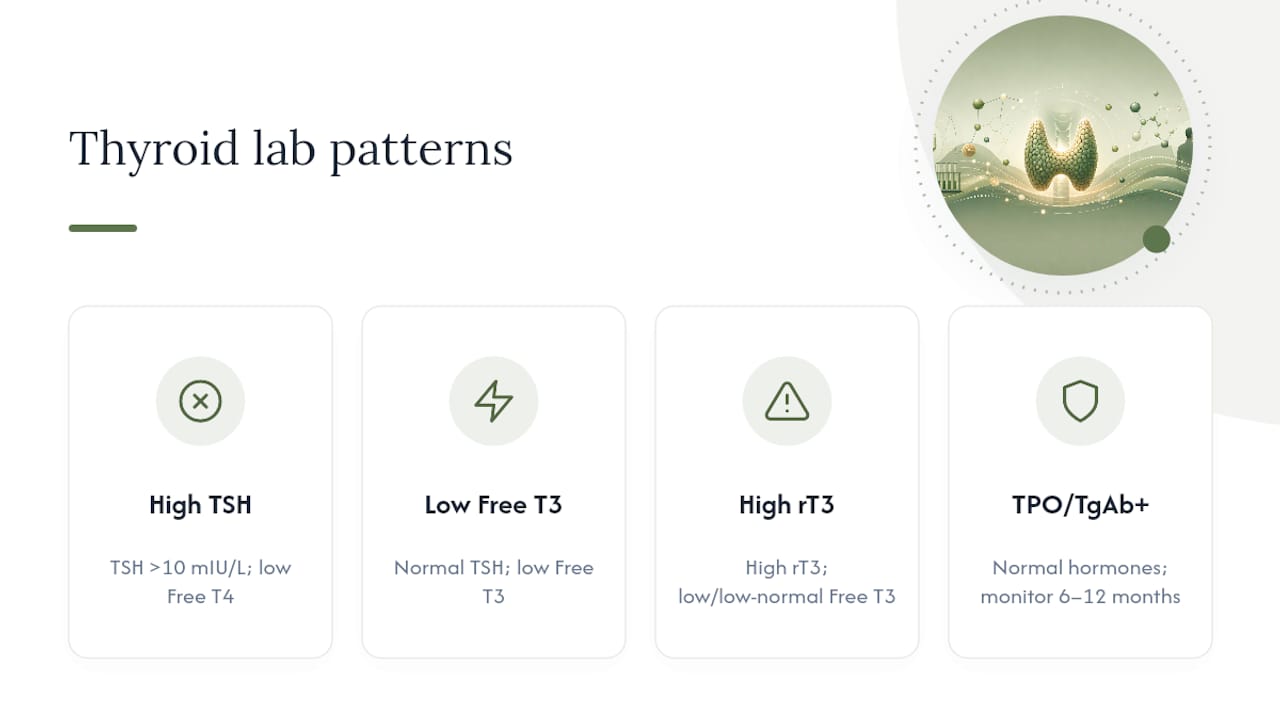
Pattern 2: Normal TSH + Low Free T3 This is the conversion problem pattern, and it is the most common reason symptomatic patients feel dismissed after a “normal” TSH result. The thyroid is producing T4, the pituitary is satisfied, but peripheral conversion to the active T3 form is impaired. Causes include chronic stress, inflammation, nutrient deficiencies (iron, selenium, zinc), and low-calorie dieting. This pattern often responds to addressing the underlying driver rather than adding thyroid medication immediately.
Pattern 3: High Reverse T3 with Low or Low-Normal Free T3 When RT3 is elevated and Free T3 is simultaneously low or low-normal, the body is shunting T4 away from the active pathway. This pattern frequently accompanies acute illness, prolonged caloric restriction, high cortisol states, or significant iron deficiency. Treating the RT3 number directly is not the goal; identifying and correcting the underlying driver is.
Pattern 4: Positive TPO/TgAb with Normal Hormones Autoimmune activity is present, but the thyroid gland is still compensating. This is the Hashimoto’s pre-clinical window. Management at this stage focuses on monitoring every 6–12 months, reducing inflammatory triggers, and optimizing selenium and vitamin D levels. No hormone replacement is typically needed yet, but knowing the antibodies are elevated changes the long-term picture entirely.
When to refer to endocrinology: TSH below 0.1 or above 10 mIU/L, Free T4 outside the reference range, a new thyroid nodule on imaging, or a patient who remains symptomatic despite optimized labs all warrant specialist involvement.
3. Cofactor labs that directly affect your thyroid results
Thyroid hormones do not work in isolation. Several nutrient and hormonal factors either enable thyroid hormone production and conversion or mimic thyroid symptoms so closely that missing them leads to misinterpretation. These are the cofactor tests worth adding to your panel.
-
Ferritin and iron studies (serum iron, TIBC, transferrin saturation): Iron is required for thyroid peroxidase enzyme activity. Low ferritin (below 50 ng/mL) impairs T4 production and T4-to-T3 conversion. Ferritin below 30 ng/mL is a common hidden driver of persistent fatigue even when thyroid hormones look adequate.
-
Vitamin D (25-OH): Vitamin D receptors are present on thyroid tissue, and low vitamin D is associated with higher TPO antibody levels. Target 50–80 ng/mL for thyroid-specific optimization.
-
Vitamin B12: Deficiency produces fatigue, brain fog, and peripheral tingling that overlap almost perfectly with hypothyroid symptoms. Serum B12 above 500 pg/mL is a reasonable functional target.
-
Selenium: The deiodinase enzymes that convert T4 to T3 are selenium-dependent. Deficiency slows conversion and may worsen autoimmune activity.
-
Zinc: Zinc is needed for TSH receptor function and T3 production. Low zinc can suppress Free T3 even when T4 is adequate.
-
Morning cortisol (8 AM serum): High cortisol from chronic stress suppresses TSH and promotes RT3 production. Low cortisol (adrenal insufficiency) can also impair thyroid hormone utilization. A 4-point salivary cortisol test gives more detail when the morning value is borderline.
-
Basic metabolic panel (BMP): Electrolyte and kidney function abnormalities can affect thyroid hormone binding and metabolism.
-
CBC (complete blood count): Anemia, whether iron-deficiency or B12-related, amplifies thyroid symptoms and can confound interpretation.
-
Lipid panel: Elevated LDL and total cholesterol are a classic hypothyroid finding. A lipid panel helps confirm clinical picture and track treatment response.
-
Sex hormones (estradiol, testosterone, SHBG) when clinically relevant: Estrogen raises thyroid-binding globulin, which lowers free hormone fractions. Women on estrogen therapy or with hormonal imbalances may show misleadingly low Free T4 on total-hormone assays.
Priority order if you cannot run everything at once: Start with ferritin, vitamin D, and morning cortisol. These three have the highest likelihood of directly altering your thyroid interpretation or explaining persistent symptoms.
4. Getting accurate results: timing, medications, and specimen handling
Even a perfectly chosen panel can produce misleading results if the blood draw is not prepared correctly. These logistics matter more than most people realize.
-
Draw blood in the morning, ideally between 7 and 9 AM. TSH follows a circadian rhythm, peaking in the early morning and dropping through the afternoon. Afternoon draws can underestimate TSH by a meaningful margin, particularly in borderline cases.
-
If you take levothyroxine (T4), delay your morning dose until after the draw. Taking levothyroxine before the draw artificially elevates Free T4 for 4–6 hours post-dose, producing a falsely high result. Draw first, then take your medication.
-
If you take liothyronine (T3 or combination therapy), the same rule applies. T3 peaks within 2–4 hours of ingestion. Drawing before your dose gives a trough level that better reflects your baseline status.
-
Stop biotin (vitamin B7) at least 48–72 hours before the draw. Biotin and estrogen can interfere with thyroid assays and produce falsely abnormal results. High-dose biotin (5,000 mcg or more, common in hair and nail supplements) is the most common culprit for spurious thyroid results in otherwise healthy adults.
-
Avoid iodine-containing supplements and contrast dye for at least 4 weeks before testing if you are assessing baseline thyroid function. Excess iodine can transiently suppress or stimulate thyroid output.
-
For Reverse T3 specifically, specimen handling is critical. RT3 assays require rapid serum separation and sometimes freezing for transport. Confirm with your lab that their RT3 protocol includes proper cold-chain handling; a mishandled specimen can produce an inaccurate result that changes clinical decisions.
-
Fast for at least 8 hours if including a lipid panel or fasting glucose. Thyroid tests themselves do not require fasting, but cofactor tests often do.
-
Note any recent illness, surgery, or significant stress before interpreting results. Acute illness suppresses TSH and elevates RT3 transiently. Testing during or immediately after a significant stressor produces a “sick euthyroid” pattern that does not reflect your true baseline.
5. How to order these labs in the U.S. and what to do with the results
You have three main routes to access a comprehensive thyroid panel in the United States, and each has real trade-offs.
Primary care physician or internist is the most common starting point. Your PCP can order the full panel, bill insurance, and coordinate follow-up. The limitation is that many PCPs order only TSH on the first visit and may not add Free T3, RT3, or antibodies unless you specifically request them. Come prepared with a written list of the tests you want and a brief explanation of your symptoms. For guidance on when and why to check thyroid levels, having that context ready helps the conversation.
Endocrinologist is the right referral when TSH is significantly abnormal, when antibodies are elevated, when a nodule is present, or when you remain symptomatic despite treatment. Wait times for endocrinology appointments can run 2–4 months in many U.S. markets, so starting with your PCP while waiting for the referral is a practical approach.
Direct-to-consumer (DTC) labs Healthspan Holistic offers a comprehensive thyroid panel which includes Free T3, Free T4, TSH, RT3, and antibodies. Turnaround is typically 2–5 business days for standard markers; RT3 may take longer due to handling requirements. DTC labs do not bill insurance, so you pay out of pocket, but they give you access to the full panel quickly and without gatekeeping.
Monitoring timeline after treatment changes:
-
New diagnosis or medication start: retest TSH and Free T4 at 6–8 weeks after any dose change.
-
Adding T3 (liothyronine or combination therapy): retest Free T3 at 4 weeks, then TSH and Free T4 at 8 weeks.
-
Stable on therapy: annual full panel including antibodies and cofactors is reasonable for most people.
-
Symptomatic despite stable labs: retest the full panel including RT3, cortisol, and ferritin before assuming the thyroid is the problem.
Questions to bring to your provider:
-
“My TSH is within range, but my Free T3 is in the lower third. Can we discuss conversion support?”
-
“My TPO antibodies are elevated. What monitoring schedule do you recommend?”
-
“Can we add ferritin and vitamin D to this order to rule out cofactor deficiencies?”
What I look for first when a symptomatic patient’s TSH looks “normal”
The most revealing scenario in thyroid work is the client who arrives with textbook hypothyroid symptoms and a TSH of 2.8. Technically normal. Practically, possibly not.
The first thing I want to see is where Free T3 sits relative to the upper half of its range. A TSH of 2.8 with a Free T3 of 2.5 pg/mL tells a very different story than the same TSH with a Free T3 of 3.8 pg/mL. The pituitary is satisfied in both cases. The tissues may not be. That gap is where thyroid symptoms persist despite normal screening and where a single-marker approach fails the patient.
The second thing I check is ferritin. I have seen clients with Free T3 in the low-normal range whose fatigue resolved entirely once ferritin was brought from 22 ng/mL to 85 ng/mL, with no thyroid medication ever prescribed. The conversion enzymes simply needed the raw material to work.
The third variable is cortisol. Chronic stress is a powerful RT3 driver, and a client who is also running on elevated cortisol will keep shunting T4 toward RT3 regardless of how well you optimize their thyroid medication. Treating the thyroid number without addressing the stress physiology is like refilling a leaking tank.
What I tell clients consistently: the panel is a starting point, not a verdict. Marginal or discordant results almost always need a second draw 4–6 weeks later, ideally under identical pre-test conditions, before any treatment decision is made. Patience with the process produces better outcomes than reacting to a single data point.
Pro Tip: Track symptoms on a simple 1–10 scale for energy, cognition, and cold tolerance for the 2 weeks before their follow-up draw. Symptom trends alongside lab trends give you far more to work with than numbers alone.
Ready to order your full thyroid panel with expert interpretation?
If you have been told your thyroid is “fine” but you still feel exhausted, foggy, or cold all the time, a standard TSH result is not the whole answer. Healthspan Holistic gives you access to a comprehensive thyroid hormone panel, plus the option to add cofactor labs that most standard workups skip, all paired with personalized coaching to help you understand what your results actually mean for your health.
The 90 Day Journey to Longevity includes advanced lab ordering, AI-powered data integration, and one-on-one coaching, giving you a structured 90-day pathway from testing to real, measurable change. You can also add the Basic Heart Health Test to your order to capture the cardiovascular and metabolic markers that often shift alongside thyroid function.
1st Time Customers can take advantage of our BUY 1 GET 1 50% OFF special offer on all supplements.
Sources
FAQ
What are optimal thyroid labs?
Optimal thyroid labs include TSH (target 1.0–2.0 mIU/L), Free T4 (1.1–1.8 ng/dL), Free T3 (3.2–4.2 pg/mL), Reverse T3 (below 15 ng/dL), TPO antibodies, and Thyroglobulin antibodies, plus cofactors like ferritin and vitamin D. These targets are narrower than standard lab reference ranges and are used in functional and integrative medicine to address persistent symptoms.
What markers make up a full thyroid panel?
A full thyroid panel typically includes TSH, Free T4, Free T3, Reverse T3, TPO antibodies, and Thyroglobulin antibodies. Comprehensive optimization panels also add ferritin, vitamin D, B12, selenium, zinc, and morning cortisol to rule out cofactor-driven dysfunction.
What is thyroid optimization?
Thyroid optimization means moving thyroid hormone levels into the narrower functional ranges where most people feel their best, rather than simply landing anywhere within broad lab reference ranges. It involves a multi-marker approach, cofactor correction, and symptom-guided interpretation rather than treating a single TSH number.
Can TSH alone miss thyroid dysfunction?
Yes. The American Thyroid Association acknowledges that TSH alone can miss clinically relevant dysfunction, particularly when conversion from T4 to Free T3 is impaired or when autoimmune activity is present with normal hormone levels. Adding Free T3 and antibodies to the panel catches patterns TSH cannot.
How often should you retest thyroid labs?
After a medication change, retest TSH and Free T4 at 6–8 weeks. Once stable on therapy, a full annual panel including antibodies and cofactors is appropriate for most adults. Retest sooner if symptoms return or worsen between scheduled draws.
Leave a comment: