

Testosterone therapy is a medical treatment that restores clinically low testosterone to a normal physiologic range. It is appropriate only when you have confirmed hypogonadism: symptoms plus two separate low early-morning testosterone measurements. The Endocrine Society and the FDA are clear that normal age-related testosterone decline alone, without symptoms and biochemical confirmation, is not a sufficient reason to start therapy.
Who typically qualifies:
-
Men with documented symptoms of low testosterone and two confirmed low morning total testosterone lab results
-
Those with primary hypogonadism (testicular failure) or secondary hypogonadism (pituitary or hypothalamic dysfunction)
Who typically should not start therapy:
-
Men with healthy aging and no biochemical hypogonadism, even if they feel tired or less energetic
-
Anyone actively trying to conceive, since exogenous testosterone suppresses sperm production
Safety callout: Testosterone therapy requires ongoing medical monitoring, including hematocrit, PSA, and testosterone levels. Starting without proper baseline testing and follow-up is unsafe.
Key Takeaways
Testosterone therapy produces real, evidence-backed benefits, but only for people with clinically confirmed hypogonadism, two low morning labs, and a commitment to ongoing monitoring.
| Point | Details |
|---|---|
| Confirmed diagnosis required | Two separate early-morning testosterone labs plus symptoms are needed before starting therapy. |
| Monitoring is mandatory | Hematocrit, PSA, and testosterone levels must be checked at baseline, 3–6 weeks, and every 3–6 months. |
| Fertility risk is real | Exogenous testosterone suppresses sperm production; discuss fertility intentions before any prescription. |
| Benefits are targeted | Sexual function, lean mass, bone density, and mood improve in confirmed hypogonadism; non-specific fatigue may not respond. |
| Healthspan Holistic | Offers comprehensive baseline panels, AI-powered analytics, and coaching to support safe, guideline-aligned hormone evaluation. |
What does testosterone therapy actually do in your body?
Testosterone is produced primarily in the testes, regulated by the hypothalamic-pituitary-gonadal (HPG) axis. The hypothalamus releases GnRH, which signals the pituitary to release LH and FSH, which in turn stimulate testicular testosterone production. When that system breaks down at any level, testosterone falls below the range your body needs to function well.
The hormone plays roles across multiple systems:
-
Sexual function: libido, erectile quality, and nocturnal erections
-
Musculoskeletal health: lean muscle mass, strength, and bone density
-
Metabolic function: fat distribution, insulin sensitivity, and red blood cell production
-
Mood and cognition: energy, motivation, and emotional stability
The clinical goal of testosterone replacement therapy is to restore serum testosterone to the mid-normal physiologic range, not to push levels above normal. Therapy types include exogenous replacement (gels, injections, pellets) and alternatives that stimulate your body’s own production, such as selective estrogen receptor modulators (SERMs) and human chorionic gonadotropin (hCG).
Who is a candidate for testosterone therapy?
The most important clinical challenge is separating true hypogonadism from the gradual, expected testosterone decline that comes with aging. Testosterone tends to decline gradually with age after 30 in most men, but that alone does not constitute hypogonadism and does not warrant treatment.
Primary vs. secondary hypogonadism
Primary hypogonadism originates in the testes. Causes include Klinefelter syndrome, testicular trauma or torsion, chemotherapy, and radiation. LH and FSH are typically elevated because the pituitary is working harder to compensate.
Secondary hypogonadism originates in the pituitary or hypothalamus. Causes include pituitary tumors, obesity, opioid use, and hyperprolactinemia. LH and FSH are low or inappropriately normal.
Distinguishing the two matters because secondary hypogonadism often responds to fertility-preserving alternatives rather than exogenous testosterone.
Symptoms that warrant testing
According to StatPearls/NCBI, high-suspicion symptoms include:
-
Reduced libido and fewer spontaneous or nocturnal erections
-
Low energy and persistent fatigue not explained by other causes
-
Decreased muscle mass and increased body fat
-
Depressed mood, irritability, or difficulty concentrating
-
Small testes or reduced facial/body hair
-
Decreased bone density or unexplained fractures
If you recognize several of these, the next step is lab testing, not a prescription.
How is low testosterone diagnosed?
Diagnosis requires more than a single blood draw. A proper workup protects you from starting therapy you may not need and from missing a treatable underlying cause.
Required diagnostic steps
-
Two separate early-morning, fasting total testosterone measurements on different days. Morning timing matters because testosterone peaks between 7 and 10 AM and can vary by 30% or more across the day.
-
Free testosterone when a binding disorder is suspected (obesity, liver disease, thyroid dysfunction), since total testosterone may appear normal while bioavailable levels are low.
-
LH and FSH to distinguish primary from secondary hypogonadism and guide treatment selection.
-
Repeat testing if results are borderline. The Endocrine Society recommends standardized, CDC HoST-certified assays when available, because assay variability between labs can produce meaningfully different results.
Baseline safety tests before starting therapy
-
CBC/hematocrit: establishes your red blood cell baseline before therapy raises it
-
PSA: required for men over 40 before initiating therapy
-
Lipid panel and fasting glucose/HbA1c: cardiovascular and metabolic risk assessment
-
Liver function tests: especially relevant for oral formulations
-
Fertility discussion: if you want biological children, a semen analysis and referral to a reproductive urologist should happen before any prescription is written
What forms of testosterone therapy are available?
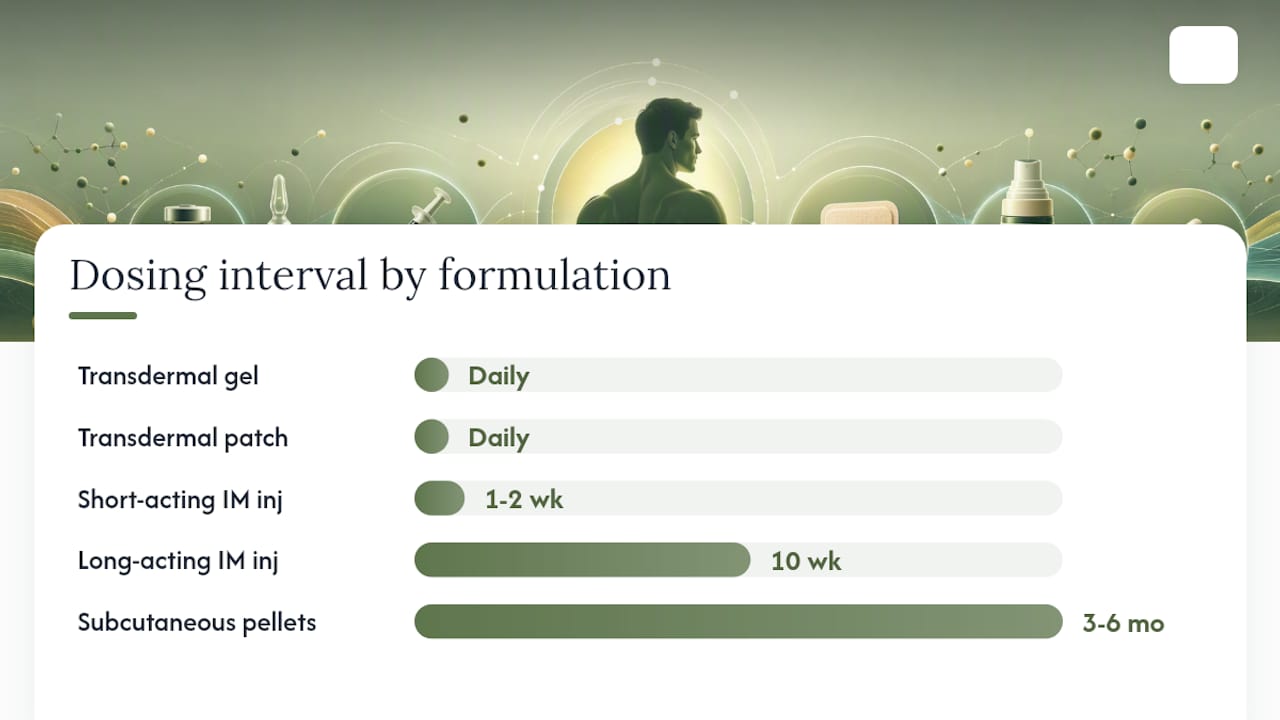
Delivery method affects how often you need to act, how stable your levels stay, and what side effects you are most likely to encounter. The AAFP notes that treatment adherence correlates strongly with treatment burden, meaning frequency and route of administration directly influence whether therapy works in real life.

| Formulation | Frequency | Key Advantages | Key Considerations | |
|---|---|---|---|---|
| Transdermal gel | Daily | Stable levels, easy to adjust dose | Skin transfer risk to partners/children; daily application | |
| Transdermal patch | Daily | Consistent absorption | Skin irritation common; visible | |
| Short-acting IM injection | Every 1–2 weeks | Low cost, widely available | Level peaks and troughs; self-injection required | |
| Long-acting IM injection (undecanoate) | Every 10 weeks | Stable levels, infrequent dosing | In-office administration; higher upfront cost | |
| Subcutaneous pellets | Every 3–6 months | Very low daily burden | Minor surgical procedure; dose not adjustable once inserted | |
| Buccal/oral (testosterone undecanoate) | Twice daily with meals | No injection or skin transfer | GI side effects; twice-daily timing with fat-containing meals |
For practical guidance on injections specifically, the testosterone injections guide at Healthspan Holistic covers administration, side-effect management, and what to expect.
Pro Tip: If you travel frequently or have an unpredictable schedule, a long-acting injectable or pellet formulation may reduce the chance of missed doses. Discuss your daily routine with your clinician before choosing a delivery method.
What benefits can you realistically expect?
Testosterone therapy can produce meaningful improvements, but the gains are targeted and depend heavily on whether true hypogonadism is present. Men with normal testosterone who pursue therapy for general vitality are unlikely to see the same results.
Benefits with the strongest clinical evidence include:
-
Sexual function: libido and erectile function improve in men with confirmed hypogonadism, though testosterone therapy is not a standalone treatment for erectile dysfunction caused by vascular disease
-
Lean body mass and strength: modest but consistent gains in muscle mass and reductions in fat mass across multiple trials
-
Bone mineral density: meaningful improvements, particularly at the lumbar spine, with longer-term therapy
-
Mood and depressive symptoms: improvements in selected patients, especially those with low mood tied to confirmed low testosterone
What the evidence shows: A pooled analysis of 35 trials involving 5,601 participants found that testosterone replacement therapy improved sexual function and quality-of-life measures. Cardiovascular and cerebrovascular events showed no statistically significant increase in the short-to-medium term (OR 1.07, 95% CI 0.81–1.42), though long-term safety data remain limited.
Non-specific complaints like fatigue, brain fog, and low motivation may or may not respond. If those symptoms exist without biochemical hypogonadism, other causes deserve investigation first.
What are the risks, and how do you monitor them?
Testosterone therapy is safe when managed properly. The risks are real but manageable with the right monitoring schedule.
Main side effects and risks
-
Erythrocytosis (elevated hematocrit): the most common lab abnormality; raises blood viscosity and clot risk if hematocrit climbs above 54%
-
Acne and oily skin: common, especially early in therapy
-
Prostate stimulation: therapy does not cause prostate cancer, but it can stimulate growth of existing disease; PSA monitoring is mandatory
-
Worsening obstructive sleep apnea: testosterone can worsen existing OSA; screen before starting
-
Reduced fertility: suppression of the HPG axis reduces sperm production (covered in detail below)
-
Mood and behavior changes: rare at physiologic doses but possible
For a deeper look at hematocrit management specifically, the hematocrit on HRT guide walks through what thresholds to watch and when to act.
Contraindications and caution flags
Therapy should be avoided or paused in men with:
-
Active or suspected prostate or breast cancer
-
Hematocrit above 54%
-
Uncontrolled heart failure or active venous thromboembolism
-
Untreated severe obstructive sleep apnea
-
Strong desire for fertility without a fertility-preservation plan in place
Recommended monitoring schedule
The Endocrine Society recommends this monitoring protocol as long as therapy continues, not just in the first year.
Monitoring matters: Erythrocytosis is the most common reason therapy is paused or the dose is reduced. Catching a rising hematocrit early, before it crosses 54%, keeps therapy on track safely.
How does testosterone therapy affect fertility?
This is the conversation that does not happen often enough before a prescription is written. Exogenous testosterone suppresses the HPG axis, which reduces LH and FSH signaling to the testes. The result is a significant drop in sperm production, sometimes to zero, within weeks to months of starting therapy.

According to StatPearls, spermatogenesis may not fully recover in some men after stopping therapy, making this a decision with potentially permanent consequences for fertility.
Fertility-preserving alternatives
The AUA Testosterone Deficiency Guideline defines testosterone therapy broadly to include options that stimulate your body’s own production:
-
hCG (human chorionic gonadotropin): mimics LH to stimulate testicular testosterone production while preserving sperm output
-
Enclomiphene citrate (a SERM): blocks estrogen feedback at the pituitary, raising LH and FSH and stimulating endogenous testosterone
-
Sperm banking: strongly recommended before starting any form of testosterone therapy if future biological children are a possibility
For men interested in peptide-based approaches that support endogenous hormone pathways, sermorelin represents one alternative worth discussing with a clinician.
The actionable step: Before any prescription is written, tell your clinician whether you want biological children. That single conversation changes the treatment options on the table.
When will you feel better, and how long does therapy last?
Testosterone therapy is not a quick fix. Different systems respond at different rates, and setting realistic expectations from the start prevents early abandonment.
-
Libido and energy: some improvement may appear within 3–6 weeks, though individual responses vary
-
Mood and depressive symptoms: changes often become noticeable within 6–12 weeks
-
Muscle mass and strength: measurable gains typically require 3–6 months of consistent therapy
-
Bone mineral density: meaningful changes take 12 months or longer and require DEXA scan confirmation
When therapy is initiated for confirmed hypogonadism, it is typically continued long-term. Stopping is not straightforward. Because exogenous testosterone suppresses the HPG axis, natural production may take months to recover after discontinuation, and recovery is sometimes incomplete. If you are considering stopping, plan that conversation with your clinician well in advance rather than stopping abruptly.
What do the major guidelines actually say?
The Endocrine Society, AUA, and FDA labeling all converge on the same core message: diagnosis requires symptoms plus confirmatory lab evidence, and monitoring is mandatory throughout therapy.
Key consensus points:
-
Therapy is indicated for hypogonadism, not for normal aging without biochemical confirmation
-
Standardized assays reduce the risk of misdiagnosis from lab variability
-
Monitoring of testosterone levels, hematocrit, and PSA is required at defined intervals
-
Long-term cardiovascular safety data remain limited; current evidence does not show a clear increase in short-to-medium term events
What pooled trials show: The 35-trial systematic review found improvements in sexual function and quality of life. Cardiovascular events showed an OR of 1.07 (95% CI 0.81–1.42), meaning no statistically significant increase in the short-to-medium term. Researchers note that most trial populations were middle-aged to older cisgender men, and longer-term, more diverse safety data are still needed.
The AAFP adds that a large randomized trial did not demonstrate increased myocardial infarction or stroke risk, but recommends individualized cardiovascular risk assessment before starting therapy.
How do you make a good decision with your clinician?
Shared decision-making is not a formality. It is the mechanism that separates appropriate therapy from unnecessary treatment. Bring these questions to your appointment:
-
Do I meet the criteria: symptoms plus two low early-morning testosterone labs?
-
Which symptoms are most likely to respond to therapy, and which may not?
-
How will you monitor my safety, and how often?
-
What are the fertility implications for my situation?
-
Are there lifestyle changes or alternative treatments worth trying first?
Red flags that should prompt caution or specialist referral
-
Only one low testosterone lab result, without a confirmed repeat
-
Untreated obstructive sleep apnea
-
Hematocrit already above 50%
-
PSA concerns or a family history of prostate cancer
-
Borderline results from a non-standardized lab (request CDC HoST-certified assays or repeat at a reliable facility)
For a broader look at hormone balance after 40, including lifestyle and non-pharmacologic strategies, that resource is worth reading before or alongside a clinical consultation.
A perspective on what matters most in testosterone therapy
The conversation around testosterone therapy has become noisier in recent years, and that noise creates real harm. Men are starting therapy based on a single low lab result, a symptom checklist from a wellness app, or a direct-to-consumer prescription written without baseline PSA or hematocrit. That is not medicine. That is risk without a plan.
What gets lost in the enthusiasm is that the evidence for testosterone therapy is genuinely good, but only for the right population. The 35-trial pooled analysis showing improvements in sexual function and quality of life is compelling. So is the bone density data. The problem is that those benefits accrue to men with confirmed hypogonadism, not to men with normal testosterone who feel tired at 52.
The other thing that gets underweighted is fertility. A 35-year-old man who starts testosterone therapy without a fertility conversation may close a door he did not know he was closing. That conversation takes five minutes and can change the entire treatment plan.
Monitoring is not optional paperwork. A rising hematocrit caught at 3 months is a dose adjustment. Caught at 18 months after skipping follow-up, it is a clot risk. The monitoring schedule exists because the therapy works on your blood, your prostate, and your cardiovascular system simultaneously.
The most useful thing you can do before any prescription is get thorough baseline labs, ask the five questions listed above, and work with a clinician who treats the monitoring protocol as non-negotiable rather than a suggestion.
Healthspan Holistic supports your hormone health from the first lab to the long haul
Getting the diagnosis right is where everything starts, and that requires more than a single testosterone number. Healthspan Holistic offers comprehensive diagnostic blood panels that cover testosterone, free testosterone, LH, FSH, hematocrit, PSA, lipids, and metabolic markers, giving you and your clinician the full picture before any decision is made. AI-powered analytics integrate your lab data with wearable and lifestyle inputs, and one-on-one coaching helps you interpret results and build a plan that fits your life.

For men over 40 who want a structured, data-driven path through hormone evaluation and optimization, the 90 Day Journey to Longevity program combines diagnostics, coaching, and ongoing monitoring in one place. This is general health information, not a substitute for clinician evaluation. Shared decision-making with a qualified provider remains essential.
Sources
-
Statement on Testosterone Replacement Therapy | Endocrine Society
-
Systematic review (Cochrane-style) on testosterone replacement therapy
-
Testosterone Replacement Therapy: Review of Clinical Applications - AAFP
-
Testosterone Deficiency Guideline - American Urological Association
FAQ
What is testosterone therapy used to treat?
Testosterone therapy treats hypogonadism, a condition where the body does not produce enough testosterone to maintain normal function. It is not indicated for normal age-related testosterone decline without symptoms and confirmed low lab values.
How many lab tests do you need before starting testosterone therapy?
Two separate early-morning, fasting total testosterone measurements on different days are required. A single low result is not sufficient for diagnosis, since testosterone levels fluctuate and lab assay variability can affect results.
Is testosterone therapy safe long-term?
Long-term safety data remain limited, which is why ongoing monitoring of hematocrit, PSA, and testosterone levels is required throughout therapy.
Can testosterone therapy affect your ability to have children?
Yes. Exogenous testosterone suppresses the HPG axis and reduces sperm production, sometimes to zero. Spermatogenesis may not fully recover after stopping therapy in some men, so fertility-preserving alternatives like hCG or clomiphene should be discussed before starting.
How long does it take to see results from testosterone therapy?
Libido and energy changes may appear within 3–6 weeks. Muscle mass and strength gains typically require 3–6 months, and bone density improvements take 12 months or longer to measure reliably on a DEXA scan.
Leave a comment: