

TL;DR:
- NAD is a vital cellular coenzyme that supports energy production, DNA repair, and cellular signaling. Its levels decline variably with age, and supplements like nicotinamide riboside can raise blood NAD+ but with limited evidence for lifespan extension in humans. A holistic approach focusing on lifestyle factors such as exercise, diet, sleep, and gut health is most effective for maintaining healthy NAD levels.
Most people searching for ways to reclaim their energy after 40 have stumbled across NAD supplements at some point, often buried under bold promises about reversing aging and restoring youthful vitality overnight. The reality is both more fascinating and more nuanced than the marketing suggests. NAD, or nicotinamide adenine dinucleotide, is a small molecule found in every living cell, and it plays a genuinely critical role in powering your metabolism. In this article, we break down what NAD actually does, what the science says about age-related decline, how nicotinamide riboside (NR) works as a precursor, and what a truly holistic approach to supporting healthy NAD levels looks like.
Key Takeaways
| Point | Details |
|---|---|
| NAD powers energy | NAD is essential for turning food into usable cellular energy for your body. |
| Aging link is complex | NAD decline with age varies, and more human studies are needed for clear answers. |
| Not a miracle cure | NAD-boosting supplements raise NAD+ but don’t guarantee better energy or slower aging. |
| Gut health matters | Your gut microbiome influences how well NAD precursors work in your body. |
| Holistic approach wins | Lifestyle, nutrition, and wellness practices are key to sustaining healthy NAD levels. |
What is NAD? The cellular powerhouse explained
Now that we’ve set the stage on why NAD matters, let’s get clear about what it really is and what it does in your cells.
NAD stands for nicotinamide adenine dinucleotide. It’s a coenzyme, which means it works alongside enzymes to make chemical reactions happen efficiently. Think of it as the spark plug inside your cell’s energy engine. Without it, the engine simply stalls. NAD exists in two forms: NAD+ (the oxidized form) and NADH (the reduced form), and your cells depend on the continuous cycling between these two states to generate usable energy.
The most important thing to understand is how NAD functions as an electron shuttle. When you eat food, your body breaks down carbohydrates, fats, and proteins through a series of metabolic steps. During those steps, NAD/NADH shuttle electrons through critical energy-producing pathways, including glycolysis and the citric acid cycle. Those electrons are then fed into the mitochondria to generate ATP, the molecule your cells use for virtually every function.
Your mitochondria, often called the cell’s power plants, rely heavily on this electron transfer process. NAD+ and NADH are tightly linked to mitochondrial function and oxidative phosphorylation, the process by which ATP is generated, and can act as a limiting factor for mitochondrial efficiency. When NAD levels are insufficient, this entire energy-generating process slows down, and you can feel it in your stamina, focus, and recovery. Learn more about how mitochondrial health and energy are fundamentally connected.
“NAD+ availability is not just a background detail in metabolism. It is a rate-limiting factor that directly shapes how efficiently your mitochondria can produce energy.” (Nature Metabolism)
Key functions of NAD in the body:
-
Energy production: Drives ATP synthesis in the mitochondria by carrying electrons from nutrient breakdown
-
DNA repair: Activates PARP enzymes that detect and fix DNA strand breaks, protecting genomic integrity
-
Cellular signaling: Fuels sirtuins (often called “longevity proteins”), which regulate gene expression, inflammation, and stress response
-
Circadian rhythm regulation: Supports the biological clock mechanisms that coordinate metabolic cycles throughout the day
-
Redox balance: Maintains the oxidation-reduction balance that keeps cells functioning cleanly and efficiently
| NAD function | Biological process supported | Why it matters for you |
|---|---|---|
| Electron transfer | Glycolysis, citric acid cycle, oxidative phosphorylation | Sustains physical and mental energy |
| Sirtuin activation | Epigenetic regulation, stress response | Supports healthy aging and resilience |
| PARP activation | DNA repair | Protects cells from accumulated damage |
| Circadian signaling | Metabolic timing | Keeps energy rhythms stable across the day |
NAD, aging, and energy: What the science really says
With the basics covered, let’s address one of the hottest topics: is declining NAD the secret to aging, and do supplements offer real-world benefits?
If you’ve read health headlines in the past few years, you’ve likely seen claims that NAD+ plummets as we age and that boosting it back up can restore youth and vitality. The biology behind the concept is real. But the human evidence is more complicated than influencer content typically lets on.
Animal studies, particularly in mice, have shown exciting results with NAD+ precursors. Older mice given NR or NMN showed improvements in muscle function, energy metabolism, and even some lifespan markers. Those findings sparked enormous interest in the human application. However, human evidence for age-related NAD+ decline is mixed, inconsistently observed across studies, and clinical trials of NAD+ precursors have shown limited efficacy for broader healthspan outcomes so far. That doesn’t mean the research is worthless. It means we need to be thoughtful about how we interpret it and what we expect.
Here are five important myths and facts worth knowing:
-
Myth: NAD+ always declines with age. Fact: Some tissues show declining NAD+, but it varies considerably by tissue type, health status, and lifestyle factors. The decline is not universal or inevitable.
-
Myth: Taking an NAD precursor supplement will directly restore youthful NAD levels. Fact: NR does raise blood NAD+ levels in most people, but whether that translates to meaningful cellular changes in target tissues remains under investigation.
-
Myth: The anti-aging benefits seen in mouse studies will translate directly to humans. Fact: Mice have very different NAD metabolism rates and lifespans. Human trials have not yet replicated those dramatic longevity results.
-
Myth: Higher NAD+ is always better. Fact: Cellular biology requires balance. Context matters enormously, and excess supplementation without understanding your baseline is unlikely to help and may have unintended effects.
-
Myth: NAD supplements are purely a longevity tool. Fact: Their most credible near-term benefit may be in supporting metabolic function and energy metabolism in people who have genuine deficiencies or high metabolic demands.
Context-dependent skepticism is warranted, as media summaries of expert opinions note that there is no proven evidence that NAD+ supplements reliably promote longevity. That said, for people interested in supporting their overall nutrition and aging strategy, NAD science is absolutely worth understanding. You can also explore evidence-based longevity supplements that have a stronger clinical track record to put NR in context.
| Claim | Animal evidence | Human evidence |
|---|---|---|
| NAD+ declines with age | Consistent in mouse models | Mixed and tissue-dependent |
| NR/NMN raises NAD+ levels | Strong | Moderate to strong in blood |
| NAD boosting extends lifespan | Shown in some mouse studies | No confirmed human evidence |
| NAD precursors improve energy | Positive in aged mice | Limited, inconsistent in trials |
| Supplements are safe short-term | Generally well tolerated | Appears safe in short-term trials |
Pro Tip: When reading an NAD study, always check whether it was done in animals or humans, what tissue was measured, and whether the participants had any underlying conditions. That context dramatically changes what the findings actually mean for you.
How NAD boosters like nicotinamide riboside (NR) work
Now that the science around aging and NAD is clarified, let’s break down how popular NAD precursors are claimed to work and what actually happens in the body.

Nicotinamide riboside, or NR, is one of several forms of vitamin B3 that your body can convert into NAD+. It has become one of the most popular NAD-boosting supplements because it appears to raise blood NAD+ levels efficiently and is generally well tolerated. But NR is just one player in a broader family of NAD precursors, each with its own pathway and effect profile.
Common NAD precursors and what makes each distinct:
-
Nicotinamide riboside (NR): Converts to NAD+ via the NR kinase pathway. Raises blood NAD+ measurably. Has the most human trial data among NR supplements to date.
-
Nicotinamide mononucleotide (NMN): A step closer to NAD+ in the biosynthetic pathway. Promising animal data. Human evidence is growing but still emerging.
-
Nicotinamide (Nam): Acts via the salvage pathway, quickly and transiently influencing the NAD metabolome. More commonly found in standard B3 supplements.
-
Nicotinic acid (NA): Enters via the Preiss-Handler pathway. Has the longest history of use as a supplement, notably for cholesterol management. Can cause flushing at higher doses.
One genuinely surprising finding from recent research involves the gut microbiome. The NAD+ boosting effect of NR and NMN in humans may depend partly on gut microbial conversion to nicotinic acid (NA), whereas nicotinamide can act more acutely via the salvage pathway. This means your gut microbiome composition could meaningfully influence how effectively you absorb and use NR supplements. Two people taking identical doses may experience very different outcomes based on their gut health alone.
| Pathway | Precursors involved | Speed of NAD+ production | Key characteristics |
|---|---|---|---|
| NR kinase pathway | NR, NMN | Moderate | Most studied in human trials |
| Salvage pathway | Nicotinamide (Nam) | Fast, transient | Acute effect on NAD metabolome |
| Preiss-Handler pathway | Nicotinic acid (NA) | Slower, sustained | Longest clinical history |
| Gut microbial conversion | NR, NMN (converted to NA) | Variable | Dependent on microbiome composition |
This gut connection also reinforces why a narrow focus on one supplement often misses the bigger picture. Supporting your overall digestive health may matter as much as choosing the right precursor. Discover how supplements for healthy metabolism fit into a broader strategy, and consider learning more about personalized supplementation to make smarter choices for your specific biology.
Pro Tip: If your gut microbiome is compromised from poor diet, antibiotics, or chronic stress, your NR supplement may convert less efficiently to usable NAD+. Addressing gut health first could make your supplementation significantly more effective.
Holistic strategies for supporting healthy NAD levels
Understanding popular supplements is one piece. Here’s how a holistic wellness approach can help you support healthy NAD naturally.
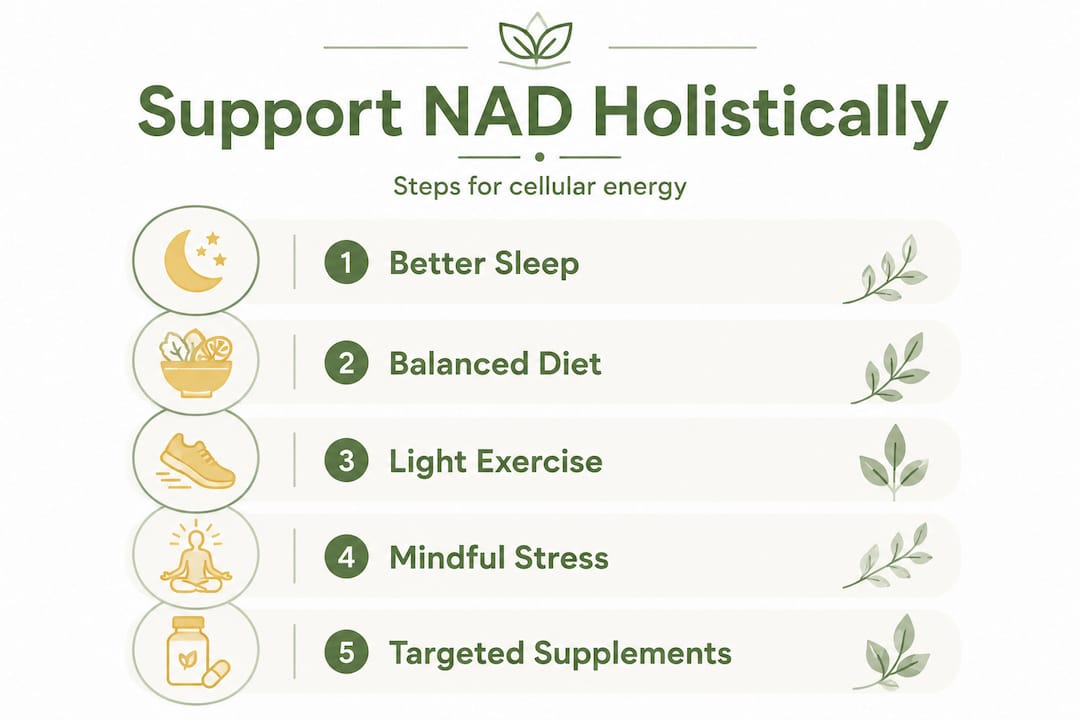
Supplements are only one dial on a much larger control panel. Your lifestyle choices shape your NAD status in ways that no capsule can fully replicate. NAD+ levels are described as limiting for mitochondrial energy production efficiency, which means keeping those levels as healthy as possible through everyday habits gives your cells a genuine performance edge.
Lifestyle factors that directly support NAD+ levels:
-
Exercise: Aerobic training and resistance exercise both stimulate NAD+ biosynthesis, particularly in muscle tissue. Even moderate daily movement makes a measurable difference.
-
Caloric balance: Overeating increases the demand on NAD+ for metabolic processing. Eating nutrient-dense, balanced meals reduces that drain and keeps NAD available for critical functions.
-
Sleep quality: Deep, restorative sleep supports circadian-synchronized NAD+ recycling. Poor sleep disrupts the NAD+/NADH cycling rhythm and leaves you feeling depleted.
-
Stress management: Chronic stress elevates inflammation and activates PARP enzymes for DNA repair, both of which consume NAD+ rapidly. Managing stress preserves your cellular energy currency.
-
Dietary sources of NAD precursors: Foods like dairy, chicken, fish, mushrooms, and whole grains naturally supply nicotinamide and other B3 forms to support the salvage pathway without supplementation.
-
Alcohol reduction: Alcohol metabolism heavily uses NAD+, converting it to NADH and creating an unfavorable ratio that impairs energy production and cellular repair.
Pro Tip: Instead of focusing on one supplement or one molecule, think of NAD optimization as a systems project. Sleep, movement, stress, and nutrient density all pull in the same direction. Building those foundations first gives any targeted supplementation you add a much stronger platform to work from.
Knowing your personal metabolic and cellular baseline is a smart next step for anyone serious about sustained energy and healthy aging. Targeted lab panels, including markers of mitochondrial function and micronutrient status, can reveal where your system genuinely needs support. You can also explore how nutrition and NAD levels intersect with broader aging strategies to build a fully informed approach.
Our perspective: NAD is crucial, but beware simple solutions
After exploring the science and wellness strategies, it’s time to take a step back and offer a balanced, experience-based perspective.
We understand the appeal of NAD supplements deeply. When you’re feeling persistently fatigued in your 50s or 60s, and you read that a simple capsule might restore the mitochondrial function of your younger self, it’s hard not to reach for it. The excitement is understandable, and the underlying biology is real. But we’ve seen too many people invest in expensive supplements without first building the foundational habits that would have done far more for their energy.
The most defensible claim is that NAD biology is central to mitochondrial redox reactions and metabolism. However, supplementing to improve energy or slow aging is not yet supported by consistently positive human clinical outcomes. That’s a statement grounded in the current state of science, not a dismissal of NR or NMN as tools. They may genuinely help certain individuals, particularly those with specific metabolic conditions, poor nutrient status, or high physiological demands.
What concerns us is the marketing machine that frames NAD as a magic bullet. Cellular health is a whole system, not a single molecule. When you focus on sleep quality, reduce chronic stress, eat nutrient-dense foods, move consistently, and get meaningful diagnostics to understand your unique biology, you create conditions where every cellular process, including NAD metabolism, can function more effectively. Explore advanced longevity strategies that go beyond single-molecule thinking and address the full picture.
Our honest view: stay curious about NAD science, consider NR as a potentially useful addition to a well-built lifestyle foundation, but do not skip the fundamentals in favor of a shortcut that the current human evidence simply does not guarantee.
Next steps: Optimize your energy and health holistically
Ready to put your knowledge into action? Here’s how to start optimizing your energy, health, and aging holistically.Take a look at our premium NAD+ formula featuring 500mg of NR, 150mg of Resveratrol, and 50mg of Quercetin.
Understanding NAD is a powerful starting point, but real transformation happens when you apply that knowledge to your own unique biology. At Healthspan Holistic, we give you the tools to do exactly that. Our cellular micronutrient testing reveals how well your cells are actually absorbing and utilizing key nutrients, including the B3 forms that feed into NAD biosynthesis. Our metabolic health panel gives you a comprehensive picture of how efficiently your body is generating and using energy. And when you’re ready to bring it all together with a personalized strategy, you can Contact Us to work one-on-one with an expert who can translate your data into a practical, sustainable plan.
Frequently asked questions
What does NAD do in the body?
NAD helps turn food into cellular energy by acting as an electron shuttle in metabolic reactions, cycling between its NAD+ and NADH forms to drive ATP production in the mitochondria.
Does NAD always decline with age?
Evidence for age-related NAD decline in humans is mixed; it is not consistently observed across studies and may depend significantly on which tissue is measured and the individual’s overall health and lifestyle.
Is taking nicotinamide riboside (NR) proven to boost health or longevity?
Human trials show NR can raise NAD+ levels in the blood, but clinical trials of NAD+ precursors have shown limited efficacy for broader healthspan or longevity outcomes so far, meaning more robust human evidence is still needed.
Are NAD supplements safe?
NAD-boosting supplements like NR appear to be safe in short-term studies; NR and NMN comparably increased circulatory NAD+ concentrations with generally good tolerability, though long-term safety data in humans is still being established.
Does gut health impact NAD-boosting supplements?
Yes, your gut microbiome actively participates in converting NR and NMN into forms that raise NAD+; ex vivo work suggests NR and NMN give rise to nicotinic acid and support microbial metabolism, meaning gut health can meaningfully influence how effective your supplement actually is.
Leave a comment: