

TL;DR:
- A personalized supplement workflow uses lab results, wearable data, and coaching to tailor routines for adults aged 45 to 75. Regular testing every 8 to 12 weeks and cautious medication review ensure safety and effectiveness. Wearables support timing adjustments but do not replace the need for lab-based, data-driven supplement decisions.
A workflow for supplement routines is a personalized, step-by-step system that schedules, tracks, and adjusts your supplements using lab results, wearable data, and one-on-one coaching. For adults 45–75, this matters because your body’s needs shift with age, and a static supplement list rarely keeps pace. The immediate next step is simple: schedule baseline labs and a coaching intake before you take a single new capsule.
Here is the five-step sequence at a glance:
-
Assess your baseline with blood panels and a medication audit
-
Plan an evidence-based protocol tied to your lab results
-
Schedule doses around your circadian rhythms and daily anchors
-
Implement with low-risk timing rules and a daily checklist
-
Monitor and adjust using wearable signals and retest labs every 8–12 weeks
Healthspan Holistic’s physician-led interpretation and one-on-one coaching are built around exactly this sequence.
What does a step-by-step supplement workflow actually look like?
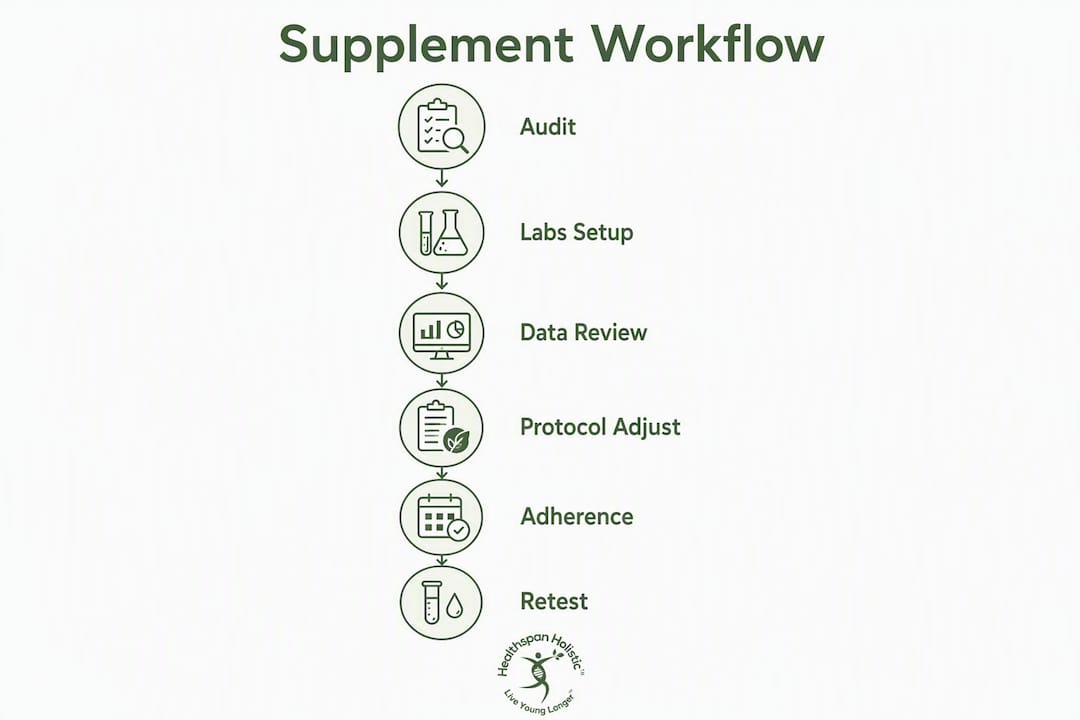
A reproducible routine moves from intake to adaptation in six clear steps.
-
Medication and supplement audit. List every prescription, OTC drug, and current supplement. Flag anticoagulants, thyroid medications, and statins for interaction screening before anything else.
-
Baseline labs and wearable sync. Order a comprehensive blood panel (CBC, metabolic panel, lipids, hs-CRP, vitamin D, Magnesium RBC) and connect your wearable. This is your data anchor.
-
Evidence-based plan design. Your coach maps lab gaps to specific supplements and doses. Personalized supplementation means your protocol reflects your numbers, not a generic stack.
-
Initiation with low-risk timing rules. Start one to two supplements at a time. Take fat-soluble nutrients (vitamins D, K2, omega-3) with your largest meal; take magnesium in the evening.
-
8–12 week retest cadence. Retest the specific markers your protocol targets. Dose tuning happens here, guided by lab changes, not guesswork.
-
Algorithmic and clinician-driven adjustments. Tiered automation handles low-risk timing nudges; dose escalations always require clinician review.
| Timepoint | Key Task | Objective |
|---|---|---|
| Week 0 | Audit, baseline labs, wearable setup | Establish data anchor |
| Weeks 2–4 | Initiate protocol, log daily adherence | Build habit, catch early reactions |
| Month 3 | Retest target markers, review wearable trends | Tune doses, confirm safety |
| Month 6 | Full panel retest, coaching review | Adapt protocol to new baseline |
How do wearables and genetics make your supplement schedule adaptive?
Wearables and genetic markers make timing and prioritization adaptive, but they do not replace lab anchors or clinician oversight. Think of them as real-time context that tells you when to take something, not whether to take it.
Concrete examples of wearable-triggered adjustments:
-
Low HRV or poor sleep score: Delay or skip stimulating adaptogens (rhodiola, caffeine-containing stacks) that morning; prioritize magnesium and L-theanine instead.
-
High-intensity recovery day or cold exposure: Schedule anti-inflammatory nutrients (omega-3, curcumin) within two hours post-session, when physiological demand is highest.
-
Elevated resting heart rate over multiple days: Flag for clinician review before adding any new stimulant-adjacent supplement.
A personal health dashboard that centralizes HRV, sleep stages, activity logs, and biomarkers lets you see whether wearable trends align with bloodwork changes. Genetic markers affecting nutrient metabolism (MTHFR for folate, VDR for vitamin D response) add another layer of prioritization.
Pro Tip: React to multi-day trends, not single-night fluctuations. One bad night of sleep does not justify restructuring your entire supplement schedule. Wait for three or more consecutive signals before making any timing change.

Which lab tests should anchor your supplement decisions?
Lab testing for adults 45–75 gives you the hard data that turns a supplement list into a targeted protocol.
| Test | What It Informs |
|---|---|
| CBC / Ferritin | Iron supplementation need; avoid over-supplementing iron without confirmed deficiency |
| Comprehensive Metabolic Panel | Renal and hepatic dosing safety; flags when to reduce fat-soluble vitamin doses |
| Lipid Panel | Omega-3 dosing strategy; statin-CoQ10 interaction screening |
| hs-CRP | Anti-inflammatory supplement priority (omega-3, curcumin, resveratrol) |
| Vitamin D | Direct supplementation need and dose range |
| Magnesium RBC | True intracellular magnesium status; serum magnesium misses most body stores |
| Thyroid panel (TSH, Free T3/T4) | Iodine and selenium supplementation safety |
Retest cadence: every 8–12 weeks for active dose tuning; a comprehensive panel every 3–6 months captures seasonal patterns and measures intervention effects. Tests tied to medication interactions or dose escalations always require physician involvement before changes are made.
Dosing, timing, and safety rules for adults 45–75
Always review your medication list and major labs before any dose change. This is the non-negotiable first step for anyone in the 45–75 age range.
Safety checklist before starting or adjusting:
-
Renal and hepatic considerations: Reduce fat-soluble vitamin doses if creatinine or liver enzymes are elevated; confirm with your clinician.
-
Anticoagulant interactions: Vitamin E, fish oil, and vitamin K all affect clotting. Anyone on warfarin or a DOAC needs clinician sign-off before adding or changing these.
-
Hormone-related cautions: DHEA, pregnenolone, and adaptogenic herbs can shift hormone levels. Baseline hormone panels come first.
-
Red flags requiring immediate review: New GI symptoms, unusual bruising, palpitations, or significant fatigue changes within two weeks of starting a new supplement.
For a practical stacking framework, the supplement stacking guide for adults 30–60 covers interaction rules and timing sequences in detail.
Pro Tip: Log every supplement, dose, and recent lifestyle stressor (heavy travel, intense training block, illness) for seven days before a blood draw. Share that log with your clinician. Transient stressors shift biomarkers, and your coach needs that context to interpret results accurately.
How do you make a supplement routine actually stick?
Design your routine to reduce friction first, then layer in tracking. The most effective supplement schedule is the one you actually follow.
Morning anchor: Take fat-soluble vitamins (D3, K2, omega-3) with breakfast. Pair the act of taking them with something you already do without thinking, like brewing coffee or filling a water glass.
Midday anchor: If your protocol includes B-complex or CoQ10 for energy support, pair it with your first full meal of the day. Avoid taking B vitamins after 2 PM if sleep quality is a concern.
Evening anchor: Magnesium and any calming adaptogens (ashwagandha, L-theanine) pair naturally with your wind-down routine, whether that is brushing your teeth or turning off screens.
Start with one or two anchors only. Add wearable tracking signals (HRV logging, sleep stage review) only after adherence is stable for two to three weeks. Nutrition tracking apps that export data to your health dashboard close the loop between what you eat and what you supplement.
Ready-to-use templates for three common goals
These are starting templates. Diagnostic validation is required before making major dose changes.
Goal: Sustained energy
-
Morning: D3 + K2 with breakfast, CoQ10, B-complex
-
Midday: Omega-3 with lunch
-
Evening: Magnesium glycinate
-
Monitor: HRV trend, afternoon energy self-rating
-
Retest: Ferritin, vitamin D, Magnesium RBC at 8 weeks
Goal: Better sleep and recovery
-
Morning: D3 + K2, omega-3
-
Evening: Magnesium glycinate, L-theanine, ashwagandha
-
Monitor: Sleep stages (deep + REM), resting heart rate
-
Retest: Cortisol, Magnesium RBC, hs-CRP at 8–12 weeks
Goal: Inflammation reduction
-
Morning: Omega-3 (high-dose EPA/DHA), curcumin with fat
-
Evening: Magnesium, resveratrol
-
Monitor: HRV, subjective joint comfort, recovery scores
-
Retest: hs-CRP, lipid panel at 8–12 weeks
Which template fits you depends on your lab values and wearable baseline. A low vitamin D result shifts the energy template; elevated hs-CRP makes the inflammation template the priority.
What do diagnostics-driven programs cost, and when will you see results?
Costs range across several tiers, each with a different depth of support, from self-guided lab orders to clinician sessions and concierge programs with recurring panels and wearable integration.
Timeline milestones to set realistic expectations:
-
Days to weeks: Wearable signals (HRV, sleep quality) often shift first, especially with magnesium and omega-3.
-
8–12 weeks: Biomarker changes (vitamin D, hs-CRP, Magnesium RBC) become measurable at retest.
-
Month 6: Full protocol re-evaluation with a comprehensive panel gives you a true before-and-after picture.
How Healthspan Holistic builds this workflow for you
The 90 Day Journey to Longevity maps directly onto the six-step workflow. It opens with a full intake, orders a baseline panel that includes the Magnesium RBC test and the Basic Heart Health Test, and syncs wearable data through AI-powered analytics before a single supplement is recommended.
A typical client example: a 58-year-old with low energy and disrupted sleep completes baseline labs at week 0. Results show low intracellular magnesium and elevated hs-CRP. The coaching team builds an evening magnesium protocol and an anti-inflammatory omega-3 stack. By week 4, wearable HRV trends upward on recovery days, prompting a timing shift: omega-3 moves to post-workout rather than morning. At the 8-week retest, hs-CRP has dropped and Magnesium RBC is within range. The protocol is refined, not rebuilt.
Key proof points:
-
Physician-led interpretation of every panel
-
One-on-one coaching cadence aligned to retest milestones
-
Wearable and genetic data integrated via AI analytics
-
Integrative health coaching that treats labs, lifestyle, and supplementation as one system
Key Takeaways
A diagnostics-driven supplement workflow requires baseline labs, wearable data, and clinician coaching to be safe, personalized, and measurably effective for adults 45–75.
| Point | Details |
|---|---|
| Start with labs, not supplements | Baseline panels (CBC, metabolic, lipids, Magnesium RBC) anchor every protocol decision. |
| Retest every 8–12 weeks | Biomarker changes become measurable at this interval; dose tuning happens here. |
| Use wearables for timing only | React to multi-day HRV and sleep trends, never single-night noise. |
| Safety check before every dose change | Anticoagulants, renal markers, and hormone panels must be reviewed first. |
| Healthspan Holistic’s 90 Day Journey | Integrates labs, wearables, and one-on-one coaching into one guided program for adults 45–75. |
Why the “just take what you feel you need” approach fails after 45
Most people over 45 are not deficient in supplements. They are deficient in data. The conventional approach, picking supplements from a bestseller list or a friend’s recommendation, ignores the single most important variable: your actual biology right now.
What surprises most people who go through a diagnostics-driven process is how often their intuition is wrong. Someone convinced they need more iron turns out to have ferritin in the upper range. Someone dismissing magnesium as basic discovers their RBC magnesium is critically low despite eating leafy greens daily. The serum magnesium test, which most standard panels run, misses intracellular deficiency almost entirely.
The other underestimated factor is interaction risk. Adults 45–75 are far more likely to be on at least one prescription medication, and the supplement-drug interaction space is genuinely complex. Vitamin K and anticoagulants. High-dose fish oil and blood thinners. DHEA and hormone-sensitive conditions. These are not rare edge cases. They are common combinations that require a clinician’s eyes on your full medication list before you add anything new.
A well-designed supplement workflow is not about taking more. It is about taking the right things, at the right time, confirmed by data you can actually measure.
Healthspan Holistic’s diagnostics-driven approach to supplementation
Real results come from real data, and Healthspan Holistic gives you both. The 90 Day Journey to Longevity pairs physician-interpreted blood panels with one-on-one coaching and wearable integration, so your supplement protocol is built on your biology, not a generic template. You get a clear retest cadence, a coach who reviews your results with you, and a plan that adapts as your markers improve.

The supplement store at Healthspan Holistic carries professional-grade products selected to match the protocols your labs support, from cardiovascular and mitochondrial health to hormone balance and bone density.
1st Time Customers can take advantage of our BUY 1 GET 1 50% OFF special offer on all supplements.
This article is for general informational purposes only and is not a substitute for professional medical advice. Confirm supplement and medication decisions with a qualified clinician.
Useful sources
-
Magnesium RBC Test for Deficiency Detection — Healthspan Holistic
-
Basic Heart Health Test for Heart Disease Risk — Healthspan Holistic
-
Benefits of Lab Testing for Adults 45 to 75 — Healthspan Holistic
FAQ
What is a workflow for supplement routines?
It is a personalized, step-by-step system that schedules, tracks, and adjusts your supplements using lab results, wearable data, and clinician coaching, rather than a static daily list.
How often should you retest labs when following a supplement protocol?
Every 8–12 weeks for active dose tuning; a comprehensive panel every 3–6 months works well for stable protocols and captures seasonal changes.
Which lab tests matter most for supplement decisions after 45?
CBC, ferritin, comprehensive metabolic panel, lipid panel, hs-CRP, vitamin D, and Magnesium RBC are the core anchors. The Magnesium RBC test is especially important because standard serum magnesium misses intracellular deficiency.
Can wearables replace blood tests in a supplement routine?
No. Wearables are useful for timing and prioritization, adjusting when you take supplements based on HRV and sleep trends, but lab anchors remain the foundation for deciding what and how much.
How does Healthspan Holistic’s 90 Day Journey to Longevity! work?
The program combines baseline blood panels, wearable data integration, AI-powered analytics, and one-on-one coaching into a structured 90-day protocol with a clear retest cadence and physician-led interpretation at each milestone.
Leave a comment: